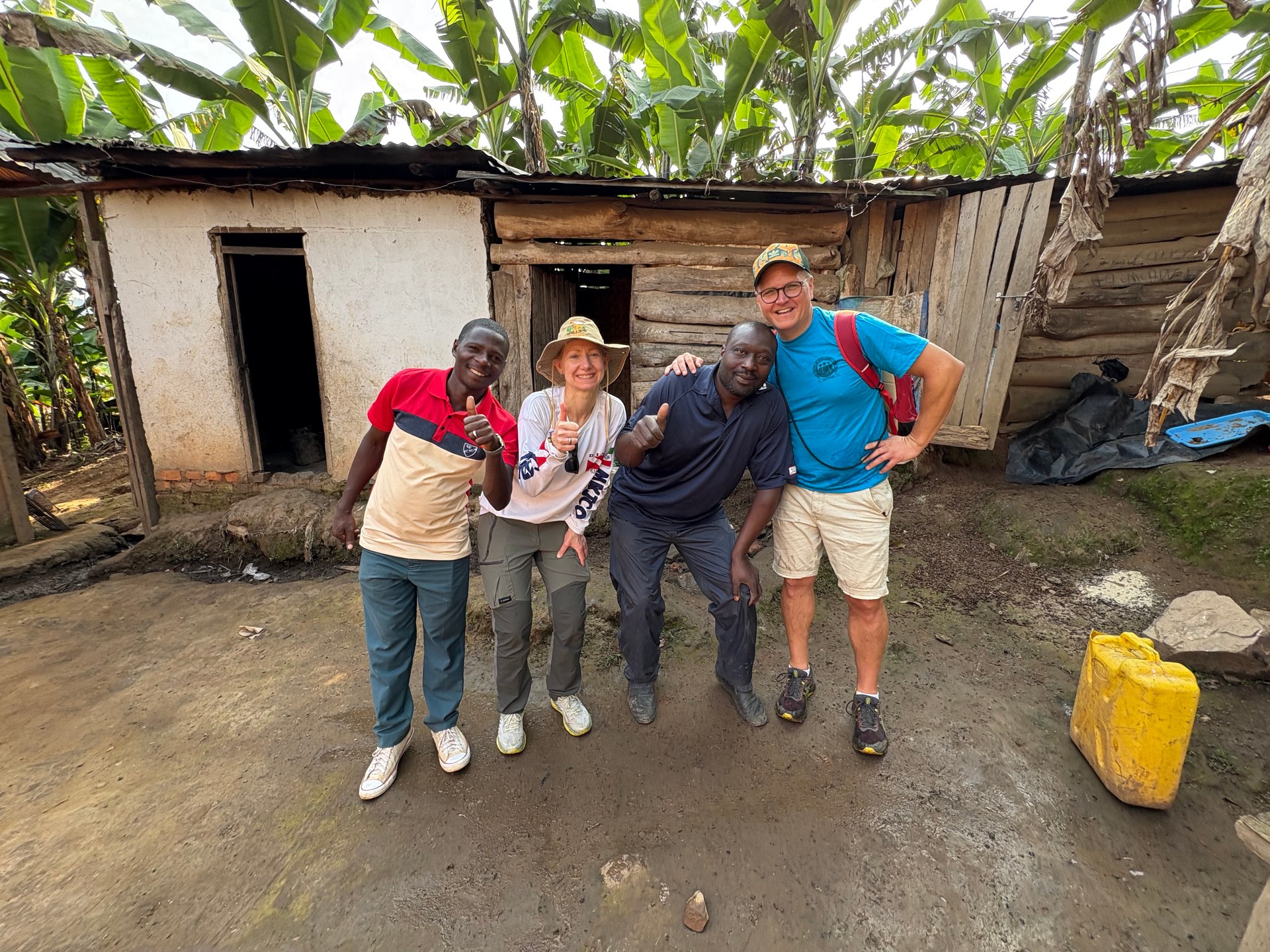
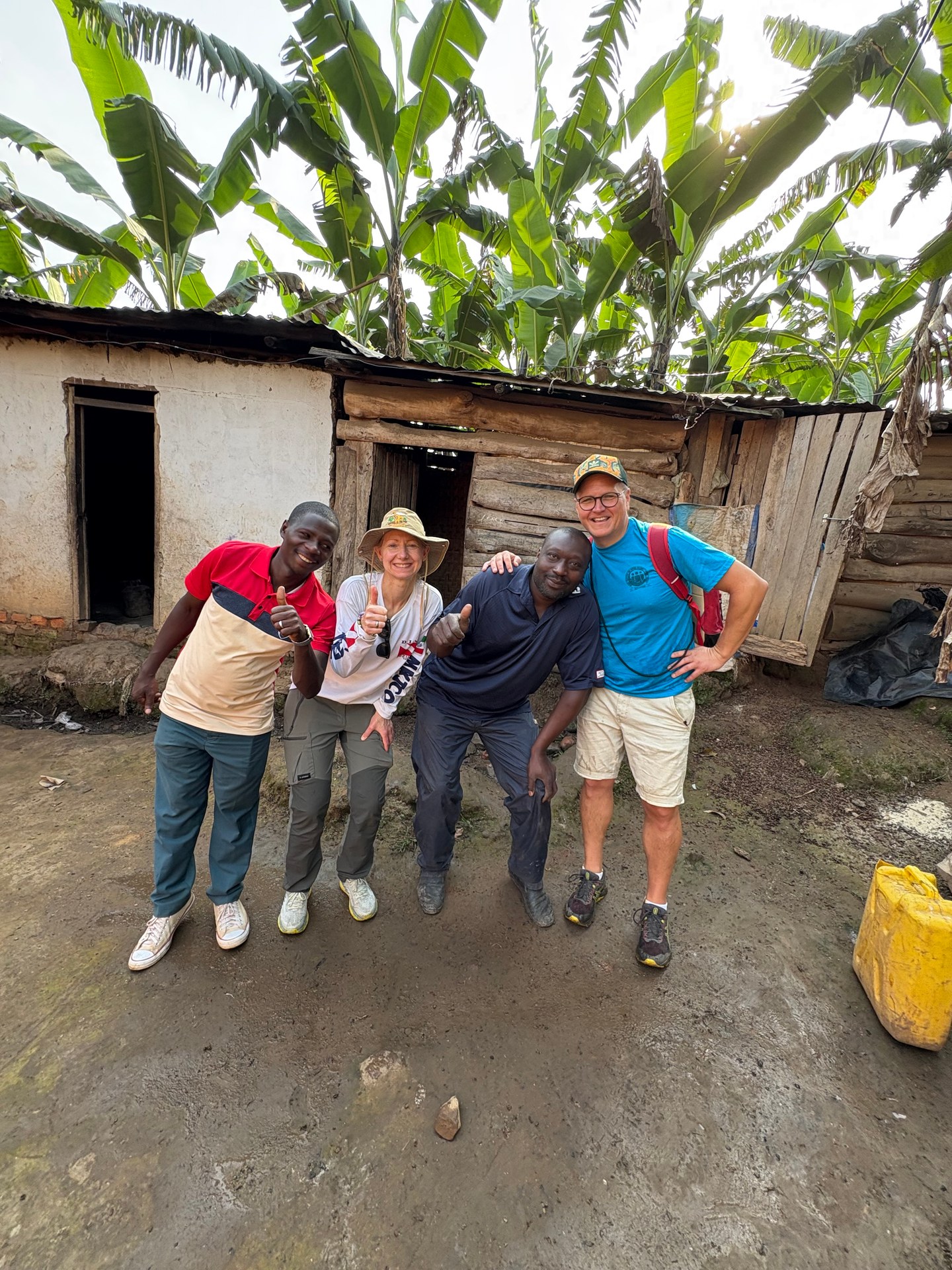
On the morning of 21 June 2026, we visited a local poultry farmer in Buhoma — a lean, focused man who had been raising chicks for several years and clearly took the work seriously. We had come to see how the birds were kept before buying a new batch for the children's home in the village, and what we found was a small operation run with a precision that belied its modest scale: clean pens, careful record-keeping, strong personal attention to each batch from hatching through to maturity. We had bought chicks from him before, across multiple visits, and the arrangement worked both ways — the children's home gained a self-sustaining source of eggs and occasional meat, and the farmer gained a reliable buyer. The three GPS-tagged photographs I took that morning (coordinates -0.9713, 29.6142) document something that no stock image library can approximate: the actual texture of the local economy that surrounds Bwindi Impenetrable National Park, and on which every lodge in the area ultimately depends.
That economy is the context missing from most lodge comparison guides. The question of which Bwindi lodge to book is not simply a question of price or amenity standard — it is a question of what kind of connection you want to the landscape and community you are visiting. The best lodges in the area understand this in a way that shows up in staffing ratios, supply chain decisions, and community fund allocations, not just in brochure language. The mediocre ones have learned to copy the language without the substance. After visits in October 2024 and January 2026 across multiple sectors, the differences are easier to identify than they used to be.
This guide covers every sector and every significant price band, with honest notes on what the accommodation actually delivers and what the lodge's relationship to its surrounding community looks like. Prices from the 2020 Uganda travel guide are included as reference points and marked where they may need verification against current rates.
The One Decision That Overrides Everything Else
Before comparing any two lodges on price, facilities, or community credentials, there is one decision that cannot be revisited after booking: your permit sector. Uganda Wildlife Authority issues gorilla trekking permits tied to a specific sector on a specific date — Buhoma, Rushaga, Nkuringo, or Ruhija. Your lodge must be in the same sector as your permit. Staying in a Buhoma lodge with a Rushaga permit means a minimum two-hour drive across unpaved mountain roads before the 7:30am briefing even begins. This is the single most common avoidable mistake in Bwindi trip planning, and it costs real money in fuel, driver fees, and lost morning time.
Tour operators who sell permits and accommodation as a package automatically prevent this mismatch. Independent travellers booking the two separately need to secure the permit first and then choose the lodge, not the other way around. The permit allocation for any given date is finite and sector-specific; your preferred lodge cannot guarantee you a permit in its sector just because you have paid for the room.
With that constraint established, the comparison between lodges becomes meaningful. The sections below cover each sector in turn, with the key properties at each price point.
Buhoma Sector: Uganda's Original Gorilla Lodge Destination
Buhoma opened for gorilla tourism in 1993, making it the oldest and most developed of the four sectors. Three decades of operation have produced a lodge landscape that covers every price band with genuine options at each level — something no other Bwindi sector can claim. The village that has grown around the park gate adds further texture: a market, small guesthouses, shops, and community enterprises including the micro-economy around the children's home and the poultry farmer I visited in June 2026. For first-time visitors who want a reliable, well-connected base with a functioning community context, Buhoma is the logical default.
Volcanoes Bwindi Lodge — High-End
Eight thatched bandas, each with en-suite shower, double washbasins, and a private terrace overlooking the forest. The lodge was completely renovated in 2018 and gained a new lounge, restaurant, and terrace area in the process. All rooms are named after individual mountain gorillas. Butler service is included for every guest. The pool addition completed the property's repositioning at the top of the Buhoma market. Single rates from around USD 445, doubles from USD 740, including full board — figures sourced from a 2020 guide and likely higher by 2025/2026; confirm current rates directly with Volcanoes Safaris.
Mahogany Springs Lodge — High-End
Close to the park headquarters, with stone paths winding down through a lush garden with a kitchen garden to the river. The main building is open-plan with high ceilings, large windows, and considerable light — a deliberate architectural choice to blur the line between interior and forest. Rooms are spacious with panoramic terraces. From approximately USD 480 per double including full board (2020 reference rate — verify with the lodge for current pricing).
Silverback Lodge — Upper Mid-Range
Twelve rooms managed by Marasa Africa, built from local materials throughout — lianas, sisal rope, and a distinctive violet slate — making it the most architecturally grounded of Buhoma's lodges in terms of its connection to the local material landscape. Five minutes on foot from the park headquarters: the closest of the larger lodges to the morning briefing point. From approximately USD 300 per double including full board (2020 reference — verify current rates). The lodge's scale means it can accommodate reasonably sized tour groups while still feeling personalised.
Bwindi Forest Lodge — Mid-Range
For travellers deterred by the high-end price points but wanting genuine comfort rather than budget compromise, Bwindi Forest Lodge occupies a useful middle position. Comfortable rooms on a hillside with views into the rainforest canopy. The owner and staff are known for practical helpfulness with logistics — permit queries, transfers, recommended guides. Breakfast included from approximately USD 100 per double (2020 reference). The value proposition is strong, though the property cannot compete on amenities with the high-end options above.
Sanctuary Gorilla Forest Camp and Buhoma Community Rest Camp — Alternative Options
Sanctuary Gorilla Forest Camp is a tented camp option inside the park boundary in Buhoma — the only property with a park-interior location, which means guests experience genuine forest surroundings at the cost of a more rustic setup. Buhoma Community Rest Camp, run by the local community, provides the most affordable accommodation in the sector and is the most direct channel for putting lodge spending into local hands.
Nkuringo Sector: High Altitude, Limited Permits, Exceptional Setting
Nkuringo sits on a ridge above 2,000 metres at the southwestern edge of the park, offering views across the Albertine Rift Valley toward the Democratic Republic of Congo on clear days. The sector has a single habituated gorilla family, which caps the daily permit allocation at eight — the smallest of any sector. That scarcity means permits here require the longest advance planning, and the lodge choices are fewer than in Buhoma. What the sector lacks in volume it compensates with atmosphere.
Clouds Mountain Gorilla Lodge — High-End
The benchmark property in Nkuringo and one of the most frequently cited lodges in Uganda's high-end safari circuit. Developed jointly by Wildplaces Africa (operating safari properties in Uganda since 1996) and the African Wildlife Foundation, the lodge channels a significant share of revenue into a community trust that funds local schools and health facilities. Standalone stone-and-timber cottages designed to read as part of the ridge rather than impose on it. Central dining with valley views. For guests who want the most remote, exclusive, and community-accountable lodge experience in Bwindi, this is the reference point.
Nkuringo Bwindi Gorilla Lodge — Upper Mid-Range
Eighteen individually decorated rooms at 2,090 metres altitude, positioned at the Nkuringo gorilla habituation site. The lodge works with the Uganda Carbon Bureau on a carbon offset programme and gives guests the option to support a local tree-planting initiative for USD 20. The community partnership model is substantive rather than cosmetic: lodge employment draws predominantly from surrounding villages, and supply chain decisions actively favour local producers.
Bwindi Backpackers Lodge — Budget
Approximately five kilometres before the Nkuringo trailhead, operated by the private Kabale Tourism Information Centre. Two-storey half-timbered construction with simple rooms on the ground floor — singles from USD 40, doubles from USD 100 — and a restaurant on the upper level with a genuinely impressive view across the forest. Three personal cottages with small verandas provide a step up from the main building rooms. Camping is available from USD 35 per person. For budget travellers, this is the most affordable credible base for a Nkuringo sector trek. Prices from the 2020 Uganda guide; verify current rates at bwindibackpackerslodge.com.
Rushaga and Ruhija: The South and East
Rushaga — High Permit Volume, Growing Lodge Scene
Rushaga holds more habituated gorilla families than any other sector — currently more than half of Bwindi's total — which translates into the park's highest daily permit availability. The gorilla habituation experience, where small groups of four track a family being habituated over four hours rather than the standard one, is based here and represents the most intimate gorilla encounter anywhere in Africa. The lodge infrastructure has developed considerably over the past decade in response to this demand.
Gorilla Safari Lodge (16 cottages, approximately 1 kilometre from the park gate) and Gorilla Valley Lodge (fireplaces, forest-edge views) form the mid-range backbone of the Rushaga offer. Nshongi Gorilla Resort and several smaller community camps complete the range. The road from Kisoro town has improved substantially in recent years, though the final stretch remains demanding after heavy rain.
Ruhija — Remote, Challenging, Rewarding
The easternmost sector is the least visited and arguably the most demanding to reach. The road from Kabale climbs past 2,000 metres through highland scenery of genuine drama, and the final approach to the sector lodges requires a reliable four-wheel drive even in dry conditions. The reward is a genuine sense of remoteness: fewer groups, quieter mornings, and Hagenia woodland that the birding community considers one of the best sites in Uganda for Albertine Rift endemics.
Ruhija Gorilla Safari Lodge (part of the Asyanut Safari operation, mixing double rooms and wooden cottages) and Ruhija Community Rest Camp — positioned beside the sector's tracking start point — are the principal accommodation options. Cuckooland Tented Camp, roughly 15 kilometres from the gate with a pool and an informal lunch policy for day visitors, adds an unexpected note to the sector's spare accommodation landscape. The camp's access road is among the steepest of any Bwindi property; confirm road conditions directly before arrival regardless of season.
Beyond the Park: Lake Bunyonyi as a Bwindi Extension
Most travellers who spend two nights trekking in Bwindi extend their southwestern Uganda itinerary with a stay at Lake Bunyonyi, the deep volcanic lake roughly three hours by road from Buhoma. The combination of park and lake is the itinerary most experienced Uganda operators recommend: the forest density of the trek is counterpointed by the open water and terraced hillsides of the lake, and the physical demands of the trek are absorbed by a day or two of genuine rest.
Arcadia Lodge — a Ugandan family operation running lakeside wooden cottages at around USD 190 per two-person cottage including half board (2020 reference rate) — is the most established mid-range property on the lake, with additional offerings including jet-skiing and quad bikes for those who want activity rather than quiet. Chameleon Hill, on one of the lake's islands, and Mount Gahinga Lodge, further west near the Mgahinga gorilla park, complete the main options for the Bwindi region extension. Sharp Island, renamed after Leonard Sharp — the Scottish missionary who in 1921 founded a leprosy hospital on what was then Bwama Island — is now a heritage and educational site rather than accommodation; its history is worth knowing for the context it adds to a region where conservation and community history are inseparable.
How to Tell Which Lodges Actually Invest in the Community
Every lodge near Bwindi now claims a community commitment. The language is so standardised that it has become nearly useless as a differentiator unless you ask specific questions. The poultry farmer I visited in June 2026 illustrated the point concisely: his relationship with the children's home was concrete, transactional, and verifiable — it produced chicks that the home raised for eggs and meat, and when meat was available it was a genuine occasion. The abstract language of "community partnership" covers everything from that kind of direct, traceable support to a single annual donation to a local school. The gap between the two is enormous.
Specific questions worth putting to any Bwindi lodge before booking: What percentage of staff are from villages within five kilometres of the property? Does the lodge participate in a formal revenue-sharing mechanism, and if so, what does it fund? Can they tell you the name of a local supplier and what they buy from them? A lodge that answers these questions concretely — with numbers, names, and mechanisms — is a different kind of operation from one that responds with a paragraph of mission statement language.
The lodges that consistently score well on these questions in the Bwindi context include Nkuringo Bwindi Gorilla Lodge (Uganda Carbon Bureau partnership, community employment, tree-planting option), Clouds Mountain Gorilla Lodge (African Wildlife Foundation co-ownership, community trust fund), and Silverback Lodge (locally sourced construction materials, Marasa Africa community investment programme). Buhoma Community Rest Camp and Ruhija Community Rest Camp are community-owned and operated, meaning that the revenue relationship to the local population is structural rather than discretionary.
None of this means that lodges with weaker community programmes deliver a worse guest experience — some of the highest-rated stays in Buhoma are at properties with relatively thin community engagement. But if the reason you are making a USD 800 permit purchase is partly about conservation, then it is worth spending a similar level of attention on where your accommodation revenue goes.
Choosing by Budget: What Each Tier Actually Delivers
The price structure around Bwindi is unusually steep at both ends. Budget accommodation exists and is genuinely functional — Bwindi Backpackers Lodge and the community rest camps prove that a comfortable, clean, well-located base does not require a high daily spend. But the distance between USD 40 and USD 740 per night is not simply a line on a price chart; it reflects real differences in location, design quality, on-site programming, and the depth of the staff's knowledge of the park and the gorilla families within it.
At the budget tier (USD 40–100 per person), you get clean accommodation with basic facilities, restaurant access, and proximity to the park gate. You will self-organise transfers and add-on activities separately. At the mid-range tier (USD 150–300 per person full board), most logistics are handled by the lodge — airport or airstrip transfers, trekking morning transfers, activity booking. The accommodation quality is substantially better and the on-site knowledge of guides and managers is more useful. At the high-end tier (USD 400–750 per person full board), you are paying for design quality that engages rather than simply houses you, a staff-to-guest ratio that allows personalised attention, and a level of planning support that removes most of the decision-making from your hands.
For a single-night stopover before or after a trek, the budget and mid-range options represent straightforward value. For a three-night or longer stay — which is what the Bwindi region actually warrants if you want to do more than check the gorilla box — the question of what a lodge offers beyond the trek itself becomes meaningful. A high-end lodge that keeps guests genuinely occupied across two non-trekking days justifies its rate in a way that a basic guesthouse with nothing but a bed and a restaurant cannot.