Murchison Falls National Park Lodges: A Complete Comparison for 2026
By Mark Suer — updated July 2026 — based on personal visits in October 2024 and January 2026
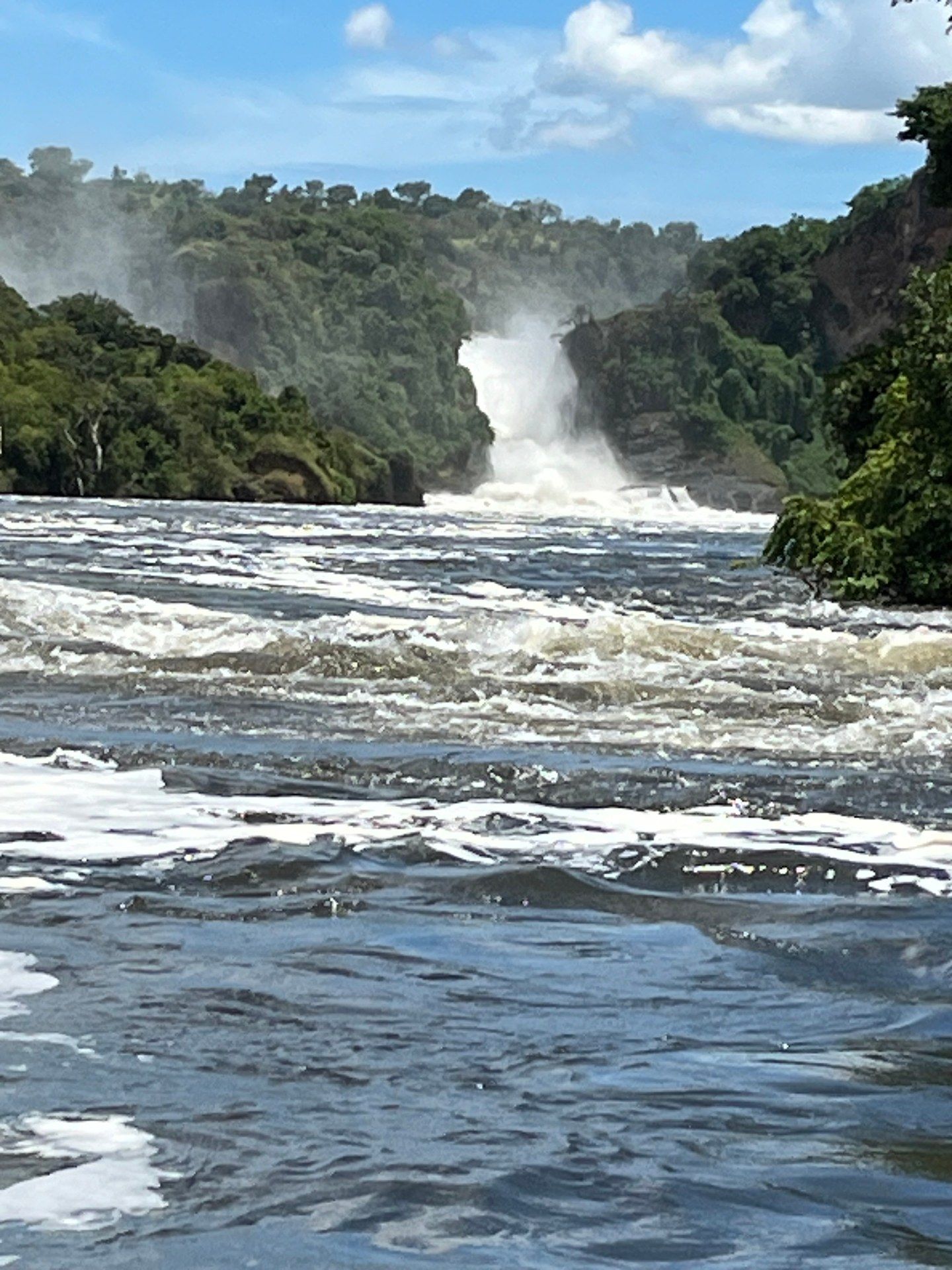
You hear Murchison Falls before you see them fully. The boat has spent the better part of two hours moving upriver through a landscape that does not hurry — hippos parting slowly, elephants moving through the riverside vegetation at their own pace, the occasional crocodile barely lifting its head from the bank. Then the roar begins to build, low and constant, layering itself over the engine noise until the engine seems almost quiet. The gorge comes into view: the entire Victoria Nile, one of the largest rivers on the continent, forced through a gap barely seven metres wide. The spray reaches the boat. The sound is physical.
During my three-day visit to Murchison Falls National Park in October 2024, that moment on the Nile was the clearest possible statement of what this park is: an accumulation of natural scale that keeps catching you off guard. I photographed the falls from the water at GPS coordinates 2.2751, 31.6762 — a precise record of exactly where I was standing when I took the shot — and the image still does not fully capture the hydraulic force involved. The water is not beautiful in the romantic sense. It is simply enormous.
Choosing where to stay at Murchison Falls shapes everything that follows: how quickly you reach the boat launch, how far you drive to the game areas, what your mornings sound like. This comparison covers the main accommodation tiers — luxury lodges near Paraa, the mid-range and character properties further along the river, and the budget options that keep costs within reach of independent travellers — based on personal experience and direct observation rather than promotional literature.
Paraa: The Park Hub and What It Means for Your Stay
Paraa is not a town. It is a small cluster of ranger accommodation, administrative buildings, a fuel point, a ferry crossing, and the departure point for the Murchison Falls boat safari. The name refers to the southern bank settlement at the crossing, where the Victoria Nile is wide and slow before it narrows upstream toward the gorge. Everything logistically important in the southern section of the park originates here: the early-morning boat trips that reach the foot of the falls, the game drive routes heading north after the ferry, and the access roads connecting to the main lodge properties.
Staying near Paraa means minimal dead time between waking and your first activity. Both Paraa Safari Lodge and Baker's Lodge are positioned within a short drive of the boat launch and the ferry that accesses the northern game area. For travellers on itineraries of two or three nights — where every hour of game time is maximised — this proximity matters more than the extra character of a more remote property.
The trade-off is the density of infrastructure. Paraa sees most of the park's visitor traffic. Morning boat departures run on a schedule shared across lodge clients, and the game drive roads heading north can carry a concentration of vehicles during peak season. For travellers who prioritise solitude — watching an elephant on the bank without another vehicle in view — Paraa is the wrong base. For those who prioritise logistical simplicity and access to the widest range of activities, it remains the most practical hub in the park.
Luxury Lodges: Paraa Safari Lodge and Baker's Lodge
Paraa Safari Lodge
Paraa Safari Lodge is the most established property in the park and the default reference point for first-time visitors. It sits on the southern bank of the Nile with direct views across the water, a swimming pool positioned for river sightlines, and a structure that mixes older stone buildings with newer guest wings. The property has been through multiple ownership and renovation cycles over the decades — it was one of the original Uganda lodge properties and still carries some of that institutional presence.
The key practical advantage of Paraa Safari Lodge is that it is the closest full-service lodge to both the boat launch and the park ferry. Departures for the Murchison Falls cruise leave from a jetty immediately accessible from the property. Game drives to the northern bank — which holds the densest lion and giraffe populations — begin with a short ferry crossing that the lodge can coordinate directly.
Accommodation runs from standard rooms in the older block to more spacious cottages and suites. The lodge offers full-board packages that are typical for the price point, with meals taken in a central dining area overlooking the river. Facilities include a bar, conference room, and the aforementioned pool. Rates fluctuate significantly between peak season (June–September, December– January) and low season — always request current pricing directly, as published rates are often out of date.
The main limitation for Paraa Safari Lodge is the same one that affects any established flagship property: it functions at scale. Groups are common, and the shared spaces — dining, boat departure points, the pool — can feel occupied in a way that a smaller camp never does. For travellers who place premium value on immersive quiet, this trade-off deserves honest consideration.
Baker's Lodge
Baker's Lodge takes its name from Sir Samuel Baker, the British explorer who, in 1864, became the first European to document the falls — naming them after Roderick Impey Murchison, then president of the Royal Geographical Society. The lodge is positioned close to Paraa but operates on a more intimate scale than the larger flagship. It offers a smaller number of cottages set in managed grounds with Nile views, making it a better fit for travellers who want the access advantages of the Paraa area without the volume of a larger property.
The property operates on a full-board model with guided activities coordinated from the lodge. Boat safaris and game drives follow the same routes available from Paraa Safari Lodge, with the same proximity benefit to the ferry and launch. The difference is in atmosphere: Baker's Lodge has fewer rooms and a correspondingly quieter rhythm. Evening meals tend to feel more like a communal dinner and less like a hotel restaurant.
Both Paraa Safari Lodge and Baker's Lodge sit in the upper pricing tier for Murchison Falls. Rates should be verified with Wildplaces Africa or through direct booking channels. The investment is justified for travellers on tighter itineraries who cannot afford to lose hours in transit to and from activities, or for those for whom a defined standard of comfort is non-negotiable.
Mid-Range Options: Murchison Treehouse and Heritage Lodge
Murchison Treehouse
Murchison Treehouse sits in a category of its own. It is a small, independently run property directly on the bank of the Victoria Nile in an isolated stretch away from the main Paraa hub. The accommodation formats available — an actual treehouse elevated above the ground, open-sided safari tents, and enclosed cottages — are unusual for the region. The treehouse in particular has no equivalent at any other property in the park: a platform structure that puts guests level with the upper canopy, with the river audible but not visible from the sleeping space, and the night sounds of the park unfiltered.
The isolation is the defining characteristic. There is no mobile signal at the property under normal conditions, and the surrounding area is active with wildlife in a way that more developed sections of the park are not. Elephants move through the riverbank vegetation at night. Hippos are audible from the accommodation. The absence of other lodge properties nearby means that the experience is less mediated — there is no background hum of distant generators or vehicle traffic from adjacent properties.
The trade-off is logistical. The drive from Murchison Treehouse to the Paraa ferry and boat launch takes longer than from the Paraa-area lodges. If the Murchison Falls boat safari is a primary goal, the additional transit time is a real cost on short itineraries. The property works best as the accommodation choice for travellers who have already been to the falls — or those who can build three or more nights into their Murchison segment, allowing the first night to settle into the location and the subsequent mornings to use the early-light hours without urgency about reaching Paraa.
Murchison Treehouse is not a budget option, but it sits meaningfully below the luxury tier. Rates should be verified directly with the property. For the experience it offers, the pricing represents reasonable value — particularly for the treehouse accommodation, which has no direct competitor in the park.
Heritage Lodge
Heritage Lodge occupies the practical mid-range position in the Murchison Falls accommodation landscape: solid facilities, competent guiding, access to the main activities, and a price point below the flagship luxury properties. It is a reliable choice for travellers who have already earmarked their Uganda travel budget for gorilla trekking permits and want comfortable but not premium accommodation at Murchison Falls. Specific current rates and room configurations should be verified with the current operator. The property consistently appears in mid-range Uganda safari itineraries from established operators.
Budget Options: Red Chilli Rest Camp and UWA Facilities
Red Chilli Rest Camp has been the standard budget recommendation at Murchison Falls for many years. It operates on the basis of providing clean, functional accommodation — dormitory beds, basic private rooms, and camping space — at a price point accessible to independent backpackers and self-drive travellers. The camp runs its own game drives and boat safari bookings through the associated tour operation, making it a self-contained option for budget travellers who do not arrive with a pre-booked operator.
The facilities are simple. Do not arrive expecting a pool or a sundeck with Nile views. What Red Chilli offers is reliability, an established community of like-minded travellers, and access to activities at rates that are structurally lower than those available through the luxury properties. It is a proven combination that has sustained the camp's reputation across multiple travel generations.
Uganda Wildlife Authority also maintains bandas — basic self-catering huts — and designated camping sites inside the park boundary. These are the most affordable overnight options available and function as the default choice for Ugandan domestic visitors and researchers. Facilities are minimal and variable; the camping sites in particular require full self-sufficiency. For travellers comfortable with that standard, the experience of sleeping inside the park boundary, away from any lodge infrastructure, is genuinely different from any other option on this list.
Lodge Comparison: Murchison Falls National Park
| Lodge | Tier | Distance to Paraa | Key feature | Best for |
|---|---|---|---|---|
| Paraa Safari Lodge | Luxury | On-site — adjacent to ferry and boat launch | Full infrastructure, Nile views, pool | Short itineraries, maximum activity access |
| Baker's Lodge | Luxury | Near Paraa — very short drive | Smaller scale, more intimate atmosphere | Couples, private safari feel at luxury tier |
| Murchison Treehouse | Mid-range | Longer drive (~45 min) to Paraa | Actual treehouse, tents, cottages on Nile — no mobile signal | Character seekers, wildlife immersion, 3+ nights |
| Heritage Lodge | Mid-range | Moderate — within day-trip range of Paraa | Solid facilities, reliable operator access | Budget-conscious travellers wanting comfort |
| Red Chilli Rest Camp | Budget | Near Paraa area | Dorms, private rooms, camping — own activity desk | Independent travellers, backpackers, self-drivers |
| UWA Bandas / Campsites | Budget | Various locations within park | Inside park boundary, lowest nightly cost | Fully self-sufficient travellers, researchers |
Getting There: The Road to Murchison Falls
The approach to Murchison Falls from the south is a well-maintained sealed road for the majority of its length — a significantly smoother drive than many Uganda national park approaches. We drove the route from the direction of Butiru in October 2024 and the road condition was good. What remained distinctly Ugandan was the traffic using it: at one point, a minibus appeared in the opposite lane carrying a load of mattresses and household goods stacked to roughly double the height of the vehicle itself. It was not a sight you would encounter anywhere else. Whether that qualifies as a curiosity or a travel memory depends on your perspective, but it is the kind of image that stays — a genuine representation of how logistics work in rural Uganda, where the maximum useful load of any vehicle is determined by geometry and optimism rather than by any formal regulation.
Most visitors arrive at Murchison Falls from Kampala, covering approximately 300 km and taking between five and six hours by road. The drive passes through the Ziwa Rhino Sanctuary, which sits on the main route and offers the option of a detour for white rhino tracking — the only location in Uganda where you can currently encounter wild rhinos. For itineraries that allow the time, combining Ziwa with Murchison Falls in a single northward journey is a well-established circuit.
Charter flights to Pakuba airstrip within the park are available for travellers on compressed itineraries. The flight from Entebbe takes approximately one hour and eliminates the full-day road drive in each direction. For stays of two nights or fewer, this option converts what would otherwise be the majority of the itinerary's travel time into additional park time. Current charter rates vary by operator and season — verify directly with a Uganda aviation charter company before booking.
Game Viewing and Seasons: What to Expect at Different Times of Year
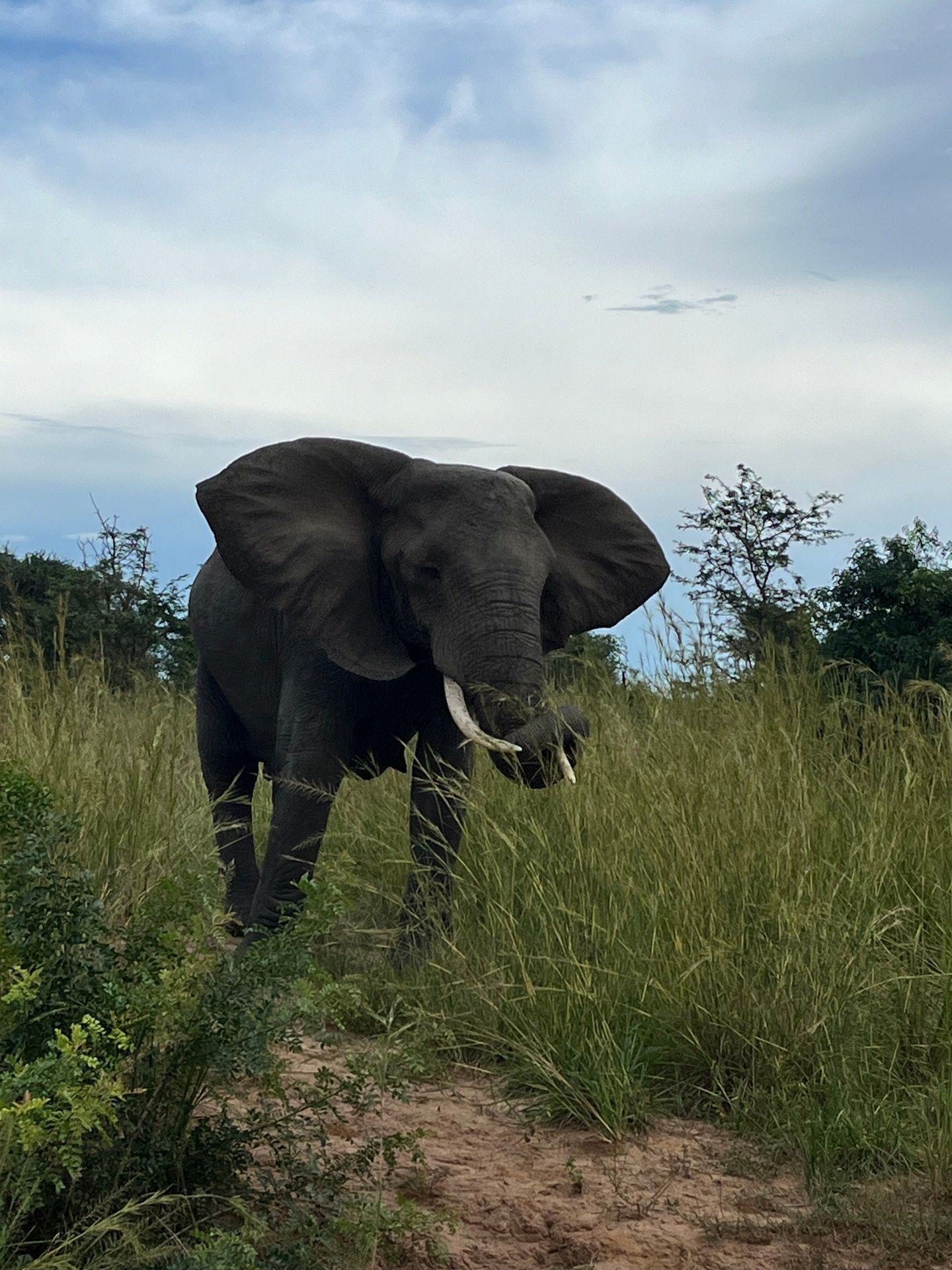
October sits in the shorter of Uganda's two rainy seasons, between the long dry period of June–September and the period of clearest skies in December. During my October 2024 visit, the grass was tall from the rains but wildlife was not difficult to find. The morning game drive produced a substantial elephant encounter — a bull moving through open grassland at close range, with his herd visible further back in the vegetation. We were in an open safari vehicle rather than a closed jeep, which meant the distance between us and the elephant was a real and present thing rather than an abstraction. He appeared entirely untroubled by us.
We left the lodge for that game drive before sunrise. This is standard practice but worth emphasising: the optimal wildlife window in Murchison Falls is roughly 06:00 to 09:30 and again from 16:00 to 18:30. The midday hours are heat-suppressed in the dry season and active but difficult in wet season due to tall vegetation obscuring ground-level sightlines. The decision to leave before first light, driving through country that was still dark when we departed, produced one of the better moments of the trip: the sunrise over the savanna with acacia silhouettes against an orange sky. Photographically, those fifteen minutes at dawn are as good as anything that follows.
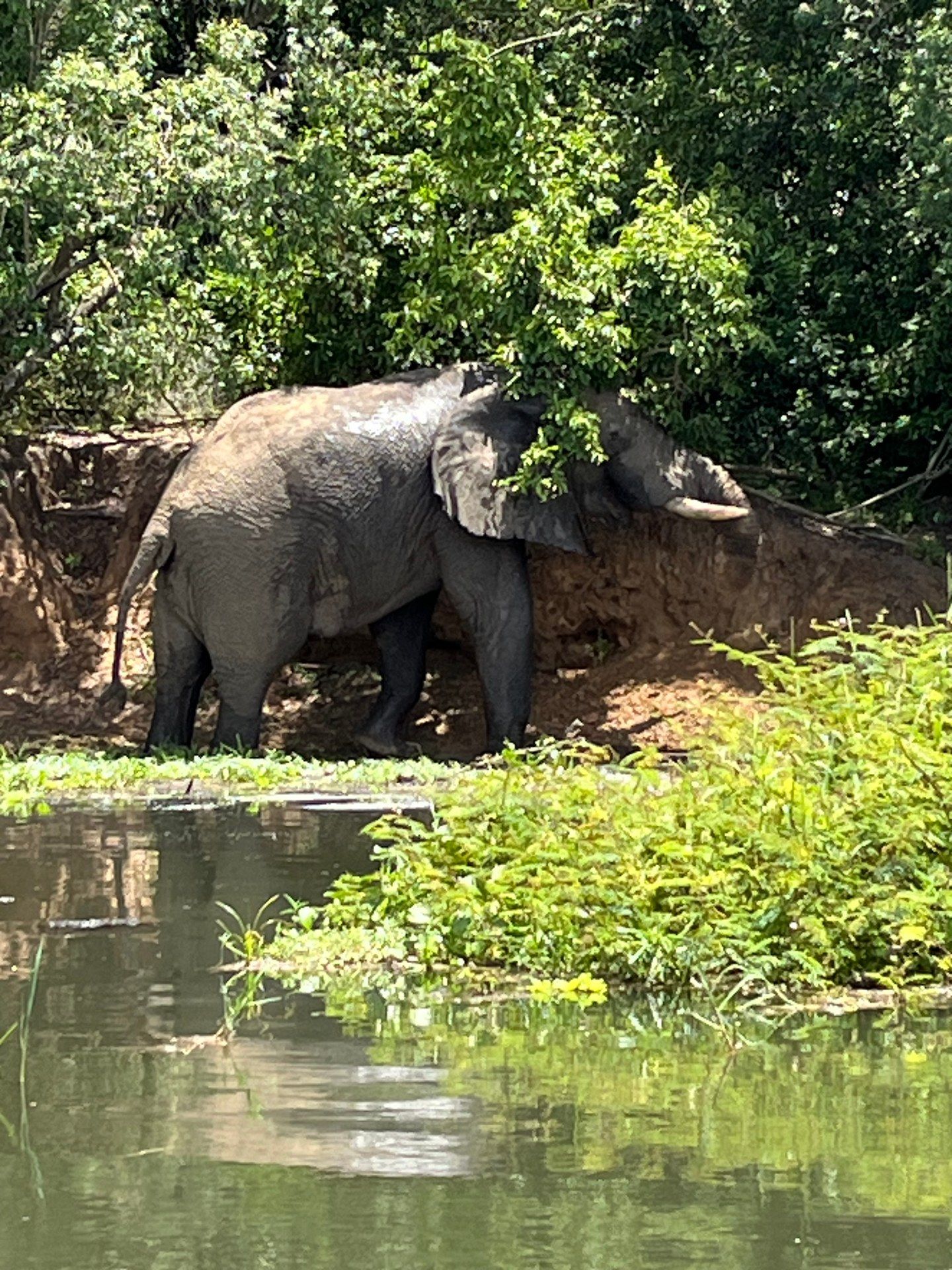
The boat safari operates differently from a game drive in one important respect: wildlife encounters are largely involuntary from the animals' perspective. The Nile is their environment regardless of whether a tourist boat is present. Hippos occupy the same sandbanks they used the previous day; crocodiles remain on the same stretches of bank. During our boat trip, we observed several Nile crocodiles from what appeared to be a comfortable distance until you actually looked at the size of the animals. They are substantially larger than photographs suggest — long, heavy, built with an efficiency that makes them look slow until you understand they are not. The boat engine covers the full distance from Paraa to the falls and back in approximately three to four hours.
For the peak dry season visit — June through September — expect the best concentrations of predators, as the northern savanna game area holds lions, leopards, and hyenas alongside the resident herds of giraffe and Uganda kob. The longer grass of October and November makes predator sightings less reliable but does not affect the elephant and hippo population, which remains year-round. The low-season months of March through May bring the cheapest rates across all properties, a near-empty park, and the visual spectacle of the savanna at full green — a different aesthetic from the golden dry-season tones but equally valid.
The Falls: What They Are and Why the Boat Trip Is Not Optional
The Murchison Falls are a geological constriction. The Victoria Nile carries an enormous volume of water westward across northern Uganda, and at a single point the riverbed narrows to approximately seven metres. Everything the river carries — water, sediment, force — passes through that gap simultaneously. The result is not a picturesque waterfall in the aesthetic sense. It is a demonstration of what happens when pressure has nowhere to go except forward and down. The noise is considerable. The mist produced by the impact reaches a radius of several hundred metres. From the boat, the approach is gradual and then suddenly overwhelming.
Sir Samuel Baker, arriving here in 1864, named the falls after the geographer whose society had helped fund exploration of the Nile's source. The colonial naming sits alongside the pre-existing local name — Kabalega Falls, after the Bunyoro king Kabalega — which was formally adopted by Uganda's government for a period and is still used. The park itself retains the Murchison name in international usage.
The falls are accessible by two routes: from below, by boat from Paraa, or from above, via the top-of-falls viewpoint reached by road. Both are worth doing if the itinerary allows. The boat gives you the hydraulic spectacle from the water's perspective; the top viewpoint gives you the gorge and the drop from above. If you can only do one, the boat safari wins — it combines the falls with three to four hours of game viewing on the water that produces its own encounters regardless of the destination.
Our Recommendation by Itinerary Length
- 2 nights, first visit: Paraa Safari Lodge or Baker's Lodge — proximity to the boat launch and ferry is the critical factor when time is short. Do not sacrifice the early morning game drive for a longer transfer.
- 3–4 nights, returning visitor: Murchison Treehouse for at least two of the nights — the Paraa activities can be done in a day trip, and the isolated riverside setting is worth the longer drive.
- Budget, independent travel: Red Chilli Rest Camp handles bookings, has its own activity desk, and connects you with other travellers. It is the most social and cost-effective entry point.
- Combining with gorilla trekking: Murchison Falls is most commonly paired with Bwindi Impenetrable National Park in a northern Uganda circuit. Allow two nights minimum at each; three nights at each is the better itinerary.
Booking, Pricing, and Practical Notes
Accommodation at Murchison Falls can be booked directly through each property or through a Uganda-based safari operator. The advantage of operator booking is coordination: activity schedules, transfers between properties, and park fee handling are managed as a single itinerary rather than assembled from separate bookings. For independent travellers comfortable with logistics, direct booking at properties like Red Chilli Rest Camp and Murchison Treehouse is straightforward.
Uganda Wildlife Authority charges daily entry fees for Murchison Falls National Park. These are set in USD for international visitors and must be paid at the park gate or through the UWA portal. Current rates change periodically and should be verified on the UWA official website before your visit — do not rely on rates quoted in travel guides or itineraries prepared more than six months before your departure.
The Uganda Tourism Board maintains a register of classified accommodation properties across the country, providing a baseline standard reference for lodges. Membership of this registry is held by the larger properties and provides some quality assurance context, though independent properties like Murchison Treehouse are well-regarded without carrying a formal classification rating.
All properties in the park area accept USD. Cards are accepted at the larger lodges but connectivity is variable and cards can fail. Carrying USD cash in small denominations as a backup is advisable for any stay in or near the park. Medical facilities in the Murchison Falls area are limited; the nearest adequate hospital is in Masindi, roughly 80 km from Paraa. Comprehensive travel insurance with evacuation cover is strongly recommended.