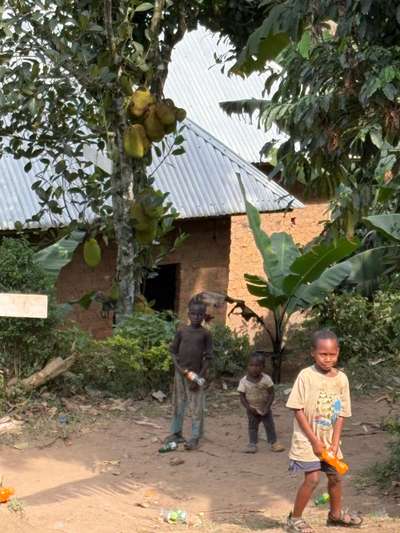
It was early morning on 21 June 2026, just before seven o'clock, when I noticed them standing at the edge of the dirt path outside the orphanage in Buhoma. Three children — shy, dressed in worn clothing, clearly from the neighboring settlement. Their posture said everything without words: a cautious curiosity mixed with the particular stillness of children who have learned not to expect much. My GPS registered coordinates -0.9617°N, 29.6109°E as I took the photograph. The children looked underfed. Their clothes were frayed in the way that speaks of long use rather than wear from play. We invited them without hesitation to join us for breakfast.
That morning stayed with me. Buhoma is a village at the edge of one of the most biologically remarkable places on earth — the Bwindi Impenetrable National Park in southwestern Uganda. Within a few kilometers of those children, in the dense montane rainforest rising above the settlement, a population of mountain gorillas goes about its daily existence: foraging, resting, raising young, holding families together with social rituals that would be recognizable to any primatologist studying human behavior. The proximity of such poverty and such natural wonder is not a contrast. It is the same reality, viewed from different angles.
During my visit in June 2026, I had spent time in and around Buhoma across multiple trips — the first in October 2024, then again in January 2026 and May 2026, and now in June. On a gorilla trek I completed earlier in 2026, our group walked for approximately three hours through the forest before finding a gorilla family at rest. They were entirely calm. The young moved between the adults. A silverback sat with his back to us for several minutes, entirely indifferent to our presence, which is precisely what habituation aims to produce. Standing within meters of a mountain gorilla in its natural habitat is an experience that resists summary. What follows is an attempt to place that encounter in its proper scientific, ecological, and conservation context.
Mountain Gorillas: Uganda's Flagship Wildlife Species
The mountain gorilla (Gorilla beringei beringei) is one of the most studied and most threatened large mammals on earth. Two populations exist: one in the Virunga massif, shared between Uganda, Rwanda, and the Democratic Republic of Congo, and one entirely within Uganda, in Bwindi Impenetrable National Park. Between 2018 and 2020, Uganda's gorilla population was counted at approximately 459 individuals — a figure documented in official Ugandan government data. This number reflects decades of intensive conservation effort and represents one of the few cases in recent wildlife history where a critically endangered species has shown consistent population growth rather than decline.
According to Uganda's Statistical Abstract 2014, mountain gorilla viewing is described as a major tourism product attraction, specifically singled out among Uganda's protected-area wildlife as the primary draw for international visitors. No other single species generates comparable tourism revenue for the country. This official designation matters because it links gorilla conservation directly to national economic strategy — protection of the gorilla is also protection of Uganda's most significant wildlife-based income stream.
Bwindi Impenetrable National Park holds a distinction that applies nowhere else on earth: it is the only protected area that hosts both the mountain gorilla and the chimpanzee within the same continuous habitat. This co-occurrence is not merely a statistical curiosity. It reflects the extraordinary biodiversity of Bwindi's mid-elevation montane forest, which spans roughly 331 square kilometers and ranges in altitude from approximately 1,160 to 2,607 meters above sea level. The forest supports over 120 mammal species, more than 350 bird species, and approximately 1,000 plant species. For the mountain gorilla, this habitat diversity means a food supply rich in leaves, stems, bark, roots, and occasional fruit across every season of the year.
Part of Cultural Tourism Circuits
The mountain gorilla does not exist in an ecological vacuum, and Uganda's tourism planners have recognized this for some time. Gorilla trekking in Bwindi is increasingly integrated into what the government's tourism planning framework describes as Cultural Tourism Circuits — routes and experiences that combine wildlife encounters with visits to local communities, craft centers, and cultural sites. In the Bwindi area, this means that a traveler trekking gorillas in the morning may visit a Batwa community in the afternoon, learning about the forest-dwelling people whose ancestors inhabited this landscape long before it became a protected area.
The Batwa, who were displaced from the forest when Bwindi was gazetted as a national park in 1991, have since been partially reintegrated into the tourism economy through community tourism projects. Some groups offer guided walks through the forest margins, sharing knowledge of medicinal plants, traditional hunting techniques, and oral history. These programs are imperfect and contested — the question of land rights and adequate compensation remains unresolved — but they represent a genuine attempt to ensure that local people benefit materially from the gorilla tourism economy rather than bearing only its costs.
The connection between gorilla conservation and cultural tourism is not merely commercial. Gorillas, like chimpanzees and other great apes, are biologically close to humans — sharing approximately 98.3 percent of DNA with Homo sapiens. Their social structures, behavioral complexity, and capacity for learning make them objects of deep human fascination that goes beyond wildlife spectacle. When cultural tourism circuits incorporate primate encounters alongside community visits, travelers often report that the juxtaposition deepens both experiences.
Serving Uganda's Tourism Development Programme
Uganda's national Tourism Development Programme is a government initiative aimed at increasing the country's attractiveness as a destination through infrastructure investment, product development, and international marketing. Mountain gorilla tourism sits at the center of this programme. The gorilla permit fee — currently set at USD 800 for foreign non-residents, USD 700 for foreign residents, and significantly lower for East African citizens — is among the highest single-experience wildlife fees anywhere in Africa. This pricing is intentional: it limits visitor numbers, reduces disturbance to gorilla groups, and generates concentrated revenue that funds both park management and community benefit-sharing schemes.
The Uganda Wildlife Authority (UWA) manages all gorilla trekking permits and allocates the revenue across conservation operations, ranger salaries, and the Revenue Sharing Programme, which directs a portion of park income to communities in the areas surrounding Bwindi and other parks. In the Bwindi area, this has funded school construction, medical facilities, and road improvements. The linkage between gorilla trekking revenue and local development infrastructure is explicit government policy, not an incidental benefit.
Protecting Communities: The Case of Rwampara District
The relationship between gorilla conservation and local government planning is illustrated by Rwampara District, which borders the protected area landscape of southwestern Uganda. Rwampara District was preparing its Local Government Development Plan IV (LGDP IV) for the period 2025 to 2030 during my research visits, with wildlife-adjacent conservation concerns explicitly included in the planning framework. Districts in this region face ongoing pressure from agricultural encroachment on forest edges, human-wildlife conflict (including gorilla crop raiding), and the need to channel tourism revenue toward community infrastructure.
The protection of mountain gorilla habitat is therefore simultaneously a wildlife conservation project, an economic development project, and a local governance challenge. When a gorilla family ranges beyond the park boundary — which does happen — community members bear the immediate cost in damaged crops. This conflict is managed through a combination of deterrence, compensation schemes funded by the Uganda Wildlife Authority, and community monitoring programmes that alert rangers to gorilla movements near farmland.
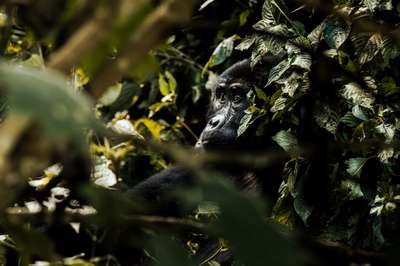
Gorilla Biology and Daily Behavior: What Actually Happens in the Forest
Mountain gorillas are not mysterious creatures in the way that nocturnal or solitary animals are mysterious. They spend a large proportion of each day doing things that are easy to observe: eating, resting, moving slowly through the forest, and maintaining social bonds through grooming and proximity. A typical gorilla family group — called a troop — consists of one dominant silverback male, several adult females, juveniles, and infants. Some troops include multiple adult males, which creates more complex social dynamics and occasional male competition, though outright violence between males is relatively rare in habituated groups.
The silverback male is not simply a bodyguard. He is the decision-maker for group movements, the arbitrator of internal disputes, and often a patient caretaker for young gorillas, including infants that are not his own offspring. Researchers studying gorilla societies have documented silverbacks allowing juveniles to climb on them, play near them, and seek refuge under them during rain — a practical reality of living in a forest where heavy precipitation is frequent and the canopy provides only partial cover.
Adult female mountain gorillas typically give birth to a single infant after an approximately eight-and-a-half-month gestation. Infants are born helpless and remain in close physical contact with their mothers for the first several months of life. They are carried, nursed, and protected until they develop the muscle strength and coordination to move independently. The interval between births is typically four years or more — one of the reasons why gorilla population growth is inherently slow, and why the loss of even a few breeding females to poaching or disease has lasting demographic effects.
Diet consists primarily of vegetation: leaves, stems, bark, and roots make up the largest share, with wild celery, thistles, and bamboo shoots preferred when available. Gorillas at Bwindi have access to a more diverse plant community than those in the Virunga volcanoes, which is thought to reduce their dependence on any single food source and may contribute to the health and stability of the Bwindi population. Fruit is consumed when available but represents a smaller portion of the diet than in lowland gorilla species.
Gorillas build a new sleeping nest every night, typically on the ground or in low branches, using bent vegetation. This daily nest-building behavior has practical value as a research tool: scientists can count abandoned nest sites to estimate group size and track movement patterns without direct observation. Nest counts, combined with fecal DNA analysis and camera trap data, form the backbone of modern gorilla population monitoring.
[QUOTE: local guide on first impressions of habituated gorilla behavior]
What Official Statistics Tell Us: The Uganda Statistical Abstract 2014
Uganda's Statistical Abstract 2014, published annually by the Uganda Bureau of Statistics, provides one of the most detailed official records of how gorilla tourism fits into the broader national economy. The document tracks permit sales, visitor numbers, and revenue generation across Uganda's protected areas, with mountain gorilla trekking consistently appearing as the highest-value single wildlife tourism product.
The Statistical Abstract 2014 also documents Uganda's accommodation infrastructure, which is directly relevant to gorilla tourism. According to this official source, Uganda's accommodation facility survey covered 20 districts distributed nationally, including Kampala. The last comprehensive national accommodation census before the 2014 publication was conducted in 2011, with the next full update scheduled to coincide with the 2014 housing census. This data gap is significant: the rapid expansion of lodge development near Bwindi after 2011 means that the 2014 figures undercount the actual hospitality infrastructure that had developed to serve the growing gorilla tourism market.
The official data confirms a pattern visible on the ground during my visits between 2024 and 2026: the area immediately surrounding Bwindi has seen sustained investment in accommodation ranging from basic community campsites to high-end luxury lodges. This investment is driven almost entirely by gorilla tourism demand, and its distribution reflects the geography of the gorilla tracking sectors — Buhoma in the north, Ruhija in the east, Rushaga and Nkuringo in the south.
What the statistics cannot fully capture is the multiplier effect of gorilla tourism on local livelihoods. Beyond the permit fee revenue tracked in the Statistical Abstract, gorilla trekking supports employment for rangers, porters, guides, trackers, lodge staff, drivers, and artisan market sellers. A single trekking day generates income across a chain of people extending far beyond the forest's edge. This economic depth is why conservation economists argue that the mountain gorilla, alive and in its habitat, is worth far more than any alternative land use in the Bwindi area.
Gorilla Trekking and Conservation Revenue: The Role of URA and Wildlife Finance
Gorilla trekking permit revenue in Uganda is administered through the Uganda Wildlife Authority and ultimately flows into the national revenue system via the Uganda Revenue Authority (URA). This institutional arrangement places gorilla conservation within the formal national fiscal structure rather than treating it as a separate charitable endeavor. The consequence is that gorilla permit income is subject to the same budget allocation processes as other government revenue — which creates both stability and vulnerability depending on broader political and fiscal priorities.
The International Gorilla Conservation Programme (IGCP), operating at www.igcp.org, works across Rwanda, Uganda, and the Democratic Republic of Congo to coordinate conservation efforts for all mountain gorillas regardless of which national park they happen to inhabit at any given moment. Mountain gorillas do not recognize international borders, and the Virunga population in particular moves freely across the boundaries of three countries. The IGCP's transboundary mandate is therefore not diplomatic courtesy but a practical necessity of gorilla biology.
The Zoological Society Frankfurt (ZGF) has been engaged in gorilla habitat conservation for more than three decades, with particularly significant work in the Parc National des Virunga in what is now the Democratic Republic of Congo. The ZGF's contributions have included the habituation of several gorilla families, equipment deliveries to park rangers, vehicle provision, training programs, and infrastructure development. In Uganda, the ZGF has focused on wildlife population monitoring across multiple national parks. The organization's long-term presence in the region provides a continuity of institutional knowledge that is rare in conservation work, where donor funding cycles often interrupt multi-decade programs.
The Dian Fossey Gorilla Fund International, based in Atlanta, Georgia, remains one of the most influential and best-funded organizations working for gorilla conservation globally. Dian Fossey's own research — conducted in the Virunga mountains from the 1960s until her murder in 1985 — established the foundation of modern gorilla behavioral science and brought the species to global public attention. The organization that bears her name continues field research and anti-poaching work, with a particular focus on the Volcanoes National Park in Rwanda, though its influence extends across the entire mountain gorilla range.
The Jane Goodall Institute Germany (JGI Deutschland), founded in Munich in 1994, focuses on practical nature and animal protection with high priority given to the protection of great apes. While the Institute is better known for chimpanzee research following Jane Goodall's pioneering work at Gombe, its engagement in Uganda includes support for programs addressing human-chimpanzee conflict and habitat preservation. In the Bwindi context, where mountain gorillas and chimpanzees share the same forest, the convergence of these conservation efforts creates a reasonably robust institutional safety net — though funding volatility and political instability in eastern DRC remain persistent threats.
Habituation: How Wild Gorillas Learn to Tolerate Humans
The term habituation describes the process by which wild gorillas are gradually accustomed to the presence of humans through repeated, non-threatening contact over a period of years. A newly targeted group will flee at first contact. Over months of daily tracking by researchers and rangers, the gorillas gradually reduce their flight distance, and eventually tolerate human presence within a few meters without displaying stress behavior. Full habituation of a gorilla group takes approximately two to four years and requires consistent, careful field work by experienced trackers.
Once habituated, a group is approved for tourism visits. Current regulations in Uganda allow a maximum of eight tourists per group per day, with a maximum visit time of one hour. All visitors are required to maintain a distance of at least seven meters from the gorillas, to wear masks to reduce disease transmission risk (gorillas are highly susceptible to human respiratory illnesses), and to follow the instructions of their assigned guide without exception. These rules exist because the risk of disease transmission is considered one of the most significant threats to habituated gorilla populations — precisely because habituation removes the behavioral barrier that would otherwise prevent close contact.
During my gorilla trek in 2026, the group I visited had been habituated for several years. The guide communicated with soft vocalizations — low rumbles and hums — that signal calm and non-threatening intent, mirroring the gorillas' own contact calls. This communication protocol is not theater for tourists. It is a practical technique developed by field researchers over decades and taught to every trained guide. The gorillas responded to it. They continued feeding, grooming, and resting without interruption, while we stood at a respectful distance in the rain, watching.
The Present and Future of Mountain Gorilla Conservation
The mountain gorilla is the only great ape whose population is currently growing. This is a genuine conservation success, and it is worth stating clearly because conservation success stories are rare enough to deserve explicit acknowledgment. The combination of intensive law enforcement, community benefit-sharing, rigorous veterinary monitoring, international funding, and carefully managed tourism has produced measurable positive outcomes over a period of roughly four decades.
The threats that remain are real. Habitat encroachment along the park boundary continues as Uganda's population grows and agricultural land becomes scarcer. Disease risk — including respiratory illnesses, scabies, and potentially novel pathogens — is a constant concern for habituated populations that have close and frequent contact with humans. Civil conflict in the eastern DRC periodically disrupts ranger operations and creates corridors for illegal activity in the forest. Climate change is altering rainfall patterns and vegetation composition in ways that researchers are still working to understand.
The 2014 Statistical Abstract's framing of mountain gorillas as Uganda's major tourism product attraction is both accurate and strategically important. As long as gorillas are alive, visible, and accessible to tourists under controlled conditions, they generate the permit revenue that funds the rangers, the veterinary teams, the community programs, and the research operations that keep them alive. The conservation model is self-reinforcing when it functions — and fragile when tourism revenue collapses, as was demonstrated during the COVID-19 pandemic, when park closures in 2020 eliminated permit income for more than a year, creating serious funding shortfalls for field operations.
The children I photographed in Buhoma on the morning of 21 June 2026 live within a few kilometers of one of the most intensively protected wildlife habitats on earth. The economic logic of gorilla conservation says that their futures and the gorillas' futures are linked — that a healthy gorilla population means tourism income, which means development funding, which means schools, clinics, and roads in communities like theirs. That logic is broadly correct. It is also a reminder that conservation is never purely a wildlife question. It is always also a question about the people who live closest to the animals, who bear the most direct costs of protection, and who have the most immediate stake in whether it works.
Frequently Asked Questions About Mountain Gorillas in Bwindi
How many mountain gorillas live in Bwindi Impenetrable National Park?
Uganda's total mountain gorilla population was counted at approximately 459 individuals in the 2018–2020 census period, according to official Uganda government data. Bwindi holds a distinct population separate from the Virunga massif group. Exact numbers within Bwindi fluctuate as new individuals are born, groups are tracked, and some animals move across landscapes. The population has grown consistently over the past four decades as a result of conservation programs.
What is gorilla habituation and how does it work?
Habituation is the process of gradually accustoming wild gorillas to close human presence through repeated, non-threatening contact. Field teams make daily visits to a target group over a period of two to four years, progressively reducing the gorillas' flight distance until they tolerate observers within a few meters without stress. Only fully habituated groups are permitted for tourism visits. The process is resource-intensive and irreversible — once habituated, gorillas remain tolerant of human presence, which also increases their disease exposure risk.
Why is Bwindi unique compared to other gorilla habitats?
Bwindi Impenetrable National Park is the only place on earth that hosts both mountain gorillas and chimpanzees in the same continuous forest habitat. This distinction reflects the exceptional biodiversity of Bwindi's montane rainforest. The park supports over 120 mammal species, more than 350 bird species, and approximately 1,000 plant species across an altitudinal range from roughly 1,160 to 2,607 meters. No other protected area offers this combination of primate diversity.
How does gorilla trekking revenue benefit local communities?
Uganda Wildlife Authority directs a portion of gorilla permit revenue to the Revenue Sharing Programme, which funds community infrastructure in areas bordering Bwindi and other national parks. This has supported school construction, medical facilities, and road improvements in villages surrounding the park. Additionally, gorilla tourism creates direct employment for guides, rangers, trackers, porters, and lodge staff in communities where formal employment alternatives are limited. The Batwa, displaced from the forest at the park's gazetting in 1991, participate in some cultural tourism programs that provide income, though questions about land rights and adequate compensation remain unresolved.
Which organizations work to protect mountain gorillas?
Several major conservation organizations operate in the mountain gorilla range. The International Gorilla Conservation Programme (IGCP) coordinates transboundary work across Uganda, Rwanda, and the DRC. The Dian Fossey Gorilla Fund International maintains research and anti-poaching programs, primarily in Rwanda's Volcanoes National Park. The Zoological Society Frankfurt (ZGF) has operated in the region for more than 30 years, with work in both the Virunga and Ugandan parks. The Jane Goodall Institute Germany focuses on great ape protection more broadly, including programs addressing human-wildlife conflict in Uganda. The Uganda Wildlife Authority manages day-to-day park operations and permit administration at the national level.