The first thing that registered about Gorilla Bluff Lodge on my January 2026 visit was the staircase. A series of solid wooden steps, cut from thick natural timber and anchored into the steep hillside, led from our room upward toward the main house. Not a gentle incline — a genuine climb, with the forest pressing in on both sides and the lodge's upper terrace visible through a frame of banana palms and dense undergrowth. My GPS logged our position at -0.9794, 29.6168 on the morning of 12 January. The path was dry, the morning cool, and even in those conditions it required attention. That staircase, more than anything else, told me what kind of place this was: a lodge that had been built to be here, in this specific terrain, rather than designed for ease and then located wherever land was available.
Gorilla Bluff Lodge sits on a hillside in Buhoma, Uganda's oldest gorilla trekking sector, and the slope is not incidental to the experience — it is structural. The lodges that occupy flat, accessible ground near the Buhoma park gate tend to be more polished, more predictable, and more expensive. Gorilla Bluff Lodge occupies a different register: a property where the natural setting imposes itself, where the distances between buildings mean you walk, and where the character of the place is inseparable from the effort it takes to navigate it. Whether that is a selling point or a problem depends entirely on what you are looking for.
I visited twice — first in October 2024 and again in January 2026. The October visit was a scouting trip; the January stay was longer and included a gorilla trek. Together they gave me a picture of the lodge across two different seasons and two different purposes, which is the only way to form a reliable view of a property in this part of Uganda, where the gap between high season and wet season conditions is significant.
What Gorilla Bluff Lodge Is — and Isn't
Gorilla Bluff Lodge is not a luxury property. It does not try to be. The rooms are comfortable, clean, and furnished with a simplicity that matches the forest setting — wooden furniture, adequate storage, decent bathrooms. What the lodge does exceptionally well is place you inside the landscape rather than beside it. The views from the upper terrace across the forest canopy and the farm patchwork below Buhoma are unmediated and genuinely striking. The main house, accessible via the timber stairway from the guest rooms, has a communal feel that the larger, more compartmentalised lodges in the sector do not always manage.
Mornings set the tone. Every morning of our January 2026 stay, coffee and African tea arrived at the room terrace without being asked — a quiet, reliable ritual that made the hour before the trek feel less like a logistical preparation and more like the beginning of something deliberate. The terrace itself looks out into the canopy, and on still mornings the sounds from the forest — birdsong at dawn, occasional movement in the undergrowth — are loud enough to orient you before you have finished the first cup.
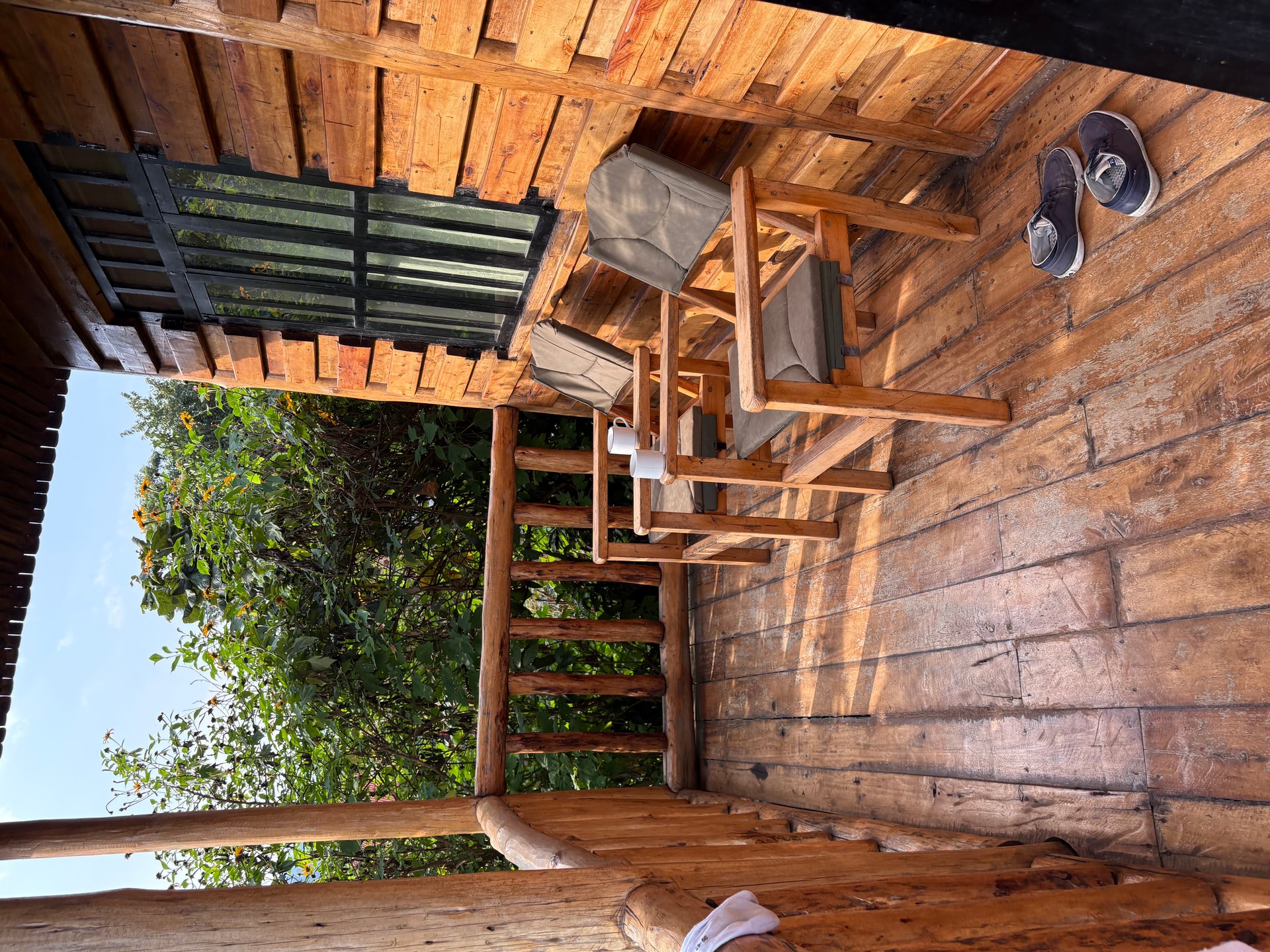
The terrain the lodge is built on is its most distinctive quality and also its primary practical constraint. The wooden stairway between rooms and the main house is steep enough to require care in wet conditions, and the paths around the property involve real gradient changes. For most travellers this is simply atmosphere — the sensation of having arrived somewhere genuinely remote rather than somewhere that simulates remoteness. For guests with limited mobility, it warrants direct discussion with the lodge before booking. There is no flat alternative route between the room tier and the upper level, and the staff does not always volunteer this information unprompted.
Food at the lodge is straightforward and well-prepared. The kitchen works with local produce where it can — a pattern common to the better Buhoma properties and one that matters both to the quality of the meals and to the lodge's relationship with the surrounding community. The dining terrace at the main house is the natural gathering point in the evening, and the informal nature of the lodge means that guests tend to talk to one another in a way that the more compartmentalised high-end properties do not always facilitate.
The Gorilla Trek: What January in Bwindi Actually Looks Like
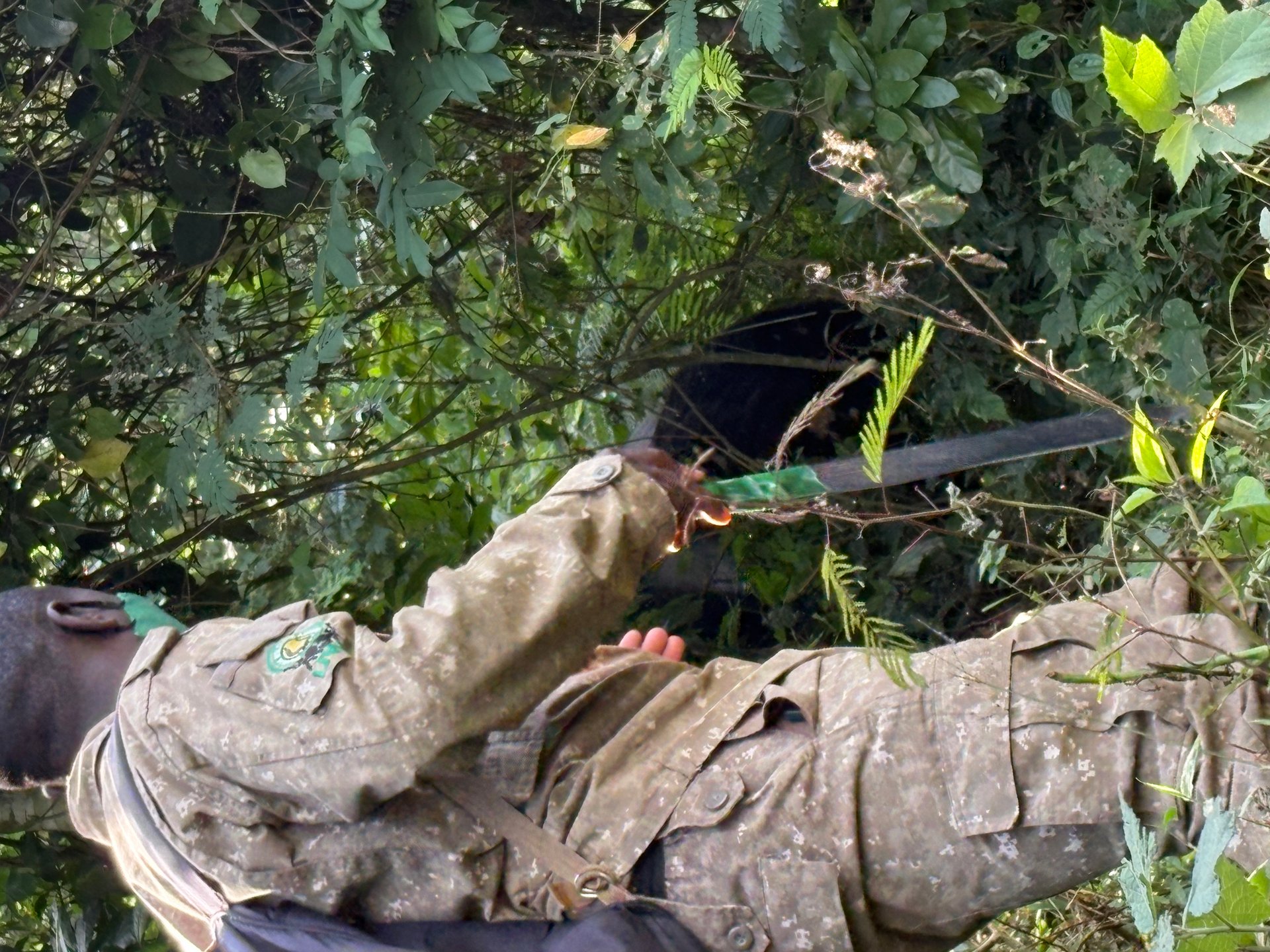
January is in the short dry season — the rains that characterise March through May have passed, and the trails are at their most passable without being as busy as the June–September peak. On our January 2026 trek from the Buhoma gate, the morning briefing assigned us to a group with one lead guide and two Uganda Wildlife Authority rangers. The rangers carried firearms, which I had been told to expect but which still registered as incongruous until it became obvious they were simply part of the standard safety protocol — not a sign of instability but a sensible precaution in an environment where unexpected wildlife encounters are possible and the terrain makes quick exits difficult.
In practice, the rangers' contribution was as much physical as precautionary. The ascent from the gate into the forest involves sections of genuinely steep, root-tangled, muddy gradient even in dry conditions. Both rangers were strong climbers and helped the group through the hardest sections without making it feel managed — they were good-natured, clearly at ease in the forest, and the combination of guide and ranger support meant that no member of the group was ever genuinely stuck, even on the more demanding stretches.
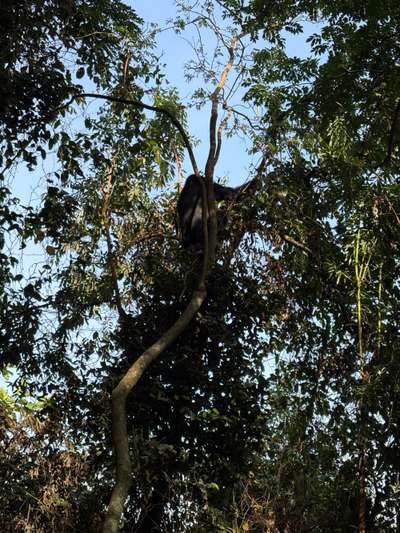
We reached the first gorilla contact approximately one hour into the walk. The gorilla — a large male, part of one of Buhoma's habituated families — was sitting in the high canopy of a forest tree, eating leaves with the kind of unhurried deliberateness that only makes sense once you understand how large an animal this is and how much it needs to consume each day to maintain its weight. The photograph I took at that moment — GPS logged at -0.9735, 29.6281 — shows him backlit in the canopy, the branch bending slightly under him, fresh leaves in hand. The one-hour contact limit passed quickly with moments like this, and the walk back to the gate felt shorter than the approach.
On a separate trek — this one lasting approximately three hours before contact was established — we reached a family at rest in a more open section of forest. The experience of being close to a peaceful gorilla group that has fully habituated to human presence is something that resists useful description in advance. The animals were close enough that you could hear breathing, see the texture of the fur, and watch juveniles moving between adults without any apparent concern. The guide maintained the seven-metre approach rule strictly, which paradoxically made the encounter feel more rather than less intimate — the constraint gives the gorillas control of the space, and they chose not to use it.
Who Gorilla Bluff Lodge Is Actually For
After two stays, the profile of the guest Gorilla Bluff Lodge suits best is reasonably clear. It works well for independent travellers and small groups who want a genuine experience of Buhoma without paying for amenities they will not use — the lodge does not have a spa, a pool, or a high staff-to-guest ratio, and if those things matter to you, properties like Silverback Lodge or Volcanoes Bwindi Lodge will serve you better. What Gorilla Bluff Lodge offers instead is a more direct connection to the setting: a building that responds to its hillside, a terrace that faces the forest rather than across a manicured lawn, and a scale that allows staff to know your name and your schedule by the second morning.
The terrain is a real consideration. Guests arriving in heavy rain should be prepared for slippery wooden steps and muddy paths that require more than casual footwear. The January conditions I experienced were manageable but noticeably different from what dry-season photographs suggest; October conditions, during the short rains, were heavier. If you have strong reasons to prefer flat, even surfaces between your room and the main building, this is the wrong lodge.
For birders, the lodge's position on a forested slope provides immediate access to Albertine Rift species that Buhoma is known for — the combination of forest edge and garden vegetation near the buildings creates habitat diversity that a lodge surrounded by mown grass cannot match. The list of species visible from the terrace alone makes early mornings worthwhile even on non-trekking days.
How Gorilla Bluff Lodge Compares to the High-End Alternatives
The most direct point of comparison in the broader Bwindi lodge landscape is Clouds Mountain Gorilla Lodge in the Nkuringo sector — widely cited as the benchmark high-end property in the park area. The two lodges are in different sectors (Buhoma versus Nkuringo), which means choosing between them is also a function of where your permit falls. But if you have permit flexibility and are deciding where to invest your accommodation budget, the differences are worth understanding clearly.
Clouds Mountain Gorilla Lodge is a joint project between Wildplaces Africa and the African Wildlife Foundation, positioned above 2,000 metres with views across the Albertine Rift Valley toward the Democratic Republic of Congo. Its community trust model — channelling lodge revenue into local schools and healthcare in a structured, auditable way — goes beyond what most Buhoma lodges offer, including Gorilla Bluff Lodge. The design is more ambitious, the service more polished, and the setting more dramatic. The nightly rate reflects all of this and is substantially higher. For a once-in-a-decade trip where the gorilla encounter is the centrepiece and budget is not the binding constraint, Clouds Mountain makes a compelling case.
Gorilla Bluff Lodge makes a different case: that a mid-range property with strong character, genuine forest immersion, and a location in Buhoma's established sector can deliver everything a solo or couple traveller actually needs from a gorilla lodge stay at a fraction of the cost. The morning terrace, the knowledgeable staff, the proximity to the gate, and the unmediated forest setting are present at both ends of the market. The additional spend at Clouds Mountain buys design quality, altitude drama, and a community investment model with documented outcomes — legitimate considerations, but not universally decisive ones.
Within Buhoma itself, the comparison to Silverback Lodge (Marasa Africa, 12 rooms, from approximately USD 300 per double including full board — 2020 reference rate) and Volcanoes Bwindi Lodge (from approximately USD 740 per double — 2020 reference rate) is more direct. Silverback is a bigger, better-serviced property five minutes' walk from the park headquarters; Volcanoes Bwindi is the most amenity-rich option in the sector, with butler service and a pool. Against those benchmarks, Gorilla Bluff Lodge's advantage is its smaller scale, its hillside character, and — depending on current pricing — its lower nightly rate.
Getting to Gorilla Bluff Lodge and Practical Details
Buhoma is the most accessible of Bwindi's four trekking sectors. The closest airstrip is Kihihi, served by scheduled charter flights from Entebbe via operators including Aerolink and Bar Aviation, with flight times of approximately one hour. From Kihihi, the lodge transfer is roughly 90 minutes by road. The alternative overland route from Kampala to Buhoma takes between nine and eleven hours depending on road conditions and traffic through Kampala — manageable as a one-off in the direction of travel but rarely worth repeating for a return journey.
The road into Gorilla Bluff Lodge's specific position on the hillside is rough by the standards of Buhoma's main access road, which is itself unpaved for significant stretches. A reliable four-wheel drive with high clearance is essential; a standard sedan is not suitable. The lodge's transfer service, if pre-arranged, uses appropriate vehicles and the drivers know the route in all conditions — this is worth using on arrival if you are unfamiliar with mountain road driving.
In January 2026, the Buhoma area was in its short dry season and trail conditions were firm. The climb from the park gate was demanding but not technically difficult, and the descent was straightforward. The October 2024 visit coincided with the beginning of the short rains, and the difference in trail conditions was noticeable — heavier underfoot, some sections genuinely slippery, the vegetation denser. Neither set of conditions prevented the trek, but January to early February and late June through September give the most consistently reliable trail surfaces.
Permit booking for Buhoma treks must be arranged through the Uganda Wildlife Authority, either directly at their Kampala headquarters at Plot 7, Kira Road, Kamwokya, or online at ugandawildlife.org. The permit cost is currently USD 800 per person for international non-residents. Gorilla Bluff Lodge can facilitate permit bookings through a licensed operator partner, but the permit itself is always a UWA transaction. Book permits before committing to specific travel dates — the allocation for any given date in Buhoma sells out months in advance during peak season.
One practical note about the lodge's position: mobile signal on the hillside is intermittent. This is not unusual for Bwindi generally, but Gorilla Bluff Lodge's elevation and forest density mean the lodge's WiFi (where available) becomes the practical internet connection. If consistent connectivity matters to you — for work calls, real-time navigation, or frequent check-ins — factor this in. For everyone else, the disconnection is part of the point.
Beyond the Single-Day Trek: Multi-Day Walking Options
Gorilla Bluff Lodge guests whose itinerary extends beyond the gorilla trek itself have access to Buhoma's wider trail network, which connects through the Bwindi Impenetrable Forest to Nkuringo in the southwest. Nkuringo Walking Safaris, a specialist operator based in the Kisoro region, runs multi-day walking itineraries through the Bwindi forest connecting the Buhoma and Nkuringo sectors, as well as canoe trips on Lake Mutanda and routes toward the Mgahinga gorilla park. These itineraries attract experienced walkers who want more than a single permit day and are willing to carry or have their gear carried between camp points in the forest interior.
For guests staying at Gorilla Bluff Lodge, the more accessible additional activities are guided forest walks along the park boundary — half-day or full-day routes that cover the forest edge habitat without requiring a gorilla permit — and village walks into Buhoma itself. The village in 2026 is a functioning community with its own internal economy, not a tourist reconstruction of one. The children's home, the market, the community enterprises including the poultry operation connected to the home's food security programme, the guesthouses and small shops — all of these are visible on a straightforward walk from the lodge gate. What that walk reveals depends on whether you take it with a guide who knows the community or alone; the difference is significant.