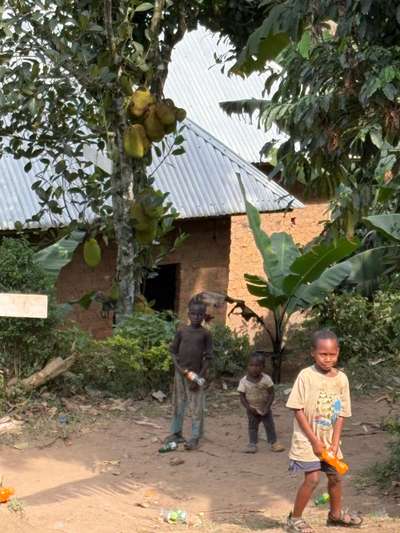
One morning in June 2026, standing outside a simple corrugated-iron building on the edge of Buhoma village, I watched three children from the neighbourhood of the local children's home approach with the careful, sideways caution of those not accustomed to strangers. Their clothes were worn, their bearing quieter than you would expect from children their age. We invited them over to eat with us without hesitation — there was nothing complicated about the decision. That small moment, GPS-recorded at -0.9617, 29.6109, summarises what twelve visits to this corner of Uganda have taught me about staying near Bwindi: the lodges are not separate from the communities around them. They are built into the same landscape, sustained by the same economics, and meaningful in direct proportion to how seriously they take that responsibility.
This is not an article about which lodge has the best plunge pool or the most dramatic sunset terrace, though both exist and deserve attention. It is a guide to understanding how the gorilla lodge system in Bwindi actually works — how trekking sectors and lodge choices are connected, what distinguishes the properties that take their community role seriously from those that simply brand themselves accordingly, and how to make a decision that serves both your itinerary and the park you are visiting.
My first visit to Bwindi was in October 2024. By the time of my most recent stay in June 2026, I had returned across multiple seasons — dry and wet, high occupancy and quiet — and the picture I have formed is considerably messier and more interesting than any lodge website conveys. What follows is what I actually observed, with the gaps I cannot fill marked honestly.
How Bwindi's Lodge System Actually Works
Bwindi Impenetrable National Park is not one place with multiple entry points — it is effectively four separate tourism ecosystems that happen to share a park boundary. The Uganda Wildlife Authority (UWA) allocates gorilla trekking permits by sector: Buhoma in the north, Rushaga in the far south, Nkuringo on the southwestern ridge, and Ruhija in the east. Each sector has its own set of habituated gorilla families, its own tracking team, and its own park gate. Your permit is tied to a sector on a specific date. You cannot transfer it to a different sector on trekking morning without losing it.
This has a direct and often underappreciated consequence for lodge choice: you need to stay in the same sector as your permit. A traveller booked into a beautiful lodge in Buhoma who holds a Rushaga permit faces a minimum of two hours of driving before the 7:30am sector briefing even begins. That journey, on roads that deteriorate significantly in wet conditions, can extend considerably. Tour operators who handle permits and accommodation together automatically manage this alignment; independent travellers booking the two separately are the ones who most often discover the problem after it is too late to change.
Lodges range from community guesthouses charging USD 40–80 per night through reliable mid-range safari camps at USD 150–300 to high-end properties where all-inclusive rates per person per night can exceed USD 500. The higher prices are not simply a function of quality; they reflect proximity to the permit ecosystem, the cost of maintaining a property in a remote mountain location with no reliable grid electricity, and the contribution many upmarket lodges make to community development and conservation programmes. That contribution varies enormously between properties, and it is worth asking specific questions before booking.
Clouds Mountain Gorilla Lodge: The Benchmark for High-Altitude Stays
Clouds Mountain Gorilla Lodge sits above 2,000 metres on the Nkuringo ridge in the southwest of the park, looking out across the Albertine Rift Valley toward the Democratic Republic of Congo. On a clear morning — and in Nkuringo the mornings are often sharp and bright before the cloud builds — the view extends across a landscape of deep valley mist, terraced hillsides, and the dark mass of the park's canopy. It is one of the most arresting settings of any lodge in East Africa.
The property is a collaboration between Wildplaces Africa, which has operated safari lodges in Uganda since 1996, and the African Wildlife Foundation, one of the more established international conservation organisations working across the continent. That partnership is not merely decorative: a significant share of revenue goes into a community trust that funds education and healthcare for villages surrounding the park, and the lodge itself employs almost exclusively from local communities. The Wildplaces Africa model, tested first at Semliki Safari Lodge and replicated here, is built on the premise that a lodge which creates genuine economic dependency in its surrounding community is more secure against encroachment and poaching than one that simply exists alongside those communities.
Clouds Mountain is often cited by Ugandan tourism operators as the benchmark against which other high-end Bwindi lodges are measured. Accommodation is in standalone stone-and-timber cottages designed to blend into the ridge rather than impose on it. Meals are taken in a central dining space with unobstructed valley views. The lodge manages its own trekking transfers and the Nkuringo sector's single daily slot — only eight permits — means the trekking group is genuinely small. The trade-off is availability: with one group of eight per day, periods of peak demand are heavily subscribed, and last-minute bookings are rarely possible.
From a practical standpoint, access to Nkuringo from Kisoro town involves a road that climbs steeply and loses its tarmac surface some way below the lodge. A standard vehicle can manage it in dry conditions; heavy rain changes the calculation significantly. Guests arriving by air land at Kisoro airstrip and transfer overland, a journey of roughly 45 minutes in good conditions.
For non-trekking companions, the lodge offers guided walks along the forest edge, birdwatching in an area with high Albertine Rift endemism, and visits to Batwa communities — the indigenous forest people displaced from Bwindi when it was gazetted as a national park in 1991, whose cultural knowledge of the forest remains encyclopaedic and whose relationship to tourism is still being navigated sensitively by the better lodges.
What the Encounter Is Actually Like: Notes from January 2026
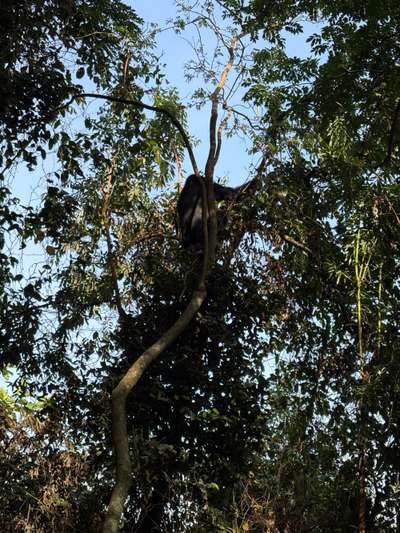
No lodge review is complete without an honest account of what the trekking experience looks like from inside it. On our January 2026 visit, Susanne and I were assigned to a group setting out from a Buhoma sector gate. The morning briefing was at 7:30am — trackers had located the family at first light and radioed in the position. The walk took just over an hour before we came to a clearing where a large male was sitting perhaps eight metres up in the canopy, methodically stripping leaves from a branch and eating with the kind of unhurried concentration that makes you aware of just how intelligent these animals are.
The photograph I took at that moment — GPS coordinates logged at -0.9735, 29.6281 — captures him backlit by filtered morning light, the branch bowing slightly under his weight. What the photograph does not capture is the sound: the tearing of bark, the occasional low rumble, the extraordinary ordinary quality of watching an animal that shares roughly 98 percent of its DNA with you go about its morning entirely indifferent to your presence.
The one-hour contact limit passes quickly. By the time the ranger called time, I was aware of having spent the hour half-focused on camera settings and half simply watching, which is probably the right ratio. The walk back to the gate was easier than the approach — the trackers cut a more direct line — and by midday we were back at the lodge.
What matters for lodge selection is what comes after those two hours. A lodge with nothing to offer for the rest of the day — no guided walks, no community programme, no birding — turns the afternoon into a waiting exercise. The better properties are designed around the assumption that gorilla trekking is the centrepiece of the stay, not the entire programme. That is a question worth putting directly to any lodge before booking.
Mountain Gorillas in Uganda: Population, Protection, and Why the Lodges Matter
The most recent comprehensive census, carried out across 2018 and 2020, recorded approximately 459 mountain gorillas in Uganda, the majority of them within Bwindi. The global population of the subspecies — Bwindi plus the Virunga Massif shared by Rwanda, Uganda, and the Democratic Republic of Congo — had passed 1,000 individuals by that period, a figure that still represents one of the smallest wild populations of any great ape.
Uganda Wildlife Authority rangers, the anti-poaching units, and the veterinary teams who monitor habituated families for disease are all funded substantially through tourism revenue. The gorilla permit fee — currently USD 800 for international non-residents — flows back into the protection infrastructure in a more direct way than most conservation levies. When occupancy at Bwindi's lodges drops, so does the economic case for maintaining the ranger numbers that keep the park's boundaries meaningful.
This is the connection that makes lodge choice a conservation decision rather than simply a travel preference. Lodges that operate a community revenue-sharing model — like Clouds Mountain Gorilla Lodge through its African Wildlife Foundation partnership, or Nkuringo Bwindi Gorilla Lodge through its work with the Uganda Carbon Bureau on carbon offset programmes — go a step further, directing income toward the villages that absorb the costs of living alongside a protected forest: lost crops to raiding elephants, restricted access to firewood, periodic disruption from ranger patrols. Several properties now run explicitly co-designed community funds where lodge employees and village representatives jointly decide on allocations for schools, health posts, and infrastructure.
A Longer History: Leonard Sharp and Lake Bunyonyi
The human presence in this corner of Uganda is older and more layered than most gorilla lodge brochures acknowledge. The name Leonard Sharp is worth knowing. A Scottish missionary and physician, Sharp arrived in the region in the early twentieth century and in 1921 established a hospital for leprosy patients on Bwama Island in Lake Bunyonyi, the deep volcanic lake roughly three hours' drive from Bwindi's Buhoma gate. The island hospital became a landmark institution, and Sharp's work shaped the social infrastructure of the region in ways that still echo in local healthcare provision and community organisation.
Lake Bunyonyi — with its fifty-odd islands, steep terraced hillsides dropping to the water's edge, and a stillness that contrasts sharply with the demanding terrain of the park — is now a popular extension for travellers combining gorilla trekking with a few nights on the water. Arcadia Lodge, Chameleon Hill, and several smaller guesthouses line its shores. The combination of park and lake, taking four to five nights in total, is the itinerary most experienced Uganda travel specialists recommend as a minimum for the Bwindi region. It turns an intense two-day sprint into something closer to a genuine encounter with the southwest.
Sharp himself would presumably have found the transformation of his remote mission region into an international gorilla tourism destination extraordinary. The leprosy patients he treated on Bwama Island are long gone; the island is now a quiet heritage site. The impulse that brought him here — the idea that this remote, difficult landscape was worth sustained engagement — persists in a different form in the lodges and conservation organisations that have made Bwindi what it is.
Choosing Your Sector: A Practical Comparison
Each of Bwindi's four sectors has a different character, and lodges within each sector reflect that character — not just in their décor but in their operating model, their community relationships, and the kind of trek they deliver.
Buhoma — The Established North
Buhoma is where Bwindi gorilla tourism began in 1993, and three decades of operation show in the quality and variety of its lodge infrastructure. The range runs from community bandas at the budget end through Bwindi Forest Lodge and Buhoma Lodge at mid-market level to Silverback Lodge (operated by Marasa Africa, 12 rooms, locally sourced materials throughout) and Volcanoes Bwindi Lodge at the top — the latter refurbished in 2018 with butler service, a spa, and rooms named after individual gorilla family members. Road and air access via Kihihi airstrip is the easiest of any sector. For first-time visitors who want reliable infrastructure and the widest choice of dining and activities outside the park, Buhoma remains the natural starting point.
The village that has grown around the park gate — a cluster of guesthouses, a weekly market, small shops, and community enterprises — gives Buhoma a texture the more isolated southern sectors do not have. It is possible to walk from most lodges into the village and back, which matters if you are spending three or four nights in the sector and want a sense of daily life beyond the lodge compound.
Rushaga — The High-Volume South
Rushaga holds more habituated gorilla families than any other sector — currently more than half of Bwindi's total — which makes it the most straightforward sector in which to secure a permit at shorter notice. The gorilla habituation experience, where small groups of four follow a family being habituated over four hours rather than one, is based here and represents arguably the most intimate legal gorilla encounter available anywhere in Africa. Mid-range lodges including Gorilla Safari Lodge (16 cottages, approximately 1 kilometre from the park gate) and Gorilla Valley Lodge (known for fireplaces and forest-edge views) are the mainstays of the accommodation offer. The road from Kisoro town has improved in recent years but remains challenging in sustained rain.
Nkuringo — The High-Altitude Southwest
Nkuringo's single habituated gorilla family and eight daily permits make it the most exclusive sector by necessity. The dramatic ridge-top setting — views into the DRC on clear days, cloud sitting in the valleys below on most mornings — has attracted the highest-end lodge development in the park, with Clouds Mountain Gorilla Lodge at its apex. Nkuringo Bwindi Gorilla Lodge (18 rooms, 2,090 metres altitude, co-managed with local community interests and working with the Uganda Carbon Bureau) offers a slightly more accessible price point while maintaining a genuine conservation commitment. For budget travellers, Bwindi Backpackers provides dormitory and private rooms from around USD 40 per night and represents one of the very few affordable options in this sector.
Ruhija — The Remote East
Ruhija rewards the effort it takes to reach it. The road from Kabale climbs to well over 2,000 metres through some of the most dramatic highland scenery in Uganda, and the final stretch to the sector lodges requires a capable four-wheel drive even in dry weather. Ruhija Gorilla Safari Lodge (operated by Asyanut Safaris, a mix of double rooms and wooden cottages) and Ruhija Community Rest Camp — positioned directly beside the tracking start point — are the main options. Cuckooland Tented Camp, roughly 15 kilometres northeast of the park gate with a pool and a USD 10 set lunch policy for day visitors, adds an eccentric note to the sector's otherwise minimal lodge scene. The birding in Ruhija is among the best in Uganda, with Albertine Rift endemics including the African green broadbill reliably recorded in the Hagenia woodland around the lodges. Experienced trekkers and serious birders are the sector's natural constituency.
What to Ask Any Bwindi Lodge Before You Book
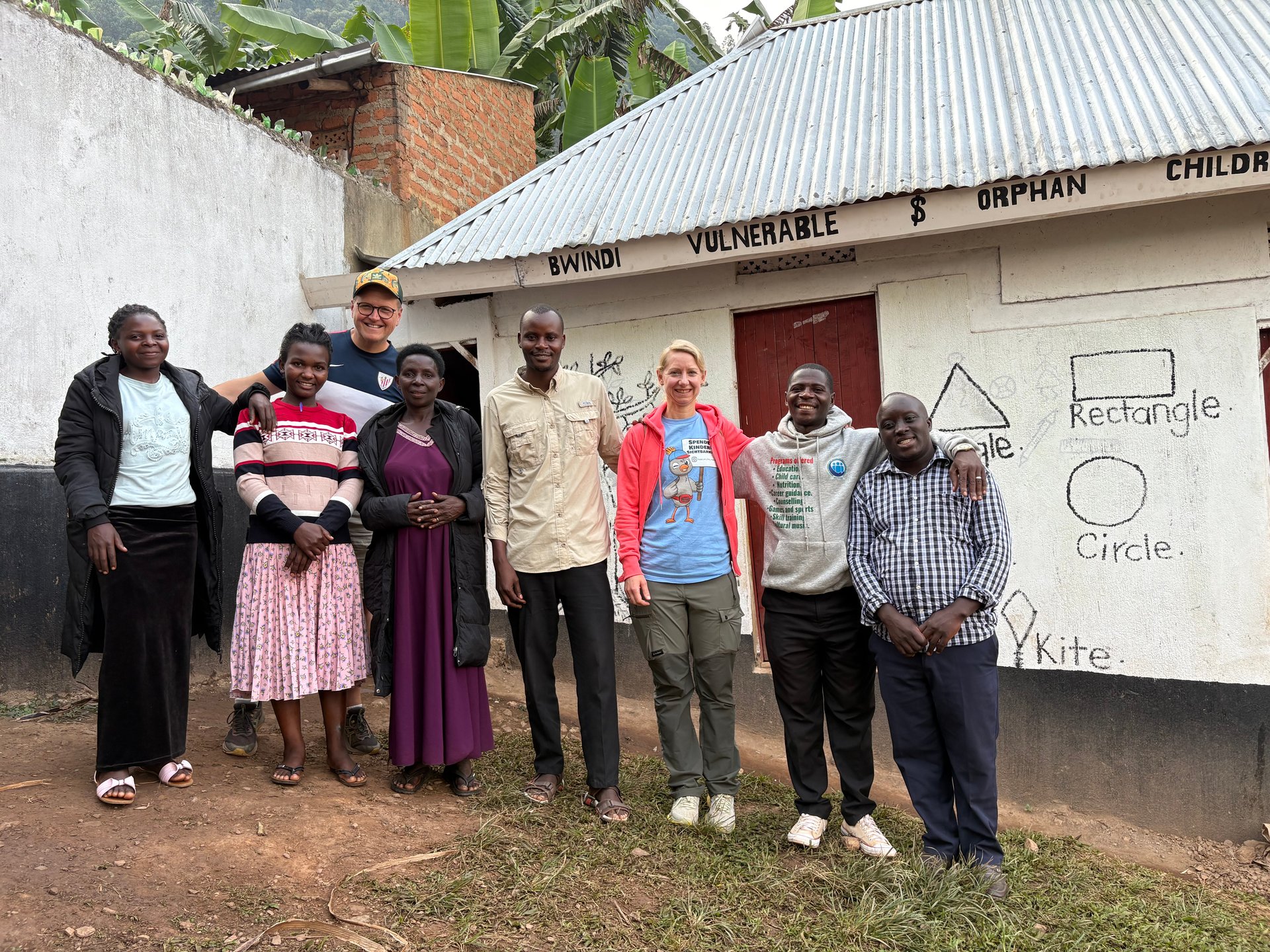
After twelve visits across different properties and seasons, I have found that a small number of direct questions separate lodges that understand their role in the Bwindi ecosystem from those that have simply learned to use the right language.
Where exactly is your permit allocated? If a lodge cannot confirm the sector of your permit at the time of booking — or, worse, offers to "sort it out" closer to the date — that is a warning. Permits are specific to a sector and a date. A lodge that books accommodation separately from permits is leaving you exposed to a mismatch.
What percentage of your staff is from the local community? A credible answer will include a specific number, not a vague claim about "supporting local communities." The best lodges employ 80–100 percent of their general staff from villages within a short radius of the property.
What happens if I am ill on trekking day? UWA requires any trekker with respiratory symptoms to stay out of the forest — gorillas are highly susceptible to human respiratory viruses. A lodge with a good relationship with UWA can often facilitate a date swap; a lodge that is simply an accommodation provider with no permit-handling relationship cannot. Knowing in advance which situation you are in changes the risk calculation significantly.
What is there to do for the rest of the day? The gorilla encounter is one hour. If your itinerary involves two or three nights in a sector, the quality of the lodge's non-trekking programming — guided forest walks, birding, community visits, cooking demonstrations, cultural performances — determines whether you leave feeling immersed or simply having waited.
What is the road condition right now? Not at the time of your visit — right now. Bwindi's access roads, particularly in Nkuringo and Ruhija, can shift from manageable to impassable within hours of sustained rain. A lodge that answers this question specifically, with a recent road report rather than a generalised seasonal description, is one that monitors conditions actively. The best properties maintain WhatsApp contact with their drivers year-round and will tell you if you need a different vehicle or an additional transfer fee.