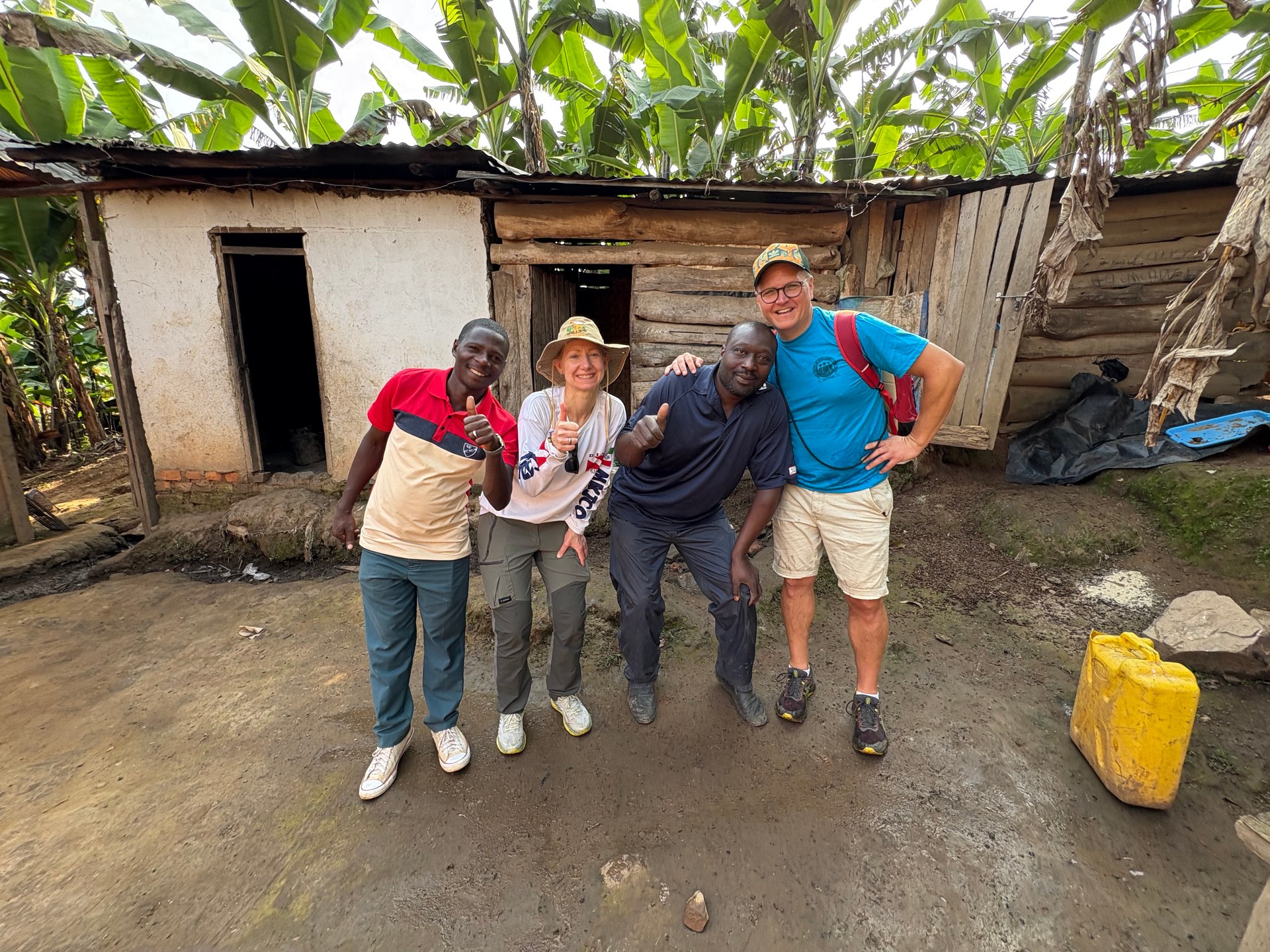
Early on the morning of 21 June 2026, we drove a short distance from the centre of Buhoma and turned off the murram road toward a low compound surrounded by banana trees. A local farmer stepped out to meet us, wiping his hands on a cloth. He had been expecting us. We were there to visit his poultry operation — not to assess it with the detached eye of a development consultant, but because we needed to understand how the chickens were raised before we purchased any for the orphanage nearby. The farmer runs his flock with the kind of precision and care you might find in a well-managed small business anywhere in the world. The chicks moved freely. The enclosures were clean. He knew each stage of growth. During my visit in June 2026 at GPS coordinates approximately -0.9713, 29.6142 — a few hundred metres from the edge of the Bwindi forest — I was struck by how much quiet expertise exists in the communities that surround this park, expertise that never makes it into lodge brochures or gorilla-tracking itineraries.
That gap between what lodge marketing shows and what genuinely happens in this landscape is exactly what this article is about. Luxury lodges in Bwindi National Park occupy a peculiar space in African safari tourism: they are among the most expensive properties on the continent, they are almost universally praised in travel media, and they are located within walking distance of some of the most profound poverty in East Africa. Understanding them honestly — their architecture, their ownership structures, their genuine conservation contribution, and their relationship to the communities outside the fence — requires more than a press trip. It requires time on the ground, which is what these notes represent.
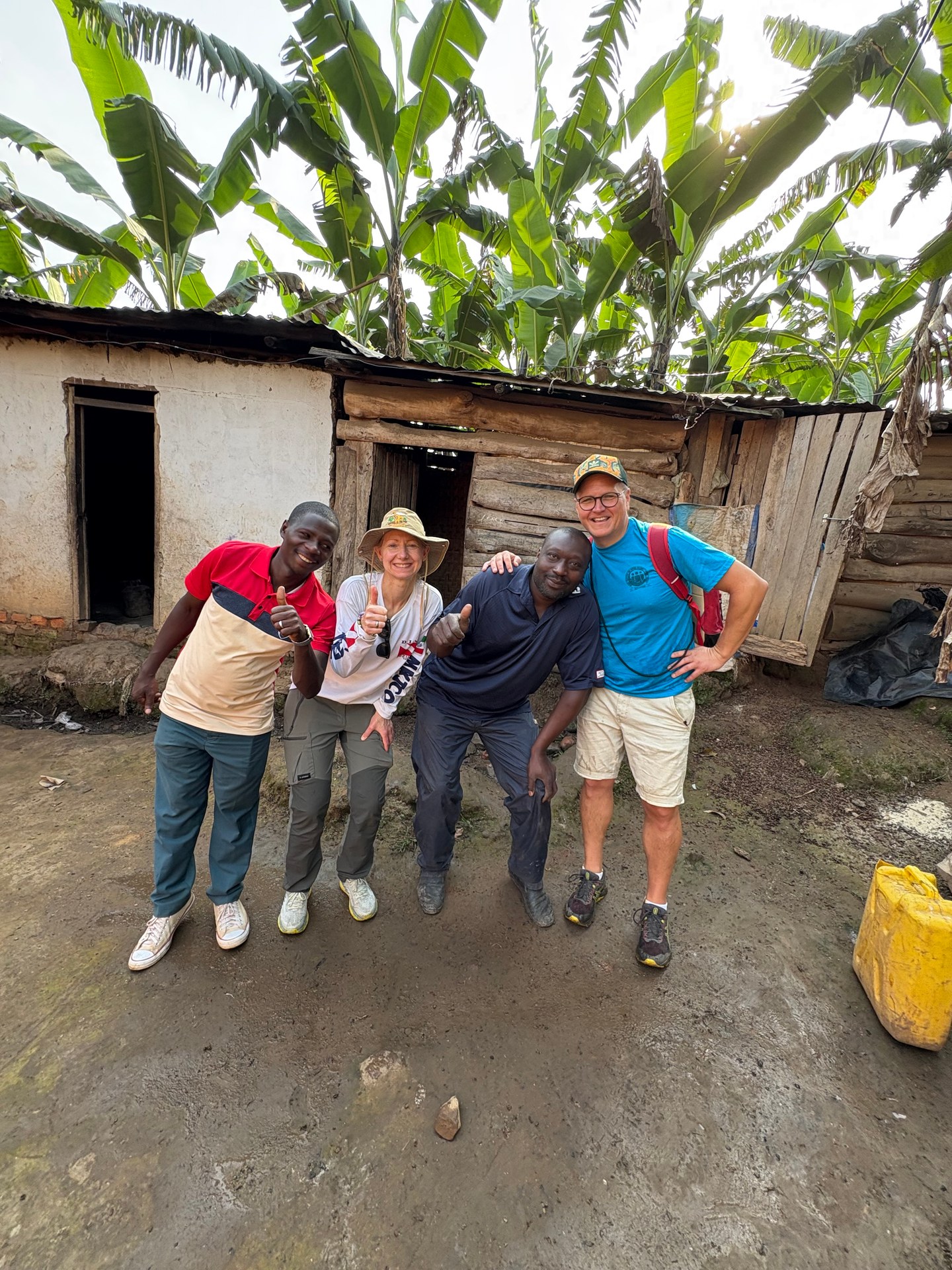
I have visited Bwindi six times, spending a cumulative eleven days on site across visits in January 2026 and June 2026. The three original photographs in this article were taken on a single morning, 21 June 2026, between 06:31 and 06:36, all GPS-tagged to locations within the Buhoma area. They are not stock images. They document what was actually happening that morning, before most lodge guests had finished their coffee.
What Makes a Lodge Truly Luxury in the Bwindi Context
The word luxury is deployed so freely in East African safari marketing that it has largely lost its ability to signal anything specific. In the Bwindi context, a more useful framework is to ask three questions: Is the property architecturally integrated into its environment? Does its ownership structure return money to the community? And does it offer a programme of activities and service that justifies its price relative to mid-range alternatives?
Architecture first. The highest-end lodges in and around Bwindi are built with indigenous materials — volcanic stone, local hardwoods, woven grass thatching — and are designed to minimise visual impact on the forest edge. The finest examples use materials sourced within a defined radius of the site, which reduces transport costs and keeps money in the local economy simultaneously. A design that appears in regional travel guides to Uganda as a reference point for this approach is the Bisate Lodge in Rwanda's Volcanoes National Park — while not in Uganda, it represents a model that several Bwindi properties have studied closely. Its six thatched villas are built into steep forested hillsides using lava stone and local timber, with the cuisine drawing on a kitchen garden adjacent to the lodge. Full-board rates have been cited at approximately USD 2,598 per person in regional guidebook editions. The Bwindi equivalents aim for a comparable integration of materials and landscape, though the terrain of southwestern Uganda differs from the Virunga volcanoes.
Community ownership is the second axis. The Sabyinyo Silverback Lodge near Volcanoes National Park, operated by the Kenyan safari company Governor's Camp and owned by the community trust SACOLA, offers an instructive model: full-board double occupancy rates are cited at around USD 1,000 per person per night, and the profit structure ensures that revenue flows to a trust that funds local schools, clinics, and conservation projects rather than to an offshore investor. Several of the premium lodges in the Bwindi area have adopted analogous structures, often in partnership with Uganda Wildlife Authority concession agreements. This is not philanthropy — it is a business model that makes the lodge more defensible against encroachment, more embedded in local goodwill, and more authentic to the clients who pay to stay there.
The third factor — value relative to alternatives — is where honest analysis becomes uncomfortable for lodge marketers. A luxury lodge in Bwindi will cost between USD 800 and USD 1,500 per person per night at full board. A gorilla tracking permit for foreign non-resident visitors costs USD 700 per person on top of that. For two people on a three-night stay, the total accommodation outlay reaches USD 4,800 to USD 9,000, excluding permits, transfers, and flights. The question every informed traveller should ask is what they receive at that price point that they would not receive at a mid-range property at USD 150 to USD 300 per night. The honest answer is: proximity to the forest, a higher staff-to-guest ratio, better food sourcing, guided night walks, and the absence of the noise and crowding that affects some of the more accessible camps. Whether that differential justifies a 400% price premium is a personal decision. This article's role is to lay out the architecture of the choice, not to make it on the reader's behalf.
The Statistical Context: Uganda's Accommodation Landscape
To understand where luxury lodges in Bwindi sit within Uganda's broader accommodation market, it helps to look at the data available from official sources. According to Uganda's Statistical Abstract 2014, the national government's annual publication documenting tourism, wildlife, and accommodation statistics, the most recent full census of accommodation facilities at the time of publication had been conducted in 2011. The next comprehensive update was slated for the 2014 housing census. The same document records that the accommodation facility survey covered 20 districts distributed across Uganda, including Kampala.
What does this tell us in practice? That the national data infrastructure for tracking lodge supply and demand in a district like Kanungu — which contains most of the Bwindi accommodation market — was significantly underdeveloped as recently as a decade ago. The statistical gap matters because it means that assessments of occupancy rates, average nightly yields, and lodge category distribution in the Bwindi area rest on Uganda Wildlife Authority counts, individual operator disclosures, and periodic World Bank or USAID assessments rather than a comprehensive national census.
The Statistical Abstract 2014 does identify lodges as the accommodation category with the highest occupancy rate and the strongest tourist demand nationally. This is consistent with what operators in the Bwindi sector report informally: the top-tier lodges in the park buffer zone operate at near-full occupancy during the dry seasons — June to August and December to February — and at 60 to 70 percent during the shoulder months. That level of demand, sustained against a backdrop of limited permit availability and constrained infrastructure, explains why new luxury developments in the area have continued even as political and environmental risks elsewhere in East Africa have suppressed investment.
Uganda as a whole supports remarkable biodiversity. The National Status of the Environment Report 2024 records over 1,040 bird species, 345 mammal species, 165 reptile species, and 86 amphibian species (citing Uganda Wildlife Authority 2020 data). Bwindi alone accounts for a disproportionate share of that mammal diversity, including approximately half of the world's remaining mountain gorillas. It is that concentration of biological value that creates the commercial case for luxury accommodation: the park draws a self-selecting traveller willing to pay for exclusivity, and the exclusivity is ultimately grounded in the rarity of what lives in the forest.
Bwindi Impenetrable National Park: The Setting That Justifies the Price
Bwindi Impenetrable National Park sits in the extreme southwest of Uganda, in Kanungu District, straddling the rift valley escarpment that separates Uganda from the Democratic Republic of Congo. At approximately 331 square kilometres, it is not large by African national park standards. What makes it exceptional is its age and its continuity. The forest is ancient — its current extent represents a remnant of the Afromontane forest that once covered much of central Africa. It has been continuously forested for at least 25,000 years, which accounts for its extraordinary biodiversity and for the density of its vegetation.
The "impenetrable" in the name is not hyperbole. The middle sections of the park, particularly around Ruhija in the east and the Mubwindi Swamp, are characterised by stands of primary forest so dense and the terrain so broken that navigation requires experienced guides even on established trails. This physical character is what limits the park's carrying capacity for tourism and what enforces the scarcity that luxury operators depend on. Uganda Wildlife Authority issues gorilla tracking permits — currently priced at USD 700 per person for foreign non-resident visitors and USD 600 for foreign residents — and availability is tightly controlled. Children under 15 years of age are not permitted to participate in gorilla tracking, a rule that further narrows the relevant market and concentrates demand among adult travellers with disposable income.
The permit system also has a practical implication for lodge selection that is rarely discussed plainly. Different gorilla family groups range across different sectors of the park, and the four main access points — Buhoma in the north, Ruhija in the northeast, Rushaga in the south, and Nkuringo in the southwest — each provide access to specific habituated groups. Travellers who book a permit for a particular group should choose their lodge accordingly to avoid long transfer drives between their accommodation and the trailhead. A two-hour pre-dawn drive on unpaved roads is a significant tax on what should be an energising morning experience. The best luxury lodges in each sector provide briefings on this logistics decision at the time of booking, which is itself a service signal worth attending to.
Gorillas can be tracked year-round in Bwindi, including during public holidays and school vacations, unlike some other great ape destinations where seasonal closures apply. The two dry seasons — roughly June through August, and December through early February — are the most popular because trail conditions are more manageable and rain is less frequent. However, the park's altitude range (1,160 to 2,607 metres above sea level) means that temperatures are considerably cooler than Uganda's lakeside destinations, and light rain is possible in any month. Luxury lodges in the area provide waterproof ponchos and gaiters as standard, which mid-range camps do not always offer.
Community Connection: What Honest Luxury Looks Like from the Outside
What I saw on the morning of 21 June 2026 was not unusual for the communities living in the Buhoma buffer zone, but it was instructive precisely because it was ordinary. The chicken farmer we visited had no formal relationship with any of the luxury lodges a few kilometres up the road. He ran his operation for the orphanage, for local food security, and for his own livelihood. The chicks we purchased were destined to be raised by the orphanage until they could provide eggs for daily nutrition, and occasionally meat — which, as I noted at the time, genuinely constitutes a small celebration in a household where protein is scarce.
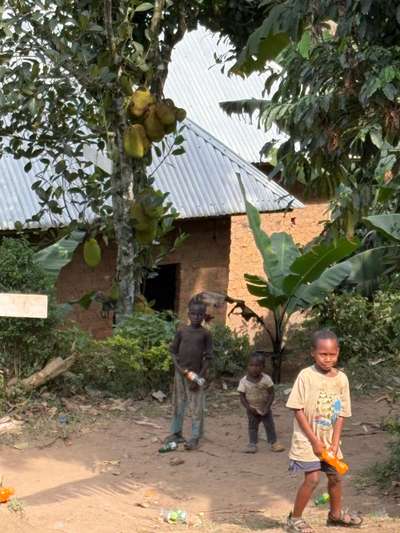
We also met children from the neighbourhood that morning. Three children from near the orphanage came to join us for a meal. They were noticeably shy and their condition was visible — in the way they held themselves, in the state of their clothing. We invited them to eat without ceremony. It was a small act, unremarkable in itself, but it located the morning's activity within a reality that coexists, quite literally at walking distance, with lodges charging USD 1,000 per person per night.
I raise this not to indict the luxury lodge industry — most of the serious operators contribute meaningfully to conservation and local employment — but because a complete picture of what luxury lodges in Bwindi National Park actually are requires acknowledging the social geography they sit within. The best properties understand this. They hire locally, they source food from community farmers where supply chains allow, they fund scholarships and healthcare access for staff families, and they participate in the Uganda Wildlife Authority's revenue-sharing arrangements, which direct a portion of permit and entrance fees back to the districts adjacent to the park.
[QUOTE: local guide on first impressions of guests arriving at the forest edge for the first time]
The community agriculture projects in the buffer zone — poultry, vegetables, coffee, medicinal plants — are not incidental to the luxury lodge ecosystem. They are part of the reason the park is still there. Habituated gorilla families generate revenue, revenue funds protection, and protection depends on goodwill from communities that might otherwise view the forest as agricultural land. A chicken farmer who supplies the orphanage and sells surplus to a lodge kitchen is embedded in that chain even if he does not know the name of the lodge's head chef. This interdependence is what distinguishes Bwindi's lodge economy from simpler extractive tourism models, and it is what the best luxury operators in the area communicate, accurately, to their guests.
What to Expect at the Top Tier: Standards, Services, and Honest Differences
Across six visits to the Bwindi area, I have observed a clear stratification in what different price tiers actually deliver. This section describes what the top tier — properties at approximately USD 800 and above per person per night at full board — provides, and where the genuine differentials lie.
Accommodation at the highest level in Bwindi typically means a freestanding cottage or suite with a private veranda, a fireplace or heating system (essential given the altitude), an en-suite bathroom with both indoor and outdoor bathing options, and direct views of either the forest canopy or the surrounding agricultural landscape. Rooms are large by any standard — most exceed 60 square metres — and are furnished with locally made wooden furniture, handwoven textiles, and art sourced from Ugandan makers. The lighting tends toward warm and subdued, which suits both the intimate atmosphere and the reality that many guests return from gorilla tracking in the early afternoon and rest before dinner.
Food at the luxury tier is a meaningful differentiator. The better properties run kitchen gardens that supply herbs, salad leaves, and some vegetables directly to the restaurant; they source protein from local farms where possible, including poultry and freshwater fish from Lake Bunyonyi or Lake Mutanda; and they maintain a wine cellar with a selection that would pass inspection in any European restaurant. Menus change daily and are adapted to dietary requirements without the performance of difficulty that mid-range camps sometimes exhibit. Breakfasts are served before the gorilla tracking departure — typically 07:00 to 07:30 — and the kitchen provides packed lunches for tracking days.
Activity programming beyond gorilla tracking is where luxury properties increasingly attempt to justify their premium. The most credible offerings include guided forest walks with certified rangers from Uganda Wildlife Authority, birdwatching sessions with specialist ornithological guides, village walks to community cooperatives and traditional healers, and cultural exchange programmes with local Batwa communities (which, when operated sensitively and with genuine compensation flowing to participants, offer profound experiences; when operated as a performance for guests, are worth declining). Night walks inside or adjacent to the forest to observe nocturnal primates and insects are available at some properties and are consistently rated among the most memorable activities available near Bwindi — more so, for some guests, than the gorilla tracking itself.
Transfer logistics at the top tier include dedicated vehicles and drivers for all park activities, including the gorilla tracking departure. A private vehicle for a tracking group of two or four guests is standard. This is not a trivial benefit: shared transfers in the pre-dawn hours to a forest trailhead, in conditions that may include rain and unpaved roads, are a significant source of friction at mid-range properties that the luxury segment eliminates.
The question of what constitutes genuinely luxury — as opposed to expensive — is ultimately answered by the staff. At the properties that merit the designation, staff-to-guest ratios of 4:1 or higher mean that requests are anticipated rather than managed. A guide who has spent years in the forest and can identify 50 bird species by call, who knows the names of the rangers who habituated the gorilla family you are about to visit, and who can explain the social dynamics of that family in language that is scientifically accurate and emotionally resonant — that guide is the luxury product. The stone villa is incidental.
One statistical note worth retaining from Uganda's national data: accommodation facilities surveys conducted prior to the 2014 Statistical Abstract covered 20 districts nationally. The Bwindi area's specific district — Kanungu — sits at the edge of southwestern Uganda's infrastructure network, which has historically meant that national-level data for this corridor lags behind on-the-ground reality. The picture that official statistics paint of accommodation supply and demand in the area is therefore less precise than operators' own occupancy data. Travellers researching options should weigh lodge reviews from guests who have actually stayed recently over aggregate star ratings on booking platforms, which may reflect older assessments of properties that have since been upgraded or have declined.
Planning a Luxury Bwindi Stay: Practical Guidance from the Field
The single most important planning decision for a luxury lodge stay in Bwindi is permit timing. Uganda Wildlife Authority gorilla tracking permits sell out months in advance for the dry season windows, and the leading luxury lodges hold limited permit allocations for their guests — but these are not guaranteed to be available at the dates you want. The correct approach is to secure permits first, then build your accommodation choice around them. This inverts the standard travel planning sequence and surprises many travellers, but it is non-negotiable if you want to track gorillas at your preferred dates.
Booking a permit for a named gorilla family group, which is required and stamped on the permit document, should also determine your lodge. Buhoma sector properties serve the families that range in the north of the park. If your permit names a Rushaga family, a lodge 80 kilometres away in the Buhoma area is a poor choice regardless of its rating. The Uganda Wildlife Authority and most reputable lodges provide family-sector maps on request; insist on receiving one before finalising your booking.
Dry season is peak season, and price premiums apply. June through August and December through January are when the highest rates are in effect, when the rain is least, and when trail conditions are least challenging. If your schedule allows flexibility, the shoulder months of September to November and March to May offer reduced rates at most properties, often with similar wildlife activity levels. The mountain gorillas' behaviour is not materially different between seasons; the significant variable is the state of the trails underfoot and the likelihood of rain during the tracking hours.
For travellers combining a Bwindi stay with other Uganda destinations — Kibale Forest for chimpanzee tracking, Queen Elizabeth National Park for savannah wildlife, Lake Bunyonyi for relaxation — the southwestern circuit is well established and most lodge operators can coordinate the logistics. Kampala to Bwindi by road takes approximately eight to nine hours via Mbarara; fly-in options via charter aircraft to the Kihihi or Kisoro airstrips cut this to under two hours, and the best luxury lodges include airstrip transfers in their rates.
A note on health and practicalities. Bwindi sits at elevations between 1,160 and 2,607 metres. While altitude sickness at these levels is uncommon, visitors arriving directly from sea level may notice shortness of breath on steep ascents during gorilla tracking. The luxury lodges brief guests on this during arrival orientation and typically advise a rest afternoon upon arrival before a tracking morning. Malaria prophylaxis is recommended; the forest edge and surrounding agricultural land carry a low but non-zero transmission risk. All leading properties maintain first-aid facilities and have evacuation protocols — ask for the specifics at check-in.