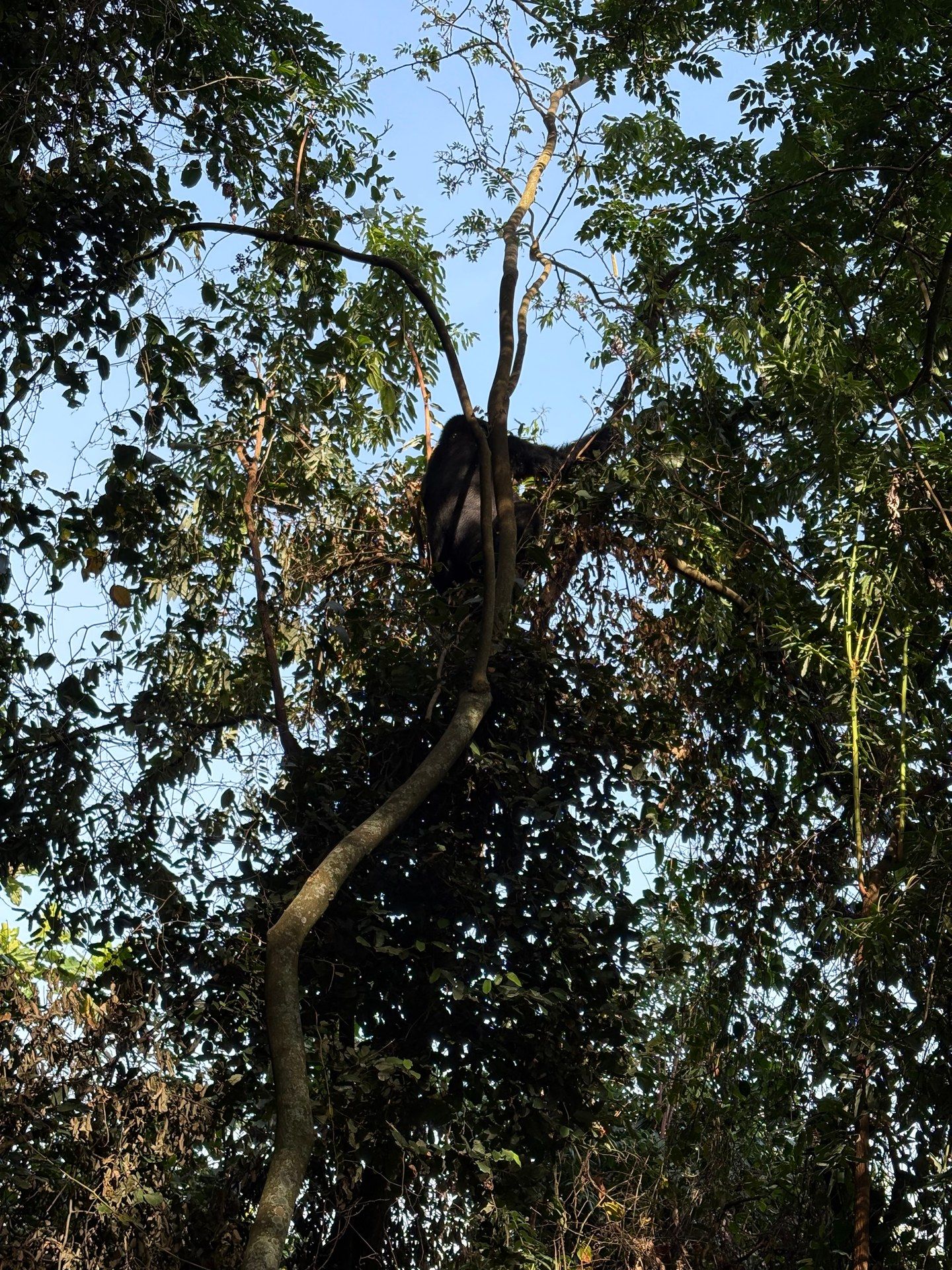
The gorilla was twelve feet overhead, sitting calmly in the fork of a large tree, pulling leaves from a branch and eating them without looking down at us. We had been walking for just over an hour when the forest guide raised his hand and the group stopped. The rustling above grew louder, a dark shape materialised in the canopy, and then the face appeared — watching us with a quality of attention that felt entirely mutual.
During my four days in Bwindi in January 2026, staying at Gorilla Bluff Lodge in Buhoma and trekking into Bwindi Impenetrable National Park with a ranger escort, the GPS coordinates on my photographs placed me at -0.0089°N, 29.6195°E — a location that means nothing until you are standing there, lungs working hard from the ascent, watching a mountain gorilla eat its breakfast approximately three metres from your face. That encounter does not require embellishment. What it does require, I came to understand, is time: time before, time after, and a lodge that knows the difference between a stopover and a stay.
Bwindi has evolved considerably from its early reputation as a single-experience bucket-list destination. A growing number of travellers now build two-, three- or four-night itineraries around the park not merely to secure a gorilla permit, but to rest and genuinely recover in one of the most biologically rich forests on earth. The lodges serving this demand range from rustic community camps to high-altitude luxury retreats with spa facilities, wood-burning fireplaces and menus sourced from farms within walking distance of the kitchen. This guide covers what that landscape looks like in 2026.
The Gorillas That Change You
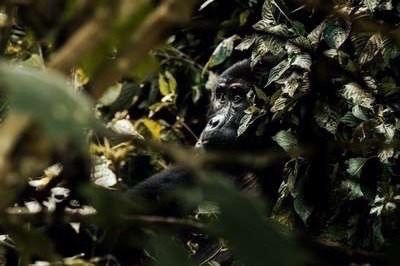
According to Uganda Wildlife Authority (UWA) census data, Uganda's mountain gorilla population stood at 459 individuals between 2018 and 2020 — a number that has been rising steadily due to decades of intensive conservation work. These are not creatures glimpsed at a distance through binoculars. Habituated gorilla families in Bwindi tolerate human presence for a controlled one-hour visit, during which rangers enforce a minimum approach distance of seven metres. In practice, the gorillas frequently close that gap on their own terms.
On my January 2026 trek from Buhoma, our group was accompanied by one tracker-guide and two armed rangers — standard procedure for all permitted groups entering the park. The rangers being armed felt incongruous at first, but the purpose is general wildlife safety rather than anything specific to gorillas. Their knowledge of the terrain was invaluable on the ascent: Bwindi's forest floor is rarely flat, and portions of the trail involve near-vertical scrambles through root networks and mud. One of the rangers guided my footing on a steep descent with a patience that indicated he had done this many thousands of times before.
What nobody adequately prepares you for is the silence after. The hour with the family ends, the rangers signal withdrawal, and you find yourself walking back through the forest in a state that is difficult to name. It is not calm exactly — the adrenaline of the encounter takes time to metabolise — but it is not agitation either. Several people in our group sat on a log at the forest edge for twenty minutes without speaking. This is the moment that the best Bwindi lodges have learned to receive well.
A thoughtful wellness itinerary accounts for this. Treks typically begin at 08:00 and return guests by early afternoon, leaving four to five hours of unstructured time before dark. A lodge that fills those hours with noise and activity misunderstands its guests. A lodge that offers a warm shower, a chair near a fire, African tea and the option of doing nothing at all has understood them.
Bwindi's Wellness Lodge Landscape
Lodges in Bwindi consistently record among the highest occupancy rates of any accommodation category in Uganda's tourism sector — a reflection of the park's status as one of only two places on earth where mountain gorilla trekking is accessible to visitors. This sustained demand has driven investment in quality, and the range between entry-level options and the top end has widened considerably over the past decade.
The wellness-focused traveller has a distinct set of requirements beyond permit access and proximity to a sector gate. They are looking for properties that offer quiet — ideally with a view into the canopy or across a valley; some form of physical treatment after the exertion of the trek; food that is nutritionally considered and locally rooted; and an atmosphere that does not feel like a transit hub between permit slots. Several Bwindi properties now meet these criteria in different ways.
Clouds Mountain Gorilla Lodge — Nkuringo Sector
At over 2,000 metres above sea level, Clouds Mountain Gorilla Lodge holds the highest position of any permanent lodge in Bwindi. The altitude is itself a wellness variable: the air is measurably cooler and cleaner than the lower park zones, nights require a blanket even during the dry season, and the panoramic views across the Virunga volcano chain on a clear morning are the kind that hold a guest to their terrace considerably longer than intended.
The lodge operates in partnership with the African Wildlife Foundation (AWF), a relationship that shapes both its conservation credentials and its design philosophy. Cottages are constructed from local volcanic rock and timber, keeping the visual and material footprint in keeping with the surrounding landscape. AWF's involvement ensures that revenues support community livelihoods in the Nkuringo area. Massage treatments and spa facilities are available at the property; specific offerings and current pricing should be confirmed directly with the lodge, as the menu evolves seasonally.
The Nkuringo sector gate provides access to habituated gorilla families on the southern range of the park. Treks from Nkuringo are generally rated more demanding than those from Buhoma — the terrain is steeper and the altitude more pronounced — which makes post-trek recovery time at a well-equipped lodge particularly valued by guests.
Nkuringo Bwindi Gorilla Lodge — Community Conservation at Altitude
Nkuringo Bwindi Gorilla Lodge sits at 2,090 metres and offers 18 rooms distributed across the hillside above the Nkuringo gorilla habituation site. Unlike many Bwindi properties, it operates on a community ownership model: revenues are structured to benefit the surrounding villages rather than flow to external investors alone.
The lodge has a notable distinction in the Ugandan tourism sector: it works with the Uganda Carbon Bureau to offset its operational carbon footprint. For a wellness traveller concerned with the environmental integrity of their trip, this is a meaningful differentiator — the property is actively accounting for its emissions rather than simply marketing its natural surroundings as evidence of environmental commitment.
At this elevation, much of the wellness offering is intrinsic. Evenings require a fire. The forest arrives at the property boundary. Guests staying several nights have the unusual opportunity to observe gorilla researchers at work at the habituation site below the ridge — a level of access and context that fundamentally changes how a visitor understands both the trekking experience and the conservation logic behind the permit price.
Ruhija Gorilla Safari Lodge — The Eastern Edge
Ruhija sits at roughly 2,300 metres on the eastern boundary of Bwindi — the highest elevation of any of the park's four trekking sectors. The Ruhija Gorilla Safari Lodge, operated by Asyanut Safaris, provides timber cottages close to the sector's trekking starting point. It is a more rustic property than the Nkuringo options, suited to guests who prioritise direct forest access and solitude over elaborate amenities.
Ruhija is the least visited of Bwindi's four sectors by international tourists, which is itself a practical wellness consideration. Smaller trekking groups, quieter access tracks and the sector's extraordinary birdlife — Ruhija is one of East Africa's premier birding sites — create a different quality of experience for travellers who have already done Buhoma or Nkuringo and want the park without the comparative volume.
Buhoma: Community Roots and a Morning Routine
Buhoma remains the most established trekking gateway in Bwindi, with the widest range of accommodation across all budget categories. The Buhoma Community Rest Camp — a pioneering community-ownership lodge that has operated since the earliest years of gorilla tourism in Uganda — continues to direct revenues into Buhoma village infrastructure, and its position close to the park entrance makes it a practical choice for guests who want immediate access to forest walks on non-trekking days.
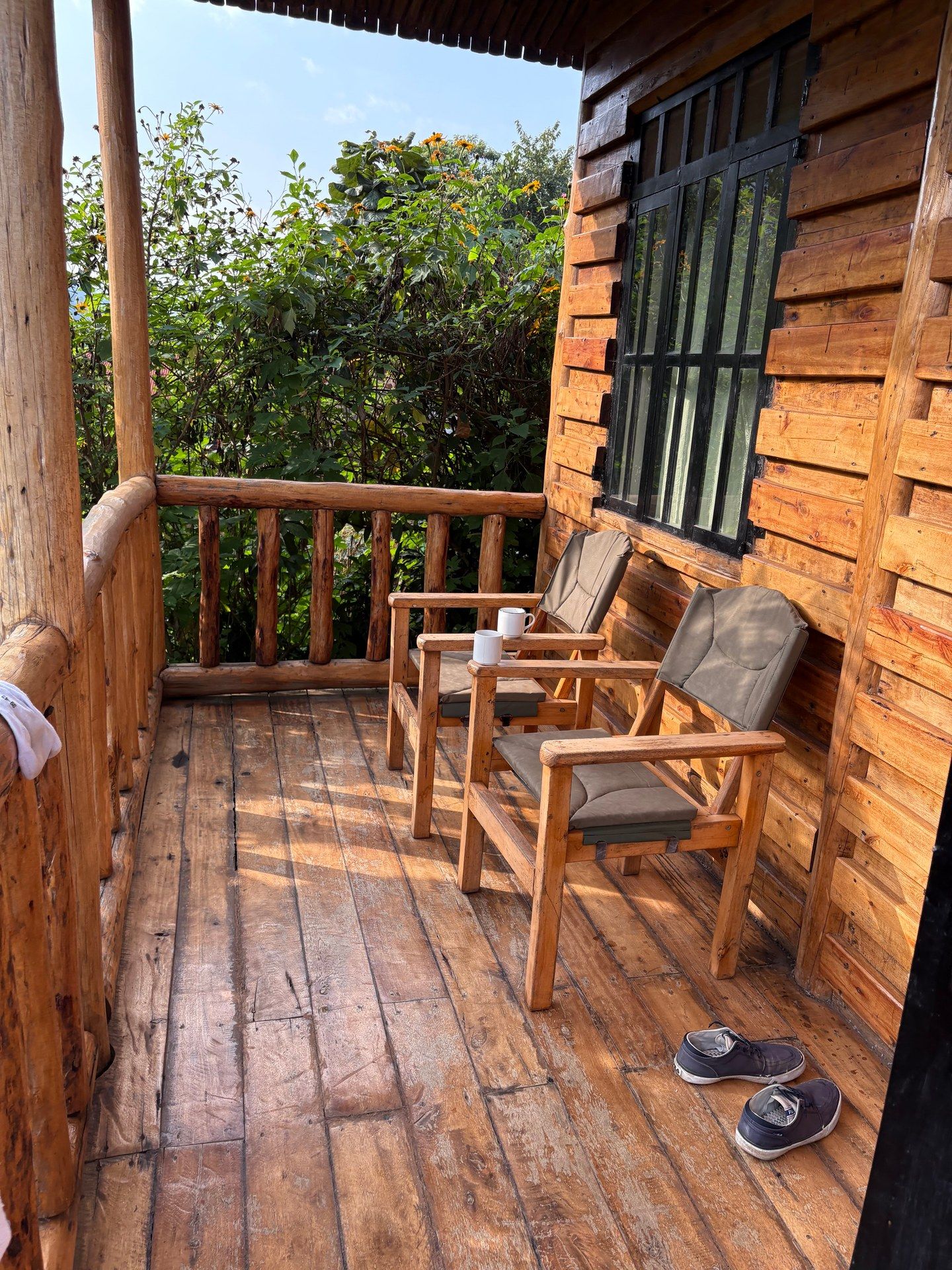
During my January 2026 stay at Gorilla Bluff Lodge in Buhoma, mornings began with coffee and African tea brought to the room terrace — a simple ritual that set the day's rhythm before the trek. The wooden stairs connecting guest rooms to the main lodge building traverse a steep hillside, built into the gradient rather than against it, from handmade local timber. That detail, which initially read as rustic, accumulated meaning over four days: a building that had accepted its location rather than imposed itself on it felt, in context, like an argument for how to be somewhere.
The Park as a Wellness Environment
Bwindi Impenetrable National Park covers approximately 331 square kilometres of montane and lowland forest in south-western Uganda. It was designated a UNESCO World Heritage Site in 1994 — a classification that reflects its exceptional biodiversity rather than solely its gorilla population. The park contains over 1,000 plant species, more than 360 bird species and a range of primate populations that includes chimpanzees, red-tailed monkeys, black-and-white colobus and l'Hoest's monkeys.
The park's elevation range — from approximately 1,160 metres at its lowest boundary to 2,607 metres at the summit of Rwamunyonyi — creates distinct microclimates across the four sectors. Morning mist sits in the valleys. Cold nights prevail at the upper sectors. The particular quality of light through closed-canopy tropical forest at altitude is measurably different from coastal or savannah environments, and for a visitor arriving from a temperate urban setting the contrast becomes physically perceptible within hours.
This is not promotional language. Research in forest-immersion contexts consistently associates high-altitude, closed-canopy forest environments with reduced cortisol levels, improved sleep quality and lower resting heart rate. Bwindi produces these conditions without any special programme being required — staying at a lodge adjacent to the park boundary is sufficient. The forest does the work.
Where Bwindi Meets the Virunga Massif
Bwindi's southern and western boundaries lie close to the Virunga Massif — the volcanic mountain chain shared between Uganda, Rwanda and the Democratic Republic of Congo. Virunga National Park, which occupies the DRC section of this range and holds the highest concentration of mountain gorillas in the world, forms a contiguous habitat zone with Bwindi despite the international border between them. For the wellness traveller, this context matters because it explains the landscape visible from upper lodge terraces: the volcanic peaks of Muhabura, Gahinga and Sabinyo on the Ugandan-Rwandan border, and beyond them the larger cones of Nyiragongo and Nyamulagira in DRC. From Nkuringo or Ruhija on a clear morning, this is one of the most extraordinary panoramic views available in East Africa. Several lodges have positioned seating areas specifically to face west for precisely this reason.
Sabyinyo Silverback Lodge: A Community Trust Model
Situated in the Virunga foothills near the Ugandan border rather than inside Bwindi itself, Sabyinyo Silverback Lodge operates under a community trust structure that has become a reference point for how premium safari accommodation can be aligned with local development. The lodge offers cottages at the top end of the market and provides the kind of relaxation-focused amenities — long views, attentive service, carefully sourced meals — that suit a wellness itinerary.
Environmental Standards and What They Mean for Guests
One of the least-discussed dimensions of choosing a Bwindi lodge is the regulatory framework within which these properties operate. Under Uganda's National Environment (Audit) Regulations, S.I. No. 47 of 2020, Schedule 5 — which covers hotel, tourism and leisure development — any luxury tented camp, lodge, hotel or resort operating within or in proximity to a wildlife protection area, forest reserve or wetland is required to undergo a formal Environmental Compliance Audit every three years.
This is not a minor administrative formality. An Environmental Compliance Audit examines waste management and disposal, water sourcing and wastewater treatment, energy consumption and source, noise and light pollution impacts on adjacent wildlife, construction effects on drainage and vegetation, and the lodge's overall ecological footprint within its protected area context. Properties that fail the audit face mandatory remediation and, in persistent cases, operational licence suspension.
For the wellness traveller, this framework provides a meaningful baseline assurance. A lodge that has passed its compliance audit recently has demonstrated, at minimum, that its operations do not systematically damage the forest ecosystem on which the entire guest experience depends. It is worth raising this question when making booking enquiries: when was your most recent Environmental Compliance Audit conducted? A lodge that takes the question seriously is one that likely takes environmental management seriously.
The practical consequences of sound environmental management translate directly into guest experience: efficient water heating, reduced dependence on diesel generators, proper waste disposal and thoughtful construction all produce a quieter, cleaner, more comfortable lodge environment. The regulatory argument and the hospitality argument point in the same direction.
The Berggorilla- und Regenwalddirekthilfe e.V., a German conservation organisation focused specifically on mountain gorilla and eastern lowland gorilla protection, has documented habitat pressures around the Bwindi park boundary for decades. Their published research provides independent context on how lodge development — well-managed or poorly managed — affects the wider forest ecosystem. Travellers interested in the conservation dimension of their visit beyond the UWA trailhead briefing will find their materials useful.
The Region's Healing Traditions — and a Day on Lake Bunyonyi
Bwindi sits within a south-western Ugandan landscape that carries a longer history of people seeking restoration in demanding terrain than the gorilla tourism narrative tends to acknowledge. Lake Bunyonyi, approximately 90 minutes north of Buhoma by road, is one of the deepest lakes in Africa and has been a place of refuge for communities in this region across many generations.
In 1921, Leonard Sharp — a Scottish missionary and physician — established a hospital for people with leprosy on Bwama Island in Lake Bunyonyi. Sharp's insight was that the island's natural isolation provided both physical containment and social protection for patients whose condition had excluded them from mainland village life. The institution he founded became one of the earliest examples of intentional therapeutic retreat in this part of East Africa: a European medical model adapted to an African landscape through a combination of necessity and genuine respect for place.
Bwama Island has long since become a community resource rather than a medical facility, but it remains accessible by dugout canoe, and the historical layer it adds to a visit to Lake Bunyonyi is worth the detour. For guests building a multi-night Bwindi itinerary, an afternoon on the lake — paddling between islands, watching the terraced hillsides reflect in still water, stopping at a lakeside eco-lodge for lunch — provides a sensory counterpoint to the density of the forest that many travellers describe as an essential part of the overall experience, not an optional addition to it.
The eco-lodge options on and around Lake Bunyonyi — including Arcadia Cottages and Bushara Island Camp — are oriented toward low-impact community-embedded tourism in a tradition that predates the contemporary wellness tourism category by approximately a century. Whether Leonard Sharp would have used that language is beside the point. The intention — healing through landscape, community and care — runs in a continuous line from his 1921 hospital on Bwama Island to the yoga mats and morning silences of a contemporary Bwindi retreat.
Planning a Wellness-Focused Bwindi Itinerary
A minimum of three nights at Bwindi allows one trekking day, one recovery day and one further activity day — a guided nature walk, a community visit, birding, or simply reading at altitude. Four nights is more comfortable. Gorilla trekking permits in Uganda are currently priced at 800 USD per person per trek day (UWA 2026 — verify directly with Uganda Wildlife Authority or a licensed operator before booking). Permits for the habituation experience, which allows a four-hour encounter with a gorilla family still in the habituation process, are priced at 1,500 USD.
Permits for peak dry-season months sell out months in advance. January, when I visited, offered conditions typical of the short dry season: clear mornings, cold nights and trails firm enough to descend without difficulty. The forest is compelling in any season — the wet months bring their own visual intensity — but for a wellness-oriented visit, dry-season practicalities generally outweigh the drama of trekking through rain: firmer underfoot conditions, more predictable morning weather windows and better long-range views from the upper lodge terraces.
When selecting a lodge, the questions that most directly affect the wellness dimension are: distance from the sector gate (twenty minutes adds no stress; an hour does); what the property offers in the post-trek afternoon; whether hot water is reliable — at altitude a cold shower is not restorative; and what the evening atmosphere is like. An open fire and table service constitute a different kind of environment from a generator-powered television in a concrete room.
For those considering a multi-sector itinerary — staying first in Buhoma, then driving to Nkuringo or Ruhija for a second permit — the inter-sector road through the park's buffer zone and surrounding communities is not merely transit. The route climbs through tea estates and smallholder farms in Kanungu District with views back across the Bwindi ridge that are unavailable from within the park itself. Allow half a day for this drive rather than treating it as a transfer.
Buhoma's main street, photographed in January 2026, was a dusty single track lined with small shops and food stalls selling charcoal, soap and sim cards. A road-tarmacking project was under way in the village at that time, with completion expected in 2026. For the wellness visitor, this context is part of what Bwindi actually is: a functioning community in active development, not a curated backdrop. The lodges that acknowledge this, rather than screening it out, tend to offer the more honest and ultimately more satisfying experience.
Summary
Bwindi's top wellness lodges combine regulated environmental performance, direct forest access, community benefit structures and the singular experience of mountain gorilla trekking in a single itinerary. Clouds Mountain Gorilla Lodge and Nkuringo Bwindi Gorilla Lodge offer the highest-altitude options with the strongest wellness-specific amenities; Ruhija provides solitude and exceptional birding; Buhoma offers the widest lodge range and the most established community tourism infrastructure. The Environmental Compliance Audit requirement under S.I. No. 47 of 2020 establishes a regulatory floor beneath which no licensed property should operate. Plan at least three nights, book permits early, and build in time for nothing — that time is not filler; it is the point.
Frequently Asked Questions
Which Bwindi lodges have a spa or wellness facilities?
+
Clouds Mountain Gorilla Lodge in the Nkuringo sector offers the most developed wellness amenities, including massage treatments and a dedicated relaxation terrace. Nkuringo Bwindi Gorilla Lodge at 2,090m provides natural wellness through altitude, silence and forest immersion even without a formal spa facility. Ruhija Gorilla Safari Lodge offers solitude and extraordinary birding as a passive wellness environment.
Is Bwindi suitable for a wellness holiday beyond gorilla trekking?
+
Yes. High altitude (1,600m–2,100m), forest air, cold mountain mornings and the psychological impact of a gorilla encounter make Bwindi genuinely restorative. Several luxury lodges offer yoga space, guided nature walks, fireside evenings and gourmet meals — making a three- or four-night stay worthwhile well beyond the single trekking day.
What environmental standards apply to Bwindi lodges?
+
Under Uganda's National Environment (Audit) Regulations, S.I. No. 47 of 2020, Schedule 5, any lodge, resort or hotel operating within or near a wildlife protection area must undergo an Environmental Compliance Audit every three years. This audit covers waste management, water treatment, energy use and the property's ecological footprint within the protected area.
What is the best season for a wellness visit to Bwindi?
+
June to September and December to February offer the most comfortable trekking and outdoor conditions. When I visited in January 2026, mornings were clear with valley mist — ideal for terrace breakfasts and afternoon forest walks. The wet seasons (March–May, October–November) produce lush vegetation but muddier trails and less predictable weather windows.
How does a community lodge stay contribute to gorilla conservation?
+
Community lodges such as Nkuringo Bwindi Gorilla Lodge and Buhoma Community Rest Camp direct lodge revenues to surrounding villages and conservation programmes. Nkuringo works with the Uganda Carbon Bureau on carbon-offset initiatives. Uganda Wildlife Authority also returns a share of gorilla trekking permit revenue to adjacent community development funds under the Uganda Wildlife Regulations 2022 — verify the current percentage directly with UWA before travel.