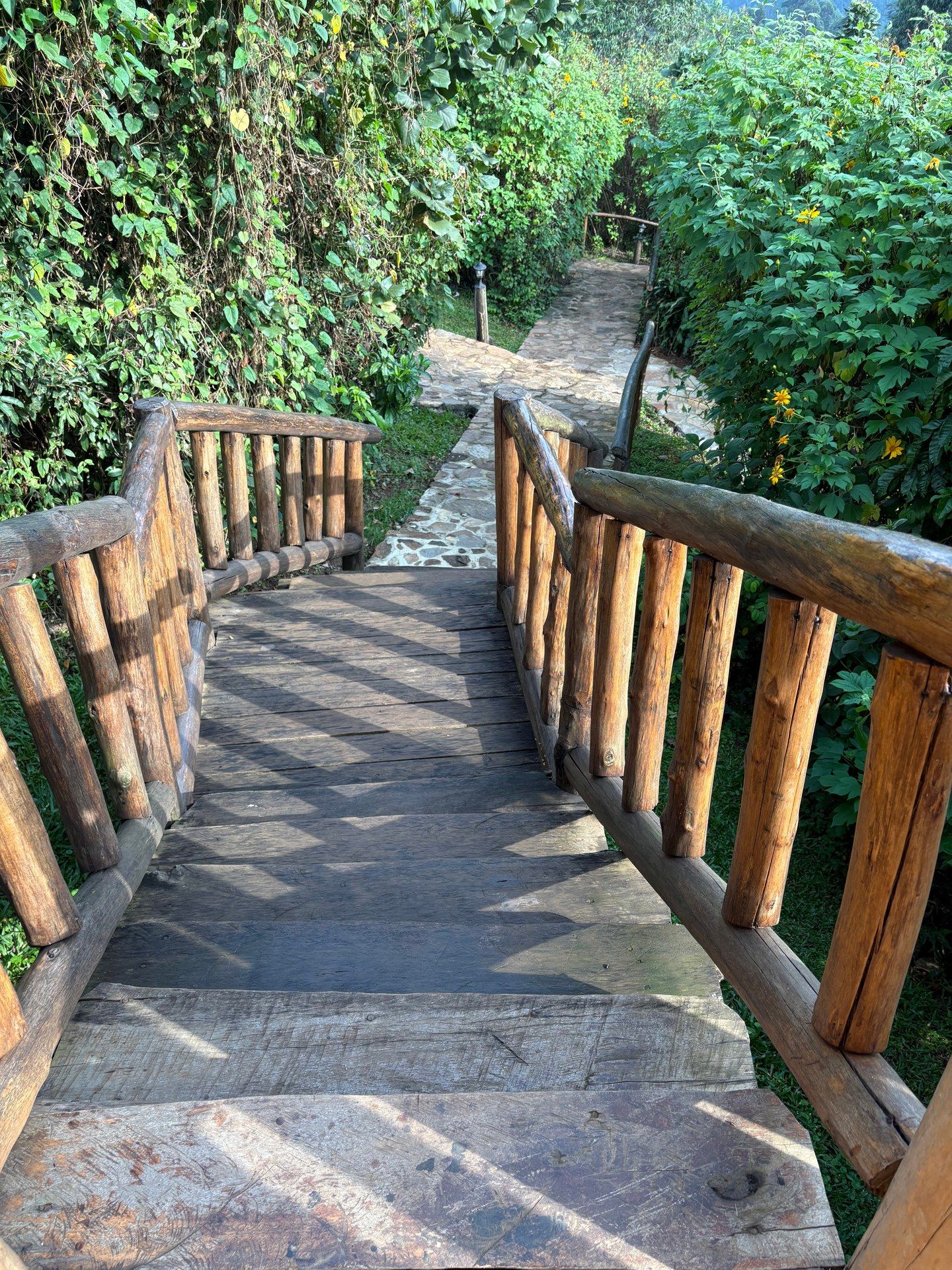
The stairs at Gorilla Bluff Lodge in Buhoma are made from split timber, embedded into the hillside at angles that the mountain dictated rather than the architect. They connect the guest rooms to the main lodge building across a gradient steep enough that coming down in the dark, without a torch, would be inadvisable. During my stay in January 2026, those stairs were the first thing I navigated every morning — and they set something up that the rest of the day in Bwindi tended to continue: a constant, low-level physical engagement with the terrain.
That quality — the terrain demanding something from you before the forest gives anything back — is the most honest way I can describe what gorilla trekking in Uganda's Bwindi Impenetrable National Park is like. It is not arduous by mountaineering standards, but it is never flat, it is often steep, the vegetation is genuinely impenetrable until the guide makes it otherwise, and the moment you reach a gorilla family after an hour or three of this is a physical and emotional event in a way that a shorter, more accessible trek cannot replicate. It is also, partly for these reasons, why some travellers choose Rwanda instead.
This guide compares gorilla trekking in Uganda and Rwanda from the ground up — permits, terrain, lodge options, what the rain does to the trail and how close the gorillas actually come. It draws on multiple visits to Bwindi across January and June 2026, and on observations from Bwindi Impenetrable National Park and the surrounding communities at the Buhoma and Rushaga sector gates.
What Gorilla Trekking Actually Involves
A gorilla trekking permit in Uganda grants a single one-hour encounter with a habituated gorilla family in Bwindi Impenetrable National Park. Trekking groups are capped at eight visitors per family per day. The trek begins with a briefing at the sector gate at approximately 08:00 — covering distance expectations, rules of engagement (7-metre minimum distance, no flash photography, turn away if you cough or feel unwell) and the route that tracker-guides have identified based on the gorilla family's overnight location. From that point, the walk into the forest can take anywhere from 30 minutes to six hours depending on how far the family has ranged overnight.
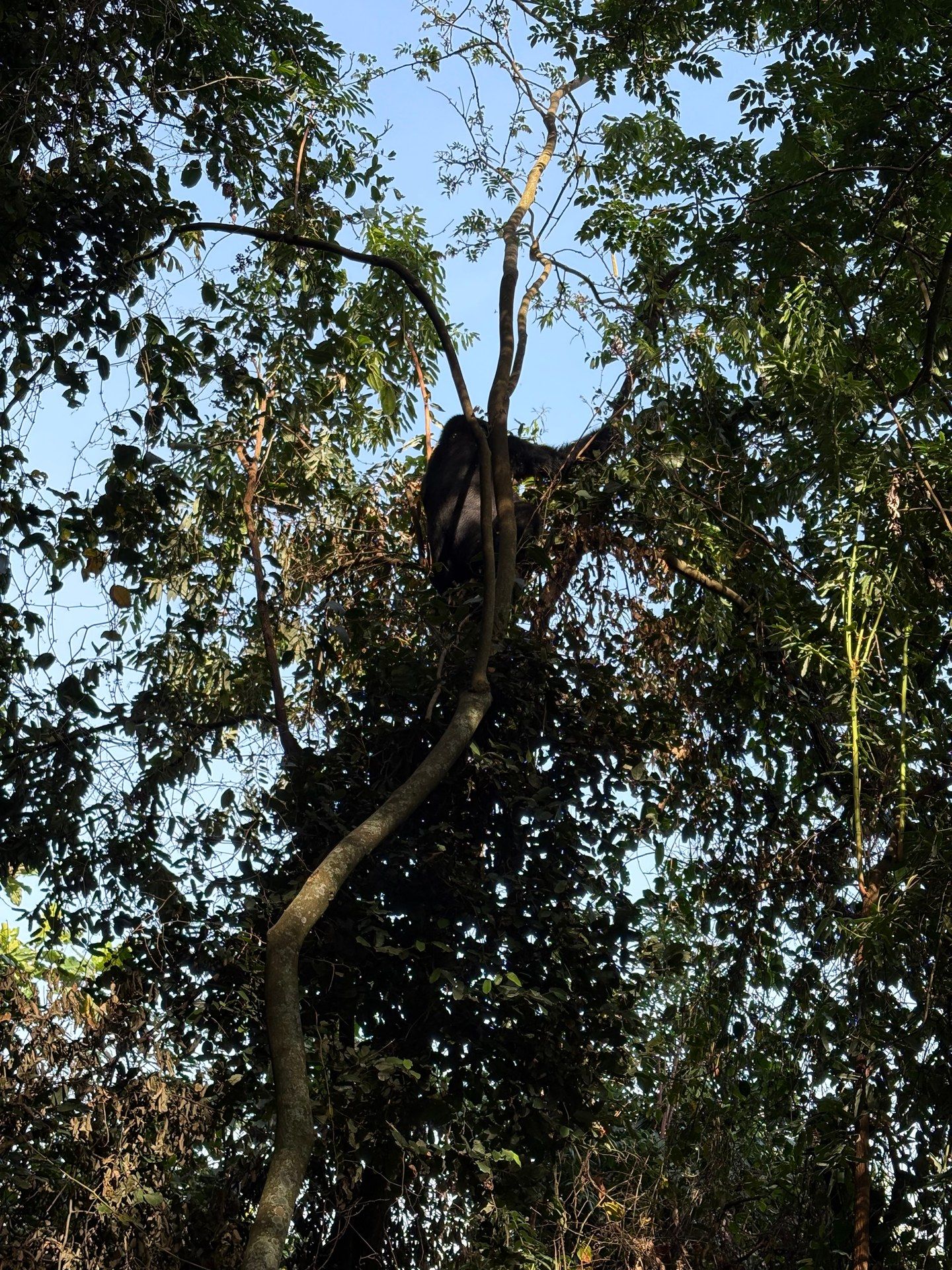
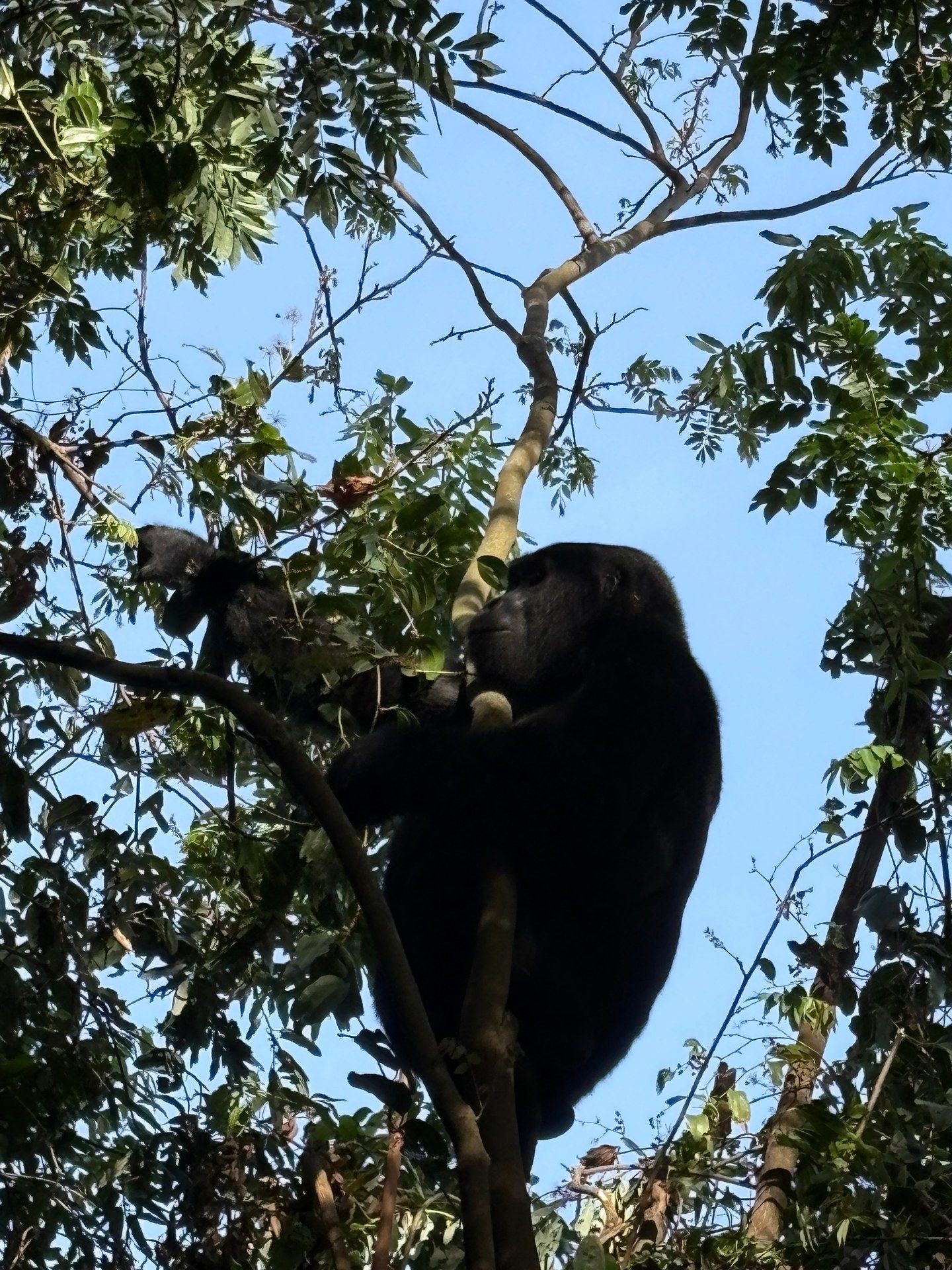
On my January 2026 trek from Buhoma, we were accompanied by one tracker-guide and two armed rangers — standard escort for all permitted groups entering Bwindi. The rangers carry firearms for general wildlife safety in a forest that contains elephants, buffalo and other large mammals, not for gorilla-specific concerns. Both rangers were confident and helpful on the difficult sections of the trail, guiding footing on root crossings and steep descents with the matter-of-fact ease of people who do this every morning. Within an hour of the gate, the tracker stopped, pointed upward, and a large male gorilla was sitting in the branches above us, pulling leaves from a branch without any apparent awareness that eight humans had just stopped beneath him to stare.
That image — a gorilla eating breakfast in a tree, entirely unbothered — is a more accurate picture of the trekking experience than the dramatic face-to-face encounter that most promotional materials show. Habituated gorilla families are accustomed to a daily visit from a group of humans and treat that visit with indifference. You are not approaching a wild animal that must be cautiously coaxed into tolerance. You are visiting a community that has decided you are irrelevant, and that decision is what makes the encounter so extraordinary.
The Mountain Gorilla Population: Why Uganda and Rwanda Share the Responsibility
According to Uganda Wildlife Authority (UWA) census data, Uganda's mountain gorilla population stood at 459 individuals during the 2018–2020 survey period. Mountain gorillas exist only in two locations on earth: Bwindi Impenetrable National Park in Uganda, and the Virunga Massif — a chain of volcanic mountains shared between Uganda, Rwanda and the Democratic Republic of Congo. The Bwindi population and the Virunga population are genetically distinct subgroups; they do not interbreed and range across separate territories.
Both Uganda and Rwanda, through their respective park agencies and the transboundary Virunga Conservation Area agreement, are responsible for protecting the same overall population. A gorilla permit bought in Uganda funds UWA ranger salaries, veterinary programmes and community revenue-sharing mechanisms at the Bwindi boundary. A gorilla permit bought in Rwanda funds equivalent work by the Rwanda Development Board. The tourism is not competitive — it is co-dependent. Neither country's gorilla families would survive without both countries' conservation investments, and without the permit revenue that funds those investments.
This shared ecology is why the Uganda-vs-Rwanda question is less a competition and more a logistical choice. The gorillas do not know which side of the border they are on. The difference is entirely in the human infrastructure around them: the road to the gate, the lodge at altitude, the permit price, the language at the briefing.
Leonard Sharp and the Region's Longer History
The south-western Uganda landscape around Bwindi and the nearby Lake Bunyonyi carries a history of purposeful, conservation-minded engagement with its terrain that predates gorilla tourism by several decades. In 1921, Leonard Sharp — a Scottish missionary and physician — established a hospital for people with leprosy on Bwama Island in Lake Bunyonyi, using the island's natural isolation as both a medical tool and a form of social protection for patients excluded from mainland communities. Sharp's institution was, in a different register, an early exercise in the same logic that drives community-owned lodges and conservation tourism today: the landscape as a resource that generates benefit when managed with care and restraint.
Uganda — Bwindi's Four Sectors and Their Lodges
Uganda's gorilla trekking is concentrated in Bwindi Impenetrable National Park, a 331-square-kilometre forest reserve in south-western Uganda covering Kanungu, Kisoro and Kabale Districts. The park has four designated gorilla trekking sectors, each with its own gate, habituated gorilla families and accommodation cluster. Lodges in Bwindi consistently record among the highest occupancy rates of any accommodation category in Uganda's tourism sector — a direct reflection of the park's unique status.
Buhoma — The North-West Gateway
Buhoma in Kanungu District is Bwindi's most established gateway, with the widest range of accommodation and the most developed community tourism infrastructure. Gorilla Bluff Lodge, where I stayed in January 2026, was built into the steep hillside above the village — the timber stairs between guest rooms and the main building are themselves a minor feat of mountain construction, fashioned from local materials by hand. Breakfast began with fresh local fruit — mango, banana and melon — served on the room terrace with coffee and African tea before the trek.
Sanctuary Gorilla Forest Camp, also at Buhoma, is the most established luxury property in the sector. Operated under the Sanctuary Retreats brand, it sits at the park boundary with the closest proximity to the Buhoma gate of any permanent accommodation. The camp offers tented suites in a forest-adjacent setting and is the choice for travellers who want Buhoma's convenience combined with a fully serviced luxury experience rather than the more rustic character of the hillside lodges.
Buhoma Community Rest Camp — one of the longest-operating community-owned lodges in Uganda's national park tourism system — remains a benchmark for how local revenue-sharing can be structured in gorilla tourism. Revenues from accommodation and the adjacent cultural trail flow back into the Buhoma village infrastructure rather than to an external owner.
Rushaga — The Habituation Sector
Rushaga, in Kisoro District on Bwindi's southern edge, is the only sector in Uganda offering the Gorilla Habituation Experience permit — a four-hour encounter with a gorilla family currently being habituated to human presence, priced at 1,500 USD per person (verify current UWA pricing before booking). The standard one-hour permit is also available at Rushaga at 800 USD.
Rushaga is also the sector with the closest links to Batwa communities — the forest-dwelling people who lived in Bwindi before the park was gazetted in 1991. Several lodges and community programmes in the Rushaga area facilitate Batwa cultural visits alongside gorilla trekking. Rushaga Gorilla Camp sits close to the Rushaga gate and serves as the primary mid-range accommodation option for this sector. The community relationship management (CRM) programmes operating in Rushaga provide context for travellers interested in the human history of the forest alongside its wildlife.
Ruhija and Nkuringo — High-Altitude Options
Ruhija sits at approximately 2,300 metres on the park's eastern edge — the highest of the four sectors — and is served by Ruhija Gorilla Safari Lodge, operated by Asyanut Safaris. It is the least visited sector, with smaller group sizes and exceptional birding alongside the gorilla trekking. Nkuringo, at the southern end of the park, features Clouds Mountain Gorilla Lodge above 2,000 metres — Uganda's highest permanent lodge, operated by Wildplaces Africa in partnership with the African Wildlife Foundation (AWF). The physical demands of a Nkuringo trek are the highest of the four sectors; the views from the ridge across the Virunga volcanic chain on a clear morning are the reward.
Rwanda — Volcanoes National Park and the Case for Going Next Door
Rwanda's gorilla trekking is centred on Volcanoes National Park in the north-west of the country, covering the Rwandan section of the Virunga Massif. The park protects a distinct mountain gorilla population from Uganda's Bwindi families — these are the Virunga gorillas, whose range extends across the Rwandan, Ugandan and DRC sections of the volcanic chain. Multiple habituated families are available for trekking through the Rwanda Development Board's permit system.
The logistical case for Rwanda is primarily about accessibility. Kigali International Airport is approximately two hours by road from the Volcanoes National Park entrance, making a same-day arrival-and-trek-the-following-morning itinerary feasible without an overnight road transfer of the kind Uganda requires from Kampala (eight to nine hours to Bwindi). Rwanda is also one of the highest-visited countries in East Africa — it was the second most visited country in the region by international arrivals in recent pre-pandemic data — and the infrastructure serving Volcanoes National Park reflects that investment: well-maintained roads, a concentrated cluster of premium lodges in the foothills and a briefing system that runs with consistent efficiency.
The terrain in Volcanoes National Park is different from Bwindi. The Virunga volcanoes rise steeply from agricultural foothills, and the approach to the forest boundary crosses open farmland before the ascent begins. Once inside the forest, the gradient increases sharply, but the overall trek is generally considered less physically demanding than Bwindi's Nkuringo or Ruhija sectors. Buhoma is broadly comparable in physical demand to a moderate Volcanoes trek.
The permit price in Rwanda is significantly higher than Uganda's 800 USD. That price difference, combined with Rwanda's generally higher accommodation costs, means that an equivalent multi-night gorilla trekking itinerary will cost substantially more in Rwanda than in Uganda. For travellers whose primary objective is the gorilla encounter at the most accessible price point, Uganda is the clear choice.
Rwanda's advantage is the broader context it offers. Kigali is a consistently well-organised city with strong infrastructure, and the combination of Volcanoes gorilla trekking with Kigali's cultural offerings, Lake Kivu and the Nyungwe Forest chimpanzee trekking makes a Rwanda itinerary cohesive in a way that Uganda's geography — more spread out, requiring longer road transfers between attractions — sometimes is not. Travellers doing both countries on a single trip typically find the combination more satisfying than either country alone.
Uganda vs Rwanda — Side-by-Side Comparison
The table below summarises the practical differences based on first-hand visits to Uganda (January and June 2026) and published official sources. Rwanda pricing and policy items are marked where current verification is required.
| Factor | Uganda (Bwindi) | Rwanda (Volcanoes) |
|---|---|---|
| Gorilla permit | 800 USD (UWA 2026) | Set by Rwanda Development Board — confirm current price |
| Trekking sectors | 4 (Buhoma, Rushaga, Ruhija, Nkuringo) | 1 (Volcanoes NP) |
| Transfer from capital | 8–9 hrs Kampala to Bwindi | ~2 hrs Kigali to Volcanoes gate |
| Permitted encounter time | 1 hour (standard); 4 hrs habituation experience (Rushaga only) | 1 hour |
| Terrain difficulty | Moderate–demanding (Buhoma) to very demanding (Nkuringo, Ruhija) | Moderate |
| Lodge price range | Community camps to luxury; widest range of any gorilla destination | Premium-heavy; fewer budget options |
| Gorilla population type | Bwindi subgroup (genetically distinct) | Virunga subgroup |
| Best combined itinerary | Bwindi + Queen Elizabeth NP + Murchison Falls NP | Volcanoes NP + Kigali + Lake Kivu + Nyungwe |
Rain, Distance and the Practical Questions
What Happens If It Rains?
Gorilla trekking in both Uganda and Rwanda proceeds regardless of weather. Uganda Wildlife Authority does not cancel or postpone permitted treks due to rain, and in a tropical montane forest that receives rainfall year-round, cancelling on that basis would be unworkable. What rain does change is the trail conditions. Bwindi's clay soils become slippery within minutes of rainfall beginning, and the descent — which is already a physical event on a dry day — becomes considerably more demanding. Trekking poles, waterproof boots and a grip that does not trust any surface unconditionally are the practical requirements.
The gorilla families themselves tend to seek shelter in denser vegetation during heavy rain. This means the tracker-guides may take longer to locate the family, as the animals move into cover that reduces visibility. The permitted one-hour encounter begins once the family is located, not when the group enters the forest, so a delay due to rain does not reduce the encounter time. It does, however, extend the overall trek duration.
The practical kit for a rain-scenario trek: waterproof jacket or poncho (pack in your day bag, not in the lodge), waterproof bag cover for camera and phone, gaiters or high waterproof boots, a change of dry clothes and socks at the lodge for the return. January in Bwindi during my 2026 visit was predominantly dry in the mornings with cloud building through the afternoon — the forest was wet underfoot from previous rain but the trek itself was in dry conditions.
How Close Do You Actually Get?
The official minimum distance from any gorilla is 7 metres, enforced by the ranger-guides on both the Uganda and Rwanda sides. In practice, this rule describes the floor of a trekking group's approach — it does not constrain the gorillas. Habituated families move freely, and individuals cross through human groups without detour. On the January 2026 Buhoma trek, a silverback walked directly across the group's path at a distance of approximately one arm's length. No one moved; the ranger did not intervene; the silverback continued at the same pace and disappeared into the undergrowth.
Juveniles are even less constrained — they approach out of what appears to be straightforward curiosity, and the guides' practical task during these moments is to ensure the human group does not reach toward them or otherwise provoke a protective response from the adults. The protocol is: stay still, do not make eye contact with a silverback that is looking directly at you, and follow the guide's instructions if the ranger signals a threat posture.
In terms of photographic distance: a 70–200mm lens on a full-frame camera will fill the frame with a gorilla's face at seven metres. At the distances that actually occur during a typical trek, a 50mm lens is often sufficient. The quality of the light in the forest — filtered, variable, often backlit — is the more challenging photographic variable, not the distance to the subject.
Getting to Bwindi — The Uganda Road Context
The eight-to-nine-hour road journey from Kampala to Bwindi is the most common practical objection to choosing Uganda over Rwanda. It is a genuine consideration — the road from the capital to the south-west passes through Masaka and Mbarara on tarmac before transitioning to unpaved sections near the park boundary, and the final approach to the Buhoma gate is a mountain road that rewards a 4WD vehicle in any weather. Uganda's road network has been improving significantly; the main southern route is substantially better than it was a decade ago. On a side trip from western Uganda in October 2024, the contrast between the improved main highway and a local truck transport route was striking — overloaded vehicles carrying cargo three times their stated capacity are a common feature of rural Uganda's informal logistics, both a testament to practical resourcefulness and a reminder that road infrastructure outside the main corridors remains variable.
Summary
Uganda offers gorilla trekking at 800 USD per permit across four distinct sectors, with the widest range of accommodation from community-owned camps to high-altitude luxury lodges, and terrain that makes the physical journey part of the experience. Rwanda offers shorter access from Kigali, a more compact itinerary and a different gorilla subpopulation in a less demanding forest. Trekking proceeds in rain in both countries; the gorillas do not honour the 7-metre rule. The choice between them is logistical and financial rather than experiential — the encounter with a habituated mountain gorilla is comparable in quality regardless of which side of the border it takes place on.
Frequently Asked Questions
Is gorilla trekking better in Uganda or Rwanda?
+
Both offer access to the same mountain gorilla species in a shared ecosystem. Uganda (Bwindi) has four trekking sectors, a wider accommodation range and a permit priced at 800 USD (2026). Rwanda (Volcanoes National Park) offers shorter transfers from Kigali and a more compact itinerary but at a higher permit cost. The encounter quality is comparable; the choice is primarily logistical and financial.
How close do you get to the gorillas?
+
The official minimum distance is 7 metres. In practice, habituated gorilla families move freely through the human group — silverbacks, juveniles and mothers with infants cross within 1–2 metres regularly. During a January 2026 Buhoma trek, a silverback crossed directly in front of the group at approximately arm's length. The rule constrains the group; it does not constrain the gorillas.
What happens if it rains during gorilla trekking?
+
The trek proceeds regardless. Rain makes Bwindi's trails significantly muddier and the descent more demanding. The gorillas may shelter in denser vegetation, which can extend the search time — but the permitted one-hour encounter starts when the family is found, not when the group enters the forest. Waterproof boots, trekking poles and a poncho are the practical essentials for a rain day.
Which Bwindi sector is best for gorilla trekking?
+
Buhoma is the most accessible and established. Rushaga is the only sector offering the 4-hour Gorilla Habituation Experience (1,500 USD). Ruhija is the highest (~2,300m) and least visited, with excellent birding. Nkuringo is the most demanding terrain-wise but offers the highest-altitude lodges including Clouds Mountain Gorilla Lodge. There is no universally "best" sector — the right choice depends on physical fitness, budget and how much terrain difficulty you want as part of the experience.
What lodges are near the Rushaga gorilla trekking gate?
+
Rushaga Gorilla Camp is the primary mid-range accommodation option close to the Rushaga sector gate in Kisoro District. The sector has a growing number of lodge options at different price points. Several properties also facilitate Batwa cultural visits, which are distinctive to this sector given the history of Batwa communities in the Bwindi forest area. See the Rushaga Gorilla Camp lodge page for current pricing and availability.