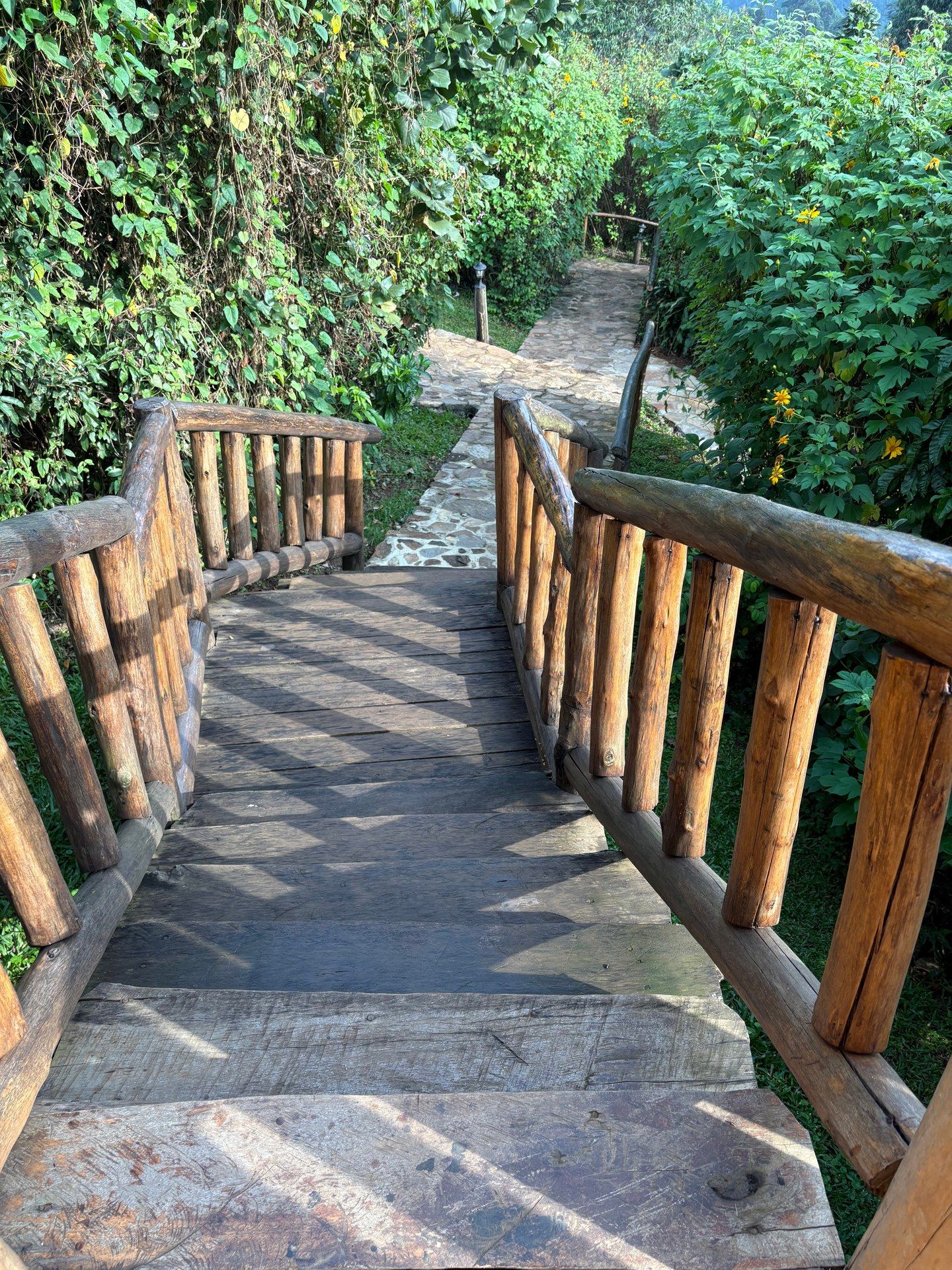
The stairs at Gorilla Bluff Lodge in Buhoma do not announce themselves. They emerge from the hillside when you come around the corner from the room — split timber posts driven into the mountain at angles decided by the slope rather than any blueprint, connecting the guest accommodation to the main lodge building across a gradient that is steep enough to require both hands on the railing on a wet morning. During our January 2026 stay, the first and last act of every day at Gorilla Bluff Lodge was navigating those stairs. They were a minor physical engagement — nothing like the trek itself — but they established the basic truth about this lodge from the first afternoon: it was built on the mountain, not beside it.
That is the appropriate orientation for a lodge whose guests are spending the following morning in the Bwindi Impenetrable National Park, a 331-square-kilometre forest reserve whose name is descriptive rather than metaphorical. The terrain around Buhoma in Kanungu District is unrelentingly vertical — roads switchback up and down ridges, the village is stacked across a hillside, and the park entrance itself sits at a point where the managed landscape gives way, abruptly, to something that has been resisting clearance for centuries. Staying at a lodge built into that hillside is not simply about proximity to the trekking gate. It is, in its own modest way, an introduction to the physical logic of the place.
This guide is drawn from multiple days in Buhoma in January 2026 and a return visit in June 2026, and from a broader familiarity with Uganda's south-western travel corridor built across several trips since October 2024. All photographs referenced here were taken on location by Mark Suer, with GPS coordinates confirming the Buhoma area (approximately -0.979°N, 29.617°E for the lodge, -0.976°N, 29.628°E for the trekking terrain). It covers the gorilla permit system, what the trek involves from gate to encounter, the lodges that serve each sector, and the community activities in Buhoma that justify an extra day before or after the trek.
The Trek — Gate, Ranger, Family and That First Hour
Each gorilla trekking day at Buhoma begins at the sector gate at approximately 08:00 with a briefing. The tracker-guide covers the distance expectation for the morning — which is genuinely uncertain because the gorilla families move through the park overnight and the starting point of each day's trek is set by where the trackers found them that morning — and the rules of engagement: groups capped at eight visitors per family, minimum distance of 7 metres from any gorilla, no flash photography, masks worn throughout the encounter, and a clear instruction to turn away and suppress coughs or sneezes within the family's proximity. Mountain gorillas are susceptible to human respiratory infections; that protocol exists because previous disease transmission events have killed individuals.
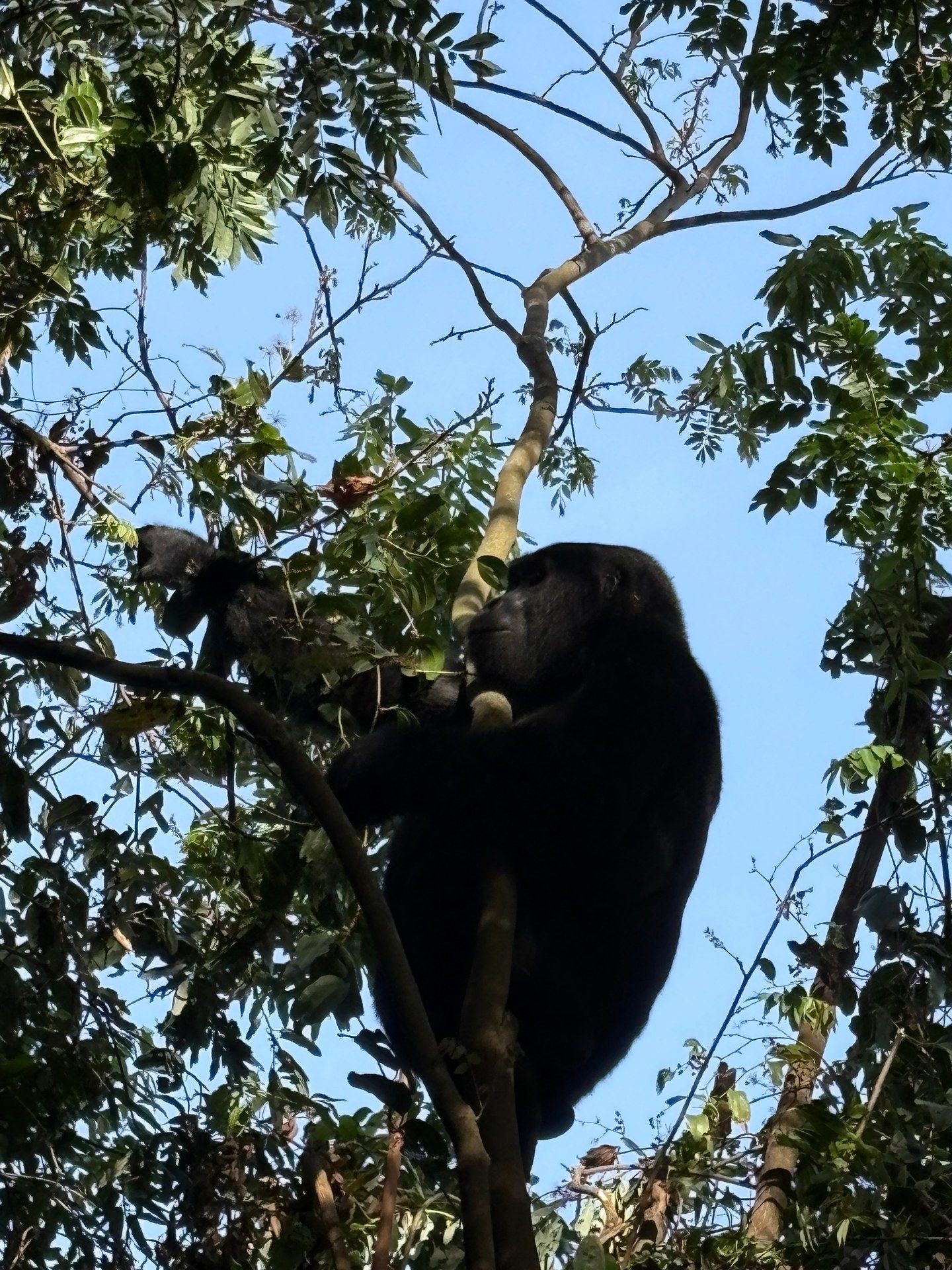
On our first trek from Buhoma in January 2026, the briefing was followed by an entry into the forest that took less than an hour before the tracker stopped, raised a hand and pointed upward. A large gorilla was sitting in the upper branches of a tree, working through a cluster of leaves with methodical patience, and utterly indifferent to the eight people standing below him with cameras raised. That gorilla — eating in a tree in the morning light filtering through the canopy, GPS approximately -0.9735°N, 29.6281°E — was the first visual confirmation that what the briefing had described was real and was happening now. The permitted hour began.
On a second trek later in the same visit, the walk to the gorilla family took closer to three hours. The forest in the Bwindi Impenetrable National Park does not accommodate comfortable forward progress — the vegetation is dense enough to close the path behind you, the gradient shifts between steep ascent and steep descent without transition, and any sense of orientation by sight alone is quickly lost. The tracker-guide navigated without apparent effort; following him required a different kind of effort. When we reached the family after roughly three hours, the encounter was one of the closest of either trek — the family was peaceful, settled in a small clearing, and several individuals moved through the group at distances of 2 to 3 metres without any anxiety on the gorillas' part or, after a few seconds of adjustment, on ours.
The two armed rangers who accompanied both treks were an element of the experience that, on first encountering it, seemed slightly incongruous — armed escorts for what is advertised as a wildlife encounter rather than a security operation. In practice it was entirely unremarkable within a few minutes. The rangers carry firearms because Bwindi contains large mammals other than gorillas, including elephant and buffalo, and a forest encounter with either in confined terrain is a different category of risk than an encounter in open savannah. Beyond their security function, the rangers were practically helpful on the difficult sections — guiding footing on root crossings, steadying trekkers on the descent, and managing the group's movements around the gorilla family with the quiet authority of people who have done this every morning for years.
The 7-metre minimum distance rule is observed as a floor for the trekking group's approach, not as a fence that contains the gorillas. Habituated families cross through and around the group freely. A silverback that is looking directly at you is not an invitation to make eye contact; the guide's instruction is to look away and hold still. The gorillas' indifference to human presence is the product of the habituation process — a multi-year programme of daily contact conducted by park staff to accustom specific families to human proximity before they are opened to tourist visits. It is a deliberate management outcome, not an innate characteristic of the animals, and it is why both Uganda and Rwanda invest in it so persistently: a habituated family is the entire economic basis of the permit system.
Gorilla Trekking at a Glance
The Mountain Gorilla Population — Numbers, Conservation and History
Uganda's mountain gorilla population stood at 459 individuals during the 2018–2020 census period, according to Uganda Wildlife Authority data. Mountain gorillas exist in only two distinct locations on earth: Bwindi Impenetrable National Park and the Virunga Massif, the chain of extinct and semi-active volcanoes shared between Uganda, Rwanda and the Democratic Republic of Congo. These two populations — the Bwindi gorillas and the Virunga gorillas — are genetically distinct subgroups that do not interbreed. Bwindi Impenetrable National Park sits approximately 50 kilometres north of Mgahinga Gorilla National Park, which protects the Ugandan section of the Virunga range. The Bwindi population of approximately 400 individuals constitutes the larger of the two groups.
The conservation status of mountain gorillas has improved significantly over recent decades, from a population nadir in the 1980s when the total number was estimated below 300 individuals. That recovery is attributed to a combination of factors: the habituation and tourism system that gives governments and communities an economic stake in the gorillas' survival; anti-poaching enforcement by Uganda Wildlife Authority rangers; and veterinary intervention programmes that treat injured or sick individuals. Organisations including the African Wildlife Foundation (AWF) — which partners with Wildplaces Africa at the Nkuringo sector's Clouds Mountain Gorilla Lodge — have contributed funding and technical support to conservation work across Bwindi. The German conservation organisation Berggorilla- und Regenwalddirekthilfe e.V. has maintained a specific focus on eastern and mountain gorilla protection for several decades, supporting ranger training and community engagement in the Bwindi area.
The Nkuringo Bwindi Gorilla Lodge works with the Uganda Carbon Bureau on carbon-offset programmes linked to the forest conservation activities around the park boundary. This represents a relatively recent axis of lodge-level sustainability — not just restricting the lodge's own footprint but using the financial structure of carbon markets to support the forest that gives the lodge its entire reason for existing.
Rwanda has the second-highest visitor numbers in East Africa for gorilla trekking — its Volcanoes National Park in the north-west of the country provides access to the Virunga gorilla population. The two countries' permit systems are separate but the animals they protect are part of the same biological system. A detailed comparison of Uganda and Rwanda gorilla trekking — including logistics, terrain and lodge options on the Rwanda side — is covered separately in our Uganda vs Rwanda gorilla trekking guide.
Leonard Sharp and the Longer Human History of the Region
The south-western Uganda corner — from Bwindi to the nearby Lake Bunyonyi, a high-altitude crater lake at approximately 1,970 metres in the shadow of the Virunga chain — carries a documented history of purposeful human engagement with the landscape that predates modern conservation practice by a century. In 1921, Leonard Sharp, a Scottish missionary and physician, established a hospital for leprosy patients on Bwama Island in Lake Bunyonyi. The island's natural isolation made it simultaneously a practical medical environment and a form of social protection for patients who faced severe stigma on the mainland. Sharp's institution used the geography — the water barrier, the elevated altitude, the distance from population centres — as a tool in service of the people he was treating. That logic — the landscape as a resource that benefits when managed with restraint and care — runs through the conservation and community tourism thinking that now defines the Bwindi area, though the parallel is rarely made explicit.
Lodges in Bwindi — Sector by Sector
Lodges in the Bwindi area consistently record among the highest occupancy rates of any accommodation category in Uganda — a reflection of the park's unique status as the only destination of its kind in the country and one of only two in the world. There are four trekking sectors, each with its own concentration of accommodation, each different in character and physical demand.
Buhoma — The North-West Gateway
Buhoma in Kanungu District is Bwindi's most established entry point and the sector with the widest range of accommodation and community activity infrastructure. The trekking gate, the community rest camp and several private lodges sit within a compact area on the park's north-western edge. The approach road from Kihihi switchbacks down into the valley and up the other side; arriving after dark is inadvisable if you do not know the final section.
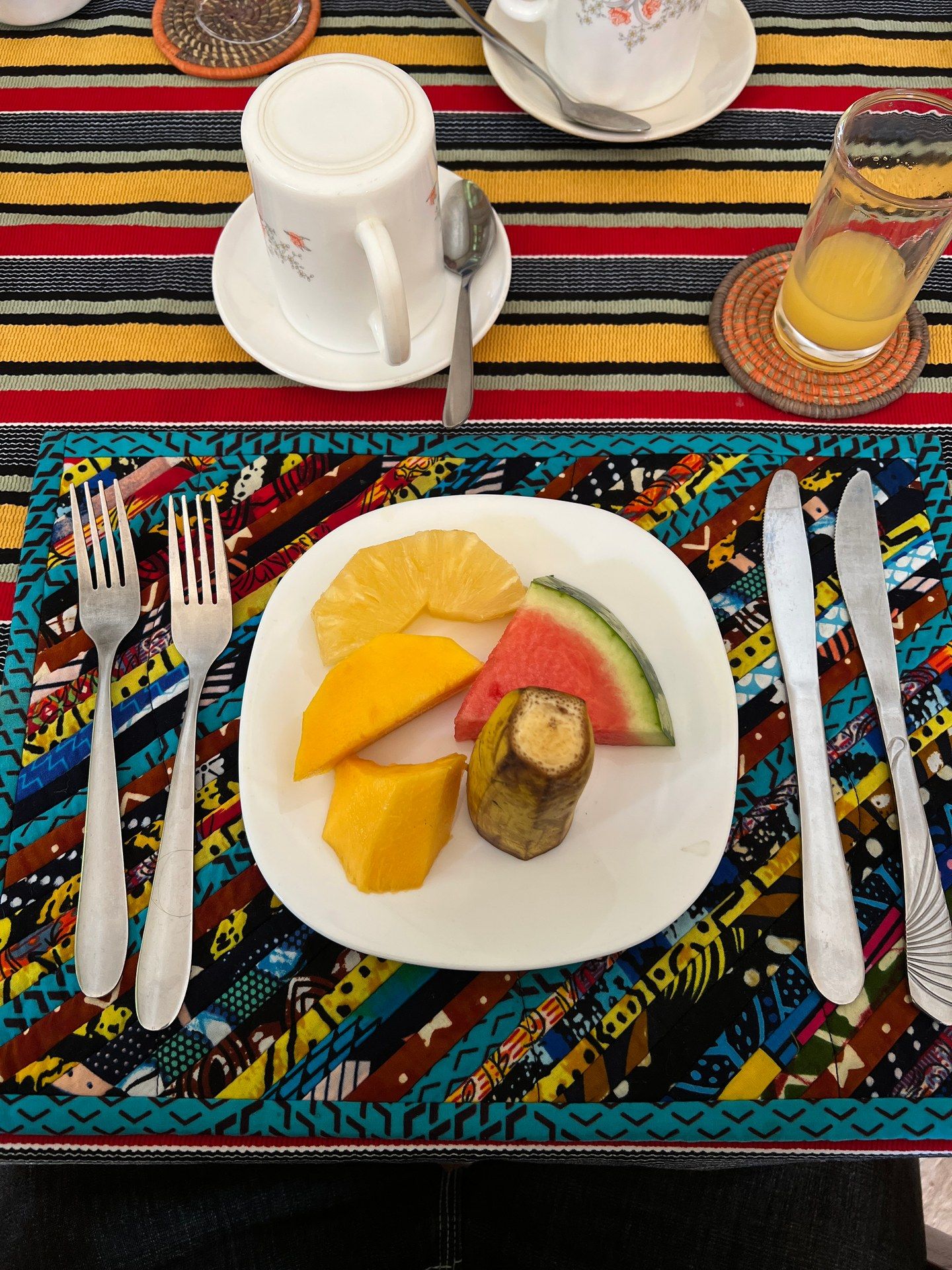
Gorilla Bluff Lodge occupies a hillside above the Buhoma village, built into the terrain at what is clearly a gradient that any conventional building method would have avoided. Each guest room has a private terrace facing the forested valley below. Every morning of our January 2026 stay, we began the day on that terrace with coffee and African tea — a ritual that the lodge delivers before the trek, and which continues whether you are trekking that day or not. The terrace, the morning coffee and the unobstructed view of the canopy below (GPS -0.979°N, 29.617°E) make the early-morning start psychologically easier than it would otherwise be. Breakfast followed the coffee: fresh local fruit — mango, banana and melon — served on the terrace before the walk to the gate.
Sanctuary Gorilla Forest Camp, operated under the Sanctuary Retreats brand (Abercrombie & Kent), is the most established luxury property in Buhoma and the closest permanent accommodation to the sector gate. Its tented suites are positioned at the forest boundary, and the camp's long operational history at Buhoma means its guides have an accumulated familiarity with the sector's gorilla families and terrain that few competitors can match.
Buhoma Community Rest Camp, one of Uganda's longest-operating community-owned lodges, sits at the park boundary and returns accommodation revenue directly to the Buhoma village rather than an external owner. It offers several room categories from budget bandas to more comfortable en-suite options, and the adjacent community trail provides a structured introduction to the village that many guests combine with the trek on consecutive days.
Rushaga — The Habituation Sector
Rushaga in Kisoro District on Bwindi's southern edge is the only sector where the Gorilla Habituation Experience permit is available — a four-hour stay with a family currently being introduced to human presence, priced at 1,500 USD per person (verify with UWA before booking; pricing subject to change). The standard one-hour permit is also bookable at Rushaga at 800 USD.
Rushaga has a different social character from Buhoma. The sector is home to Batwa communities — the Batwa are the forest-dwelling people who lived in Bwindi Impenetrable National Park before its gazettal in 1991 and whose relationship with the forest and with the conservation system that displaced them is complex and ongoing. Several lodges and NGOs in the Rushaga area facilitate cultural visits and community engagement programmes alongside the gorilla trekking, and a number of the sector's community revenue management (CRM) structures are among the more developed in Bwindi. Rushaga Gorilla Camp is the primary mid-range accommodation option for this sector, located close to the trekking gate.
Nkuringo and Ruhija — High-Altitude and Remote
Nkuringo at Bwindi's southern boundary is the most physically demanding sector. The descent from the ridge to the park floor and the climb back out are both steep enough that Nkuringo treks are routinely described as the hardest of the four sectors. Clouds Mountain Gorilla Lodge sits above 2,000 metres on the ridge, operated by Wildplaces Africa in partnership with the African Wildlife Foundation. It is the highest-altitude permanent lodge in Uganda. The views from its position above the Virunga volcanic chain on a clear morning are among the most dramatic in East Africa. On the other side of the park, Ruhija in the north-east at approximately 2,300 metres is the least visited sector, with smaller group sizes, exceptional montane forest birding and Ruhija Gorilla Safari Lodge — a rustic property with double rooms and timber cottages operated under the Asyanut Safaris umbrella. Ruhija is the choice for travellers who want the gorilla trek combined with a genuinely off-the-main-track experience.
Buhoma Beyond the Trek — Ride 4 a Woman and Community Activities
An additional day in Buhoma before or after the gorilla trek is not wasted. The village adjacent to the Bwindi park entrance has developed, over the three decades since gorilla tourism took hold, a set of community-run activities that reflect both what the landscape offers and the needs of the communities that live alongside it.
Ride 4 a Woman is the most distinctive of these. Founded in Buhoma in 2009, the organisation runs guided mountain bike tours on trails around the community and through the landscape immediately adjacent to the park boundary. What makes it unusual is its business model: income from bicycle tourism funds skills training and vocational education programmes for local women. The bikes are a vehicle — literally and structurally — for channelling visitor spending directly into a programme that builds long-term economic capacity for women in the community.
The logic behind Ride 4 a Woman is the same logic that underlies the entire gorilla tourism system at a larger scale: if the forest has economic value to the people who live beside it, those people have a reason to protect it. The gorilla permit fee of 800 USD, of which a percentage flows into community revenue programmes around the park boundary, funds ranger salaries, veterinary support and infrastructure investments that conservation budgets alone could not sustain. Ride 4 a Woman extends that logic further — making the landscape around the park, not just the gorillas inside it, economically productive for the community.
The Buhoma Community Trail — a guided walk through the village and its surrounding farms with stops at community enterprises and cultural demonstrations — is the most commonly visited community activity in the sector, typically run by Buhoma Community Rest Camp's staff and returning revenue to the same community trust. It is also the quickest way to understand what Buhoma actually is beyond the lodge cluster: a working agricultural community whose residents live adjacent to one of the most valuable wildlife habitats in the world, and who have negotiated, over three decades, a complicated but generally improving relationship with the conservation system that protects it.
Getting to Bwindi — What the Road from Kampala Actually Looks Like
The road from Kampala to Bwindi takes between eight and nine hours under normal conditions — longer after heavy rain on the final section, which is unpaved. The route south-west from Kampala runs through Masaka and Mbarara on well-maintained tarmac before turning towards Kabale and eventually descending to Buhoma on a mountain road that rewards a 4WD vehicle in any weather and requires one in wet conditions. The final kilometre or two to the lodge cluster at Buhoma is steep enough that guest vehicles occasionally need assistance in the rainy season.
That eight-to-nine-hour road transfer is the most common practical objection to choosing Uganda over Rwanda for gorilla trekking — Rwanda's Kigali is approximately two hours from Volcanoes National Park's entrance. It is a real difference. It is also, for many travellers, part of the experience. The road south-west from Kampala passes through agricultural landscapes that shift progressively as the altitude increases — eucalyptus plantations give way to banana groves, tea terraces and eventually the montane vegetation of the south-west that announces the approach to Bwindi.
A consistent feature of Uganda's main road corridors, observed across multiple journeys since October 2024, is the creative logistics practised on secondary routes and trading roads. On a drive along a well-surfaced highway in western Uganda, the most visually arresting thing was not the landscape but a minibus carrying a load of mattresses and household goods stacked to twice the vehicle's own height on the roof rack, travelling at steady road speed and apparently entirely stable. It was an image that a European or North American traveller would find surprising and someone who moves freight regularly in rural Uganda would find entirely ordinary. That gap in perspective — between what looks improvised and what is in fact a well-practised and effective system — is a useful frame for arriving in Bwindi with appropriate expectations.
The most practical approach to the Bwindi road transfer is an overnight stop in Kabale — Uganda's highest town, at approximately 1,890 metres — which breaks the journey into two manageable segments and allows an early-morning final drive of roughly two hours to Buhoma or Rushaga. There is a direct flight option from Kampala's Kajjansi airstrip to small airfields near the park (approximately 1 hour), which is the standard approach for short itineraries and high-budget travellers. Ground transfer, however, provides a more complete picture of Uganda than a flight can.
Frequently Asked Questions
How much does a gorilla trekking permit cost in Bwindi in 2026?
+
A gorilla trekking permit in Bwindi costs 800 USD per person per day (Uganda Wildlife Authority, 2026). Permits for the Gorilla Habituation Experience — a four-hour encounter available only at Rushaga — cost 1,500 USD. Both require advance booking through UWA or a licensed operator. Always verify current pricing directly with UWA before booking; prices are reviewed periodically.
What do the rangers do during gorilla trekking in Bwindi?
+
Each trekking group is accompanied by one tracker-guide and two armed rangers. The firearms are a general wildlife safety precaution — Bwindi contains elephant and buffalo — not a gorilla-specific measure. In practice, the rangers are actively helpful during the trek: assisting on difficult terrain, managing the group's position around the gorilla family and guiding the encounter timing. Both rangers during our January 2026 Buhoma treks were skilled on difficult sections and clearly familiar with the terrain.
Is Gorilla Bluff Lodge in Buhoma good for gorilla trekking?
+
Gorilla Bluff Lodge is well positioned for trekking from the Buhoma gate, approximately 10–15 minutes' walk away. The lodge is built directly into the mountain — moving between rooms and the main building involves steep timber-and-earth stairs, which is part of the experience rather than an inconvenience. Private terraces have forest views; morning coffee and African tea are served before the trek. Fresh local fruit (mango, banana, melon) makes up the early breakfast.
What is Ride 4 a Woman in Buhoma?
+
Ride 4 a Woman is an NGO founded in Buhoma in 2009. It runs guided mountain bike tours around the community adjacent to Bwindi and uses the income to fund vocational training and skills programmes for local women. It is a practical example of how gorilla tourism's economic pull can be channelled into community benefit beyond the permit fee itself.
What is the best time of year to go gorilla trekking in Bwindi?
+
Gorilla trekking proceeds year-round regardless of weather — UWA never cancels treks due to rain. The drier seasons (June to September and December to February) offer firmer trails and easier descents. Our January 2026 Buhoma visit found trails muddy in places but manageable with waterproof boots. The wetter months (March–May and October–November) mean heavier underfoot conditions but also lower permit demand. The gorillas are present in the forest year-round.