
Lodges in Bwindi National Park: How Your Accommodation Choice Shapes What Tourism Does Here
By Mark Suer — updated July 2026 — based on personal visits to Buhoma in October 2024, January 2026, and June 2026
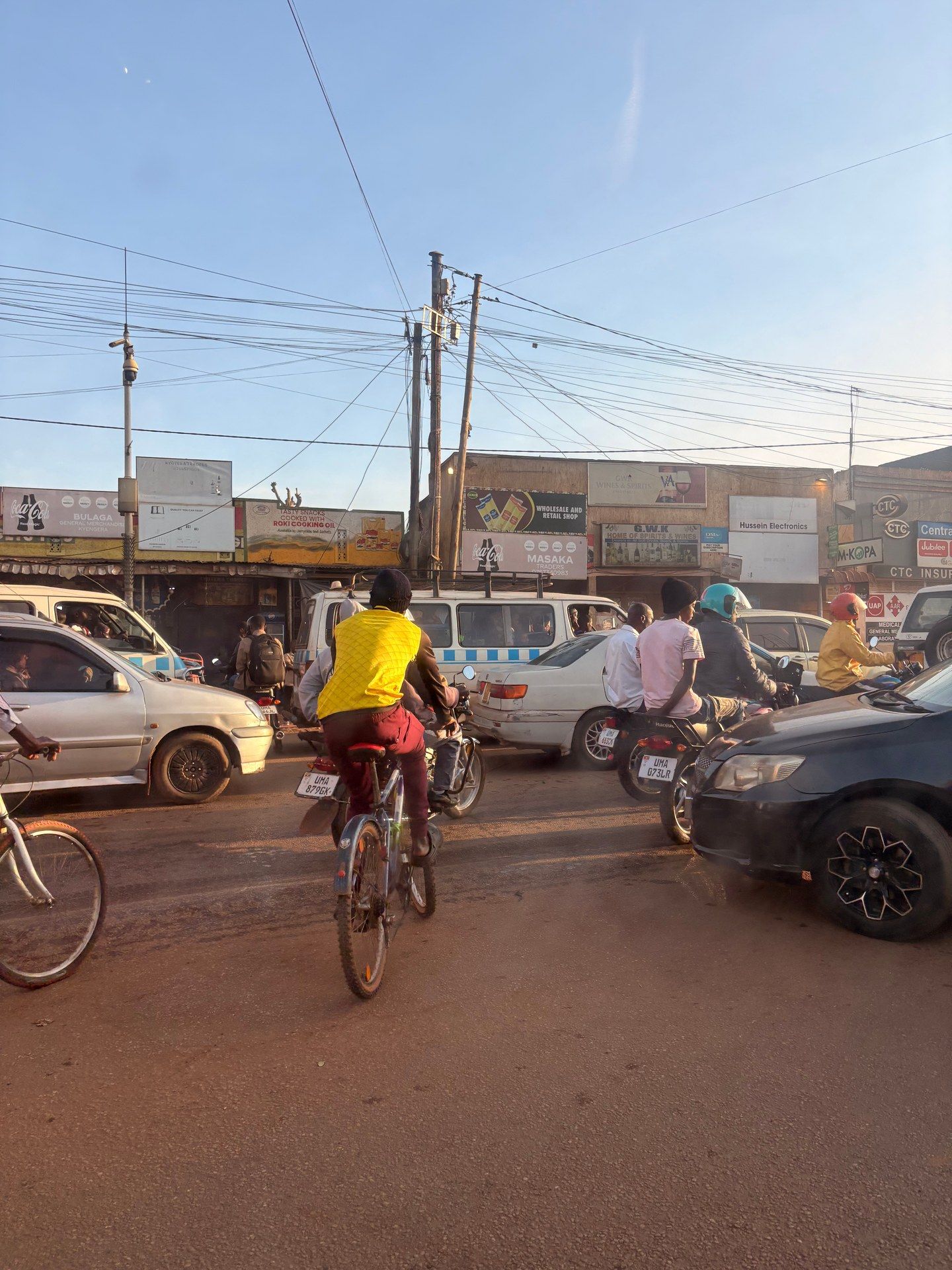
The first hour after landing at Entebbe is an immediate education in Uganda's scale and pace. You are collected from the arrivals hall and drive directly through Kampala. The road passes through dense traffic where boda-boda motorcycles, minibuses, and pedestrians all occupy the same space with apparent fluency. On the roadside, small stands and shops line every stretch — corrugated iron, painted signage, open fronts, people conducting business in the space between the road and the buildings. It is not chaotic in the way the word implies disorder; it is dense in the way of a city that has grown faster than its formal infrastructure and improvised effectively. I drove through Kampala on an October 2024 arrival and again in January 2026 and May 2026, photographing from the vehicle on each occasion (GPS: 0.2917, 32.4996). Each time, the same impression: enormous energy, minimal waste of space.
The lodges in Bwindi National Park sit at the other end of a seven-to-nine hour drive from that arrival scene, in one of the most biologically significant forest areas on the continent. What connects the two — the density of the capital and the quiet of the mountain forest — is the question of where economic value goes. Uganda's tourism sector generates revenue, employment, and investment across the country, and the decision about which lodge to book at Bwindi is one small but tangible part of how that value circulates. This guide covers what the community and environmental dimensions of lodges in Bwindi National Park actually look like on the ground, based on direct visits to Buhoma across three separate trips.
How Gorilla Tourism Revenue Reaches Communities Around Bwindi
The gorilla trekking permit at USD 800 per person (UWA rate for foreign non-residents, 2026) is the largest single line item in most Bwindi visit budgets, and understanding where that money goes is the foundation for understanding the local economy the lodges in Bwindi National Park operate within. Uganda Wildlife Authority administers the permits and manages the park. A defined share of park revenues is distributed to communities in the immediate border area through the UWA Revenue Sharing Programme — a mechanism that has been part of the park's governance structure since the 1990s, when Bwindi faced significant pressure from farming encroachment and the revenue sharing model was introduced in part to give bordering communities a direct stake in the park's survival.
The revenues fund community projects: schools, health centres, water infrastructure, and roads in the parishes immediately adjacent to the park boundary. What is established is the structural principle: if Bwindi stops being viable as a gorilla trekking destination, the permit fee stream that funds these projects stops. The communities that benefit from it have a direct economic interest in the forest's continued health. That alignment is what makes the Bwindi model one of the more cited examples of conservation finance in East Africa.
Lodges contribute to this ecosystem in a secondary but material way. Every international visitor who stays at a lodge in or around Bwindi National Park generates employment directly — guide, porter, kitchen staff, housekeeping — and indirectly through the supply chains lodges operate. Lodges that source food from local farms, employ staff from Buhoma and surrounding communities, and reinvest a portion of revenue into community infrastructure contribute more to the local economy than those that centralise procurement and staffing outside the immediate area. The difference is not always visible from promotional materials; it requires asking specific questions before booking.
Buhoma: What the Community Around Bwindi's Lodges Actually Looks Like
The village of Buhoma sits at the northern entrance to Bwindi Impenetrable National Park. The main road through the village is a dirt track flanked by small stores, food stalls, and service businesses that have developed to serve both the local population and the flow of tourists coming for gorilla trekking. During a June 2026 visit, we stopped at one of those stores on the main road — a small bench under a makeshift shade cover, cold water sold from a cooler — and sat for twenty minutes in the ordinary rhythm of the village. Boda-boda drivers congregated at a nearby junction; a group of schoolchildren passed on their way uphill; a woman carried a basket on her head in the direction of the market. The tourism infrastructure of Bwindi — the lodges, the park headquarters, the ranger station — runs parallel to this everyday life rather than replacing it, GPS: -0.9673, 29.6145.
Nicholas runs a children's home in Buhoma on a compound a short walk from the park briefing area. He is a pastor, and the home he founded with his wife Media takes in children from the surrounding community who have lost parental care. In January 2026, we visited the compound — a sandy courtyard in front of a low building, with a group of children and teenagers gathered to watch the unusual spectacle of visitors with cameras. Two teenagers posed with the kind of performative confidence that came from understanding they were the subject of the photograph, GPS: 0.9616, 29.6109. The moment was a small one but it captured something specific about Buhoma: the community is not a backdrop to gorilla tourism. It has its own texture — its own pastor, its own children's home, its own rhythms — and the lodges in Bwindi National Park that engage meaningfully with that texture provide something qualitatively different from those that do not.

Several lodges in the Buhoma area have formal or informal connections to the Nicholas home — whether through organising visits as part of community walk activities, through staff who are directly connected to the home, or through lodge-guest donation programmes. The existence of these connections is worth asking about when comparing lodges: a lodge that can point to a specific, named community relationship is demonstrating something that cannot be fabricated for a brochure.
Beyond the orphanage, Buhoma's community economy includes a women's craft cooperative, the Buhoma Community Walk (a guided half-day walk through the village and surrounding farmland that has operated for decades), and the informal market that supplies both local households and lodge kitchens. The most community-embedded lodges in the area treat these not as optional excursions but as structural parts of the guest experience — the afternoon after the morning trek, not the activity you do instead of the trek.
UTB Certification: What Uganda's Lodge Classification System Tells You
The Uganda Tourism Board operates an e-Grading system that classifies accommodation properties against defined standards for facilities, service delivery, and safety. Properties that have undergone the process are assigned a star rating on a scale that runs from one to five stars for hotels and lodges. The system is administered through a digital platform that allows inspectors to assess properties against standardised criteria and generate a classification that operators can display.
The UTB's classification work has included a registration drive that added significant numbers of new facilities to the national register — a process conducted in cooperation with KCCA in Kampala and with regional offices across the country. The coverage is not complete: smaller, newer, or more remote properties — some of which are among the most genuinely community-embedded lodges operating near Bwindi — may not yet have undergone formal classification. The absence of a UTB star rating does not indicate a low-quality operation; it may simply indicate a property that has not prioritised formal classification against a system that was designed primarily for urban and mid-scale properties.
That said, UTB registration and a valid e-Grading classification is a reasonable baseline signal when evaluating lodges you are unfamiliar with. Properties that have been through the process have committed to meeting defined minimum standards and have been assessed against them. For the major lodges in the Buhoma, Rushaga, and Nkuringo sectors that appear consistently in professional safari itineraries, UTB registration is standard.
A practical point worth noting: the inspection criteria for e-Grading include hygiene standards, physical safety (structural integrity, fire safety), staff qualifications, and guest service standards. These criteria apply whether a property is a luxury tented camp or a budget rest camp. A one-star UTB classification at a budget property means the basic inspection thresholds have been met; a five-star classification at a luxury property means a more comprehensive set of standards has been assessed. Both are preferable to no classification, which provides no externally verified baseline at all.
Uganda's UTB also runs the broader Uganda Tourism Development Programme, which aims to position Uganda as a preferred tourism destination and coordinates with the Uganda Investment Authority on attracting new lodge investment to underserved areas. The development of new properties in the southern Bwindi sectors — Rushaga and Nkuringo — reflects this investment environment, where the groundwork laid by the gorilla permit system and the international reputation of Bwindi have created a viable market for new accommodation development.
What to Look For: Choosing Lodges in Bwindi National Park with Community Benefit in Mind
The difference between a lodge that genuinely embeds itself in the local economy and one that presents that claim for marketing purposes is not always obvious from a website or a booking page. The following criteria are practical filters rather than ideological ones — they correlate with community impact that can be verified or at least asked about.
Staff recruitment geography. Lodges that recruit housekeeping, guiding, porter, and kitchen staff primarily from Buhoma and the immediately surrounding parishes contribute directly to local household incomes. This is the single largest economic impact most lodges have on any given community — the monthly wage bill paid to local employees exceeds the sum of all other community contributions in most cases. A lodge that can name the specific parishes it recruits from and give approximate staff numbers from those areas is demonstrating genuine local embeddedness.
Food sourcing. Fresh produce — vegetables, eggs, fruit — can be sourced from farms within walking distance of most Bwindi lodges. The farms exist; the capacity exists; the question is whether the lodge has built the supply relationships that require initial effort to establish. Lodges that source food from Kampala wholesalers rather than local farms do so primarily for consistency and convenience. The economic leakage is real: money paid for food that was not grown locally does not circulate in the Bwindi community economy.
Community activity integration. The Buhoma Community Walk, visits to the Nicholas children's home, craft cooperative visits, and beekeeping project tours are all established activities that have existed in the area for years. A lodge that includes these as standard afternoon options — not as expensive add-ons but as part of what it means to spend time in Buhoma — is reflecting a genuine understanding of what the community has to offer. A lodge that offers only in-house activities is not inherently worse as an accommodation, but it is providing a different experience.
Transparency about conservation contributions. Some Bwindi lodges contribute directly to conservation programmes beyond the UWA permit system — either through partnerships with organisations like the International Gorilla Conservation Programme or through their own ranger support, habitat restoration, or wildlife monitoring activities. These contributions are worth verifying specifically: a line in a website's "sustainability" page is not the same as a named partnership with a defined scope and a verifiable output.
None of these criteria require a lodge to sacrifice quality or comfort. The most community-embedded lodges in Buhoma include properties at the upper end of the price range as well as the middle and budget tiers. The correlation between price and community contribution is weak in both directions: some luxury properties have extensive community programmes; some do not. The only reliable way to know is to ask before booking.
Lake Bunyonyi: The Nearest Eco-Tourism Extension from Bwindi
Lake Bunyonyi lies approximately 25 kilometres from the Bwindi park boundary, in Kisoro district. The lake is a crater lake system — twenty-nine islands of varying sizes set in a body of water enclosed by steep terraced hillsides that have been farmed for centuries. For travellers who have completed a gorilla trek and are not immediately departing Uganda, Bunyonyi is the most accessible next destination and offers a physically distinct experience from the forest: open water, paddled canoe access, island walks, and a quieter pace.
The Bushara Island Camp, on Bushara Island, is the most frequently cited community-owned accommodation on the lake. The camp was developed under a model where revenues from guest accommodation circulate within the community that manages the island rather than being extracted through external ownership. Walking trails across the island, canoe hire, and guided visits to the birdlife of the lake edge form the activity programme. It is a practical demonstration of what lodge-based community tourism looks like when the ownership structure is aligned with local benefit from the outset rather than grafted on through a partnership arrangement.
Several other eco-lodges and guesthouses operate around the lake perimeter. The definition of eco in this context varies: some properties use it to mean physical design minimising environmental impact; others mean community ownership; others mean simply that they are in a natural setting. The Bushara model is the most documented and externally verified example of genuine community benefit in the Bunyonyi area; other properties should be evaluated against the same practical criteria described for Bwindi lodges above.
The combination of Bwindi gorilla trekking (two to three nights) and Lake Bunyonyi (one to two nights) is a natural short itinerary for travellers who want to cover both without extending the overall trip significantly. The drive between the park boundary and the lake takes under an hour. The landscapes are completely different — dense mountain forest giving way to open water and farming terraces — and the transition between them is one of the more memorable sequences in a Uganda itinerary.
Practical Notes: Booking, Arriving, and Getting the Most from Your Stay
The road from Entebbe to Bwindi passes through Kampala and then southwest through Masaka and Mbarara before turning west toward Kisoro or north toward Buhoma. On a January 2026 trip, the route through Kampala took approximately ninety minutes in midday traffic — less than the morning rush hour would have added. The road from Kampala to the Bwindi boundary is sealed tarmac for the majority of its length, though the final sections to some lodge areas use unpaved tracks that require high clearance and, in wet season, four-wheel drive.
On the approach through Uganda, the character of the roadside economy changes progressively. In Kampala, the boda-boda density and the volume of small commerce at every junction reflect an urban informal economy of significant scale. Further west, the towns along the route — including small places like Luwerro, passed on the road north, with its roadside stalls under red canvas awnings — have a quieter but equally functional commercial life. The further you travel from Kampala, the more the economic activity you see is directly connected to the agricultural land around it rather than to the city supply chains behind it. By the time you reach Buhoma, the economy around the lodges in Bwindi National Park is almost entirely local in its character: local food, local staff, local porters, local crafts sold at local prices. The question is which lodge has built that reality into its operations rather than performed it for marketing purposes.
Advance booking remains essential for peak season (June–September and December–January) at both lodges and for gorilla permits. The permit sector and the lodge sector must match. Most travellers book through a Uganda safari operator who coordinates both simultaneously and handles the transfer logistics. Independent booking through UWA's online permit portal is possible but requires careful management of sector alignment. Both approaches work; the operator route reduces coordination complexity for first-time visitors.