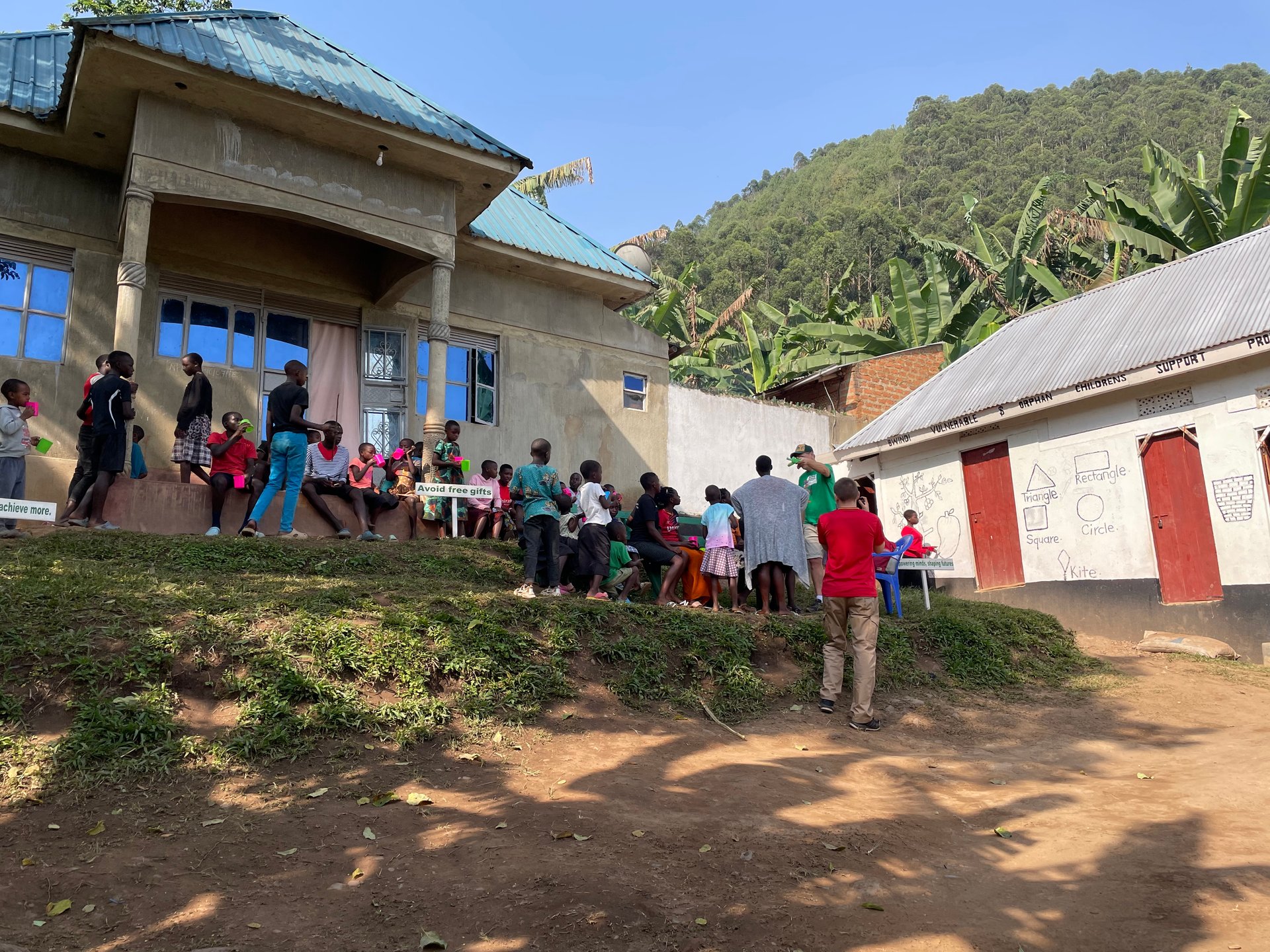
The orphanage in Buhoma looks bigger from the outside than it is. The main building has three rooms, electricity, and no running water. A small annex holds a sleeping area and the office. Because there is not enough space inside, almost everything takes place in the courtyard: meals, homework, games. Life on that packed red-earth compound is constant and unguarded. When I visited in January 2026, children were moving between a half-finished chalkboard lesson and a shared bowl of food while a rooster ignored all of it from the corner of the yard. The bananas planted along the fence gave the place its only shade.
That image stays with me because it makes the abstract concrete. When conservationists talk about community benefit sharing around Bwindi Impenetrable National Park, this is the scale they are working at: a three-room building in Buhoma, a plot of land without a piped-water connection, families whose daily logistics depend on what the surrounding forest and the tourism economy do or do not deliver. My GPS-verified visit to this community site (coordinates 0.1042°N, 32.1684°E, January 2026) made one thing clear: the gap between the phrase "communities benefit from gorilla tourism" and what that actually looks like on the ground is wide, complicated, and worth examining closely.
This article traces how benefit-sharing frameworks around Bwindi were designed, how they function today, and where the most significant gaps remain — with particular attention to the Batwa, the indigenous forest-dwellers whose history with Bwindi is older than the park itself.
Bwindi Impenetrable National Park: A Resource at the Centre of Competing Needs
Bwindi Impenetrable National Park sits in southwestern Uganda, straddling the Albertine Rift between roughly 1,160 and 2,607 metres above sea level. It is one of the most biodiverse tropical forests in Africa and holds approximately half the world's remaining mountain gorilla population. That ecological fact is the foundation of everything that follows: the gorillas attract tourists, tourists generate revenue, and the question of how that revenue is distributed has shaped conservation policy, community relations, and the everyday lives of people in Buhoma, Nkuringo, Rushaga, and Ruhija for decades.
The park is gazetted, meaning its boundaries are legally fixed and human settlement inside is prohibited. Communities in the surrounding buffer zone — farming families, small business operators, guides, lodge workers — are therefore positioned at the edge of an asset they cannot directly use in the ways their grandparents could. The gorillas eat crops. Baboons raid gardens. Elephants break fences. The tangible costs of living next to a national park fall on households, while the conservation benefits — biodiversity, carbon sequestration, watershed protection — are diffuse and often felt at a national or global level rather than at the village level.
Benefit-sharing mechanisms are the policy response to this imbalance. The theory is straightforward: if the people bearing the costs of conservation also receive a meaningful share of the economic gains, they have a material reason to support the park rather than to encroach on it, poach in it, or simply regard it as an obstacle. The practice is considerably more complicated.
Tourism as an Economic Sector: What the Numbers Say
Tourism is, in the language of Uganda's statistical authorities, an economic sector that creates employment, generates revenue, and attracts investment. In practice, around Bwindi, that translates to gorilla trekking permits, lodge employment, guiding fees, and ancillary services. The permit system is the financial engine: Uganda Wildlife Authority (UWA) sets the price per permit — currently structured to support both conservation operations and community revenue-sharing pools — and a portion of permit income flows to designated community funds.
Understanding the full economic picture is constrained by data gaps. According to the Statistical Abstract 2014, accommodation facility survey data in Uganda covers 20 districts distributed nationally, including Kampala, and the last comprehensive national accommodation census was conducted in 2011, with the next update scheduled around the 2014 housing census. For a country whose tourism sector has expanded substantially since then, this means that accurate, granular data on lodge numbers, bed capacity, occupancy, and employment around Bwindi specifically is difficult to verify from official sources. What is available are sector-level estimates and the administrative records of UWA and its NGO partners.
What is not in dispute is the direction of dependency: the communities around Bwindi, and especially those in the Buhoma sector, are deeply integrated into the tourism economy. Lodge employment — kitchen staff, grounds staff, porters — represents stable wage income in an area where agricultural incomes are irregular and vulnerable to crop raiding by park wildlife. The presence of tourist infrastructure also supports secondary markets: fresh produce supply, laundry services, craft sales. This integration is a strength, but it also means that any disruption to gorilla trekking — pandemic closure, political instability, permit price changes — reverberates immediately through household budgets in villages that have no fallback.
The Batwa: Indigenous Forest-Dwellers and the Consequences of Conservation
The Batwa are the indigenous inhabitants of the Bwindi rainforest. They lived inside the forest as hunter-gatherers for generations before the park was gazetted in 1991. When the national park was established, the Batwa were evicted — without compensation, without alternative land, and without a legal framework that recognised their tenure rights. The eviction was total and, from a material standpoint, catastrophic. Overnight, the Batwa lost their homes, their food sources, their medicine, and the entire physical and spiritual framework of their culture.
They did not disappear. They settled at the park's edges, many in extreme poverty, and have spent the decades since navigating a development landscape that was not designed with them in mind. Standard agricultural extension services assume land ownership. Education programmes assume school fees are manageable. Health clinics assume clients can travel to them. For Batwa families without land title, without savings, and without the social capital that comes from generations of settled community life, these assumptions exclude them at every step.
The moral dimension of this history is important to state plainly: conservation at Bwindi was achieved, in part, at the direct expense of the Batwa. Any discussion of community benefit sharing that does not start from this fact is incomplete. The organisations working in this space have understood this at varying levels of depth and with varying results.
Collaborative Resource Management: The Organisations and Their Approaches
A dense network of governmental bodies, NGOs, and community-based organisations now operates around Bwindi with mandates that overlap, sometimes cooperate, and occasionally conflict. Understanding who does what is necessary for evaluating whether benefit-sharing models are working.
Bwindi Mgahinga Conservation Trust (BMCT) is among the oldest institutional actors in this space. Established in the mid-1990s with support from international conservation finance, BMCT operates as a grant-making trust that channels funds to community projects around both Bwindi and Mgahinga Gorilla National Park. Its mandate includes livelihood support, conservation education, and Batwa-specific programming. The Trust has funded health interventions, income-generating projects, and educational support for Batwa households over multiple grant cycles.
Nkuringo Cultural Center is located in the Nkuringo sector on Bwindi's southern edge. It functions as both a cultural preservation facility and a tourism interface, offering visitors an introduction to Batwa culture, traditional practices, and history. Revenue generated from cultural tourism at the centre is intended to support the Batwa community directly. The centre represents one of the cleaner direct-benefit models available: a defined tourism product, a defined beneficiary community, and a relatively short chain between transaction and outcome.
Batwa Development Program (BDP), operating under the umbrella of Empowering Vulnerable Communities, focuses on holistic development for Batwa households — land acquisition, housing, health care access, and education. The BDP has been one of the more consistent long-term actors in Batwa advocacy and has played a role in pushing for the recognition of Batwa rights within Uganda's policy framework, where Batwa interests have historically been marginalised.
Batwa Indigenous Development Organization (BIDO) is a Batwa-led civil society organisation. Its significance lies in its governance structure: unlike externally-managed programmes, BIDO gives Batwa communities a direct voice in how development priorities are set. In the context of benefit sharing, the difference between an organisation that delivers benefits to Batwa and one that is governed by Batwa is not trivial. The former reproduces a dependency relationship; the latter builds institutional capacity and self-determination.
Among international NGO partners, the International Gorilla Conservation Programme (IGCP) is the most operationally significant. IGCP works across the gorilla range — Uganda, Rwanda, and the Democratic Republic of Congo — supporting community development enterprises around Bwindi Impenetrable National Park, problem animal control, tourism development, and field equipment support for rangers and community monitors. The problem animal control component is directly relevant to benefit sharing: if crop-raiding by park animals is not managed effectively, the economic costs borne by farming communities around the park undermine any financial benefits from revenue sharing.
The Gorilla Organisation (GO) focuses on community engagement, forest trail development, and livelihood programmes. One of its documented activities is strengthening the Batwa Forest Trail — a guided cultural experience that takes visitors into forested areas with Batwa guides who narrate the history and ecology of forest life. The Trail is both a cultural product and an employment mechanism: Batwa guides are employed, their knowledge is recognised as having economic value, and visitors receive an experience that no mainstream lodge programme can replicate.
Pro-Biodiversity Conservationists in Uganda (PROBICOU) rounds out the main roster of NGO actors. PROBICOU works on biodiversity conservation in community-managed landscapes, with programming that includes indigenous tree planting, restoration of pocket forests, and livelihood support. Its collaboration with Batwa communities on tree planting and forest restoration is notable: it positions the Batwa not as recipients of conservation charity but as active agents in restoring the ecosystem they originally managed.
The Communities of Southwestern Uganda: Geography, Diversity, and Vulnerability
The communities living alongside Bwindi are located in Uganda's southwestern region, a heterogeneous landscape stretching between roughly 1°S and 0°N and between 29.7° and 31.5°E. The region encompasses a range of districts including Kisoro, Kabale, Rubanda, Rukungiri, Mitooma, Bushenyi, Rubirizi, Ntungamo, and Rukiga. The terrain varies from high-altitude volcanic landscapes near the Rwandan border in Kisoro to lower, warmer valleys further north. This geographic diversity produces significantly different agricultural conditions, connectivity levels, and economic profiles across communities that are administratively grouped under the same park management regime.
The southwestern region is also vulnerable to natural hazards. Landslides are a recurring risk in areas of steep terrain and high rainfall. This physical vulnerability interacts with economic vulnerability in ways that matter for benefit-sharing design: a community that loses infrastructure to a landslide, or whose crops fail due to erratic rainfall, cannot wait for quarterly disbursements from a revenue-sharing fund. Resilience requires both reliable benefit flows and the local institutional capacity to manage disruptions.
The ethnic and linguistic diversity of the region also shapes how community benefit programmes land. The predominant groups in the districts surrounding Bwindi include Bakiga and Bafumbira communities, who are largely settled agricultural farmers. The Batwa are numerically much smaller and linguistically distinct. In communities where the Batwa are a minority within a minority, institutional outreach that does not specifically account for their marginalisation tends to reproduce their exclusion even when the programme's stated goals include them.
Birth registration is one proxy indicator of how administrative systems reach different populations. Data cited in Uganda's statistical literature notes significant variation in birth registration rates across ethnic groups — with some communities in the southwestern region showing rates below 25 percent. Low registration rates are not trivial: without birth certificates, children face barriers in accessing education and health services, and adults face barriers in acquiring land titles, bank accounts, and formal employment. For Batwa households, where documentation has historically been poor, this administrative gap compounds the other disadvantages they face.
How Benefit-Sharing Works in Practice: Mechanisms, Results, and Persistent Gaps
Uganda's formal community revenue-sharing framework requires Uganda Wildlife Authority to allocate a portion of gate and permit income to communities adjacent to national parks. The mechanism has evolved since its introduction and operates through community institutions — usually parish-level committees — that are supposed to identify, prioritise, and oversee projects funded from the revenue pool.
In Bwindi's case, the revenue pool generated by gorilla trekking permits is substantial relative to other parks. This has funded community infrastructure — classroom blocks, water points, health facilities — in the buffer zone. The challenge is that disbursement cycles, bureaucratic procedures, and committee governance all introduce friction between the permit revenue generated at the park gate and the benefit reaching a Batwa household in a satellite settlement outside Buhoma.
The organisations described above supplement the formal UWA mechanism with project-based interventions. The result is a layered system: UWA's revenue-sharing pool operates at the parish level; NGOs and trusts operate at household and community levels with specific targeting; Batwa-led organisations advocate for structural changes in how the overall system is designed. Each layer addresses different parts of the problem, and none operates with sufficient resources to close the gap entirely.
A key area of documented programming is the Batwa Forest Trail and related cultural tourism products. When a tourist visits a Batwa cultural site and pays a fee, that payment can in principle flow directly to Batwa participants with minimal administrative overhead. Compared to the several-step chain from permit revenue to community fund to project to household, this is a relatively efficient transfer. Its limitation is scale: cultural tourism visits are a small fraction of total park visitor activity, and not all lodges or tour operators include Batwa cultural experiences in their standard itineraries.
Tree planting and forest restoration activities, supported by PROBICOU in collaboration with Batwa communities, represent a different model. Here, the Batwa are employed for conservation work — planting indigenous trees in pocket forests around the park boundary — and receive wages for that labour. The work also restores ecological connectivity between the park and surrounding landscapes, which has conservation value for the park management. This is a rare example of a programme where Batwa labour, Batwa ecological knowledge, and conservation objectives are aligned rather than in tension.
Advocacy and rights-based work remains the most underfunded component. Legal recognition of Batwa land rights, representation in park buffer zone management committees, and formal consultation rights over decisions affecting the park's edge are all areas where progress has been slow. Without these structural changes, even well-designed benefit-sharing programmes operate within a framework that does not fully recognise the Batwa as rights-holders rather than as beneficiaries.
[QUOTE: local guide on first impressions of benefit-sharing changes in Buhoma]The orphanage I visited in Buhoma in January 2026 is not a Batwa institution — it serves a broader community of children in need in the Buhoma area. But it captures something true about the scale at which community benefit operates around Bwindi: three rooms, no piped water, a yard that does the work the building cannot. The ambition of benefit-sharing frameworks is much larger than what exists on the ground. That gap is not a reason to abandon the frameworks. It is a reason to understand them clearly, support the organisations closing the distance, and — for the travellers who choose to visit Bwindi — make informed choices about where they stay and whose programmes they engage with.