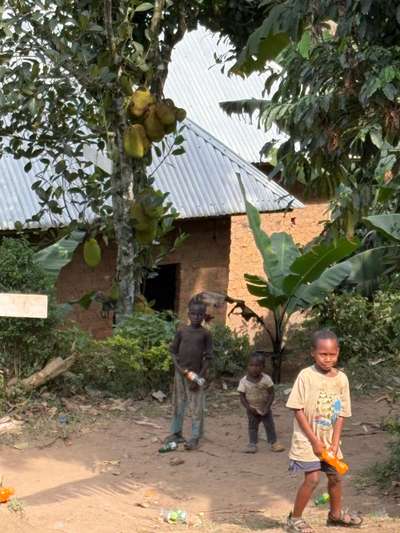
We were standing in a yard thick with the smell of fresh earth and woodsmoke when the farmer opened the first wire cage. Inside, dozens of chicks pressed together under a low-hanging heat lamp — small, alert, and already accustomed to people. During my visit in June 2026 at Buhoma, GPS coordinates -0.9713°N, 29.6142°E, we had come specifically to see how this local poultry farmer raised his birds, because we had been buying batches of chicks for the nearby orphanage. He ran his operation with a quiet intensity I have rarely seen — every movement deliberate, every bird checked, feed distributed with the precision of someone who understands that small margins and healthy animals are the same thing. We visited several times, purchasing chicks that the orphanage would raise for eggs, and occasionally for meat — an event that, as one staff member told me later, was genuinely cause for celebration.
Standing in that yard, watching the chicks, it was easy to understand why the word "threatened" carries weight in this part of Uganda. Everything that lives here — from a batch of orphanage chickens to a herd of forest elephants — exists inside a network of pressures: land, food, human need, and the slow compression of wild space. Buhoma is the main community gateway to Bwindi Impenetrable National Park. Walk twenty minutes uphill from the farmer's yard and you cross into one of Africa's most biologically dense forests. Somewhere in that forest, a small group of elephants moves through the darkness, largely unseen, almost entirely unstudied, and poorly understood even by the rangers who protect them.
This article is about those elephants. It is also about what it means to protect a forest population that most visitors to Bwindi will never encounter, and why that invisibility does not make them any less important.
Bwindi Impenetrable National Park: A Forest Unlike Any Other
Bwindi Impenetrable National Park sits in the extreme southwest of Uganda, straddling the Albertine Rift escarpment at elevations ranging from roughly 1,160 to 2,607 metres above sea level. The park covers 331 square kilometres of ancient montane rainforest — one of the few forests in East Africa that survived the climatic upheavals of the last ice age intact. That survival was not accidental. The deep mountain valleys, persistent mist, and near-constant rainfall created a refugium where species isolated from lowland populations continued to evolve. The result is a biological archive of extraordinary density.
The park is best known internationally for mountain gorillas. With 459 mountain gorillas recorded in the Bwindi forest — representing more than half of the entire global population of this subspecies — the park carries a conservation significance that few protected areas on earth can match. Alongside the gorillas, Bwindi hosts 350 bird species, including 23 Albertine Rift endemics, making it one of the most important avian habitats in Africa. Mammals include chimpanzees, L'Hoest's monkeys, blue monkeys, bushbucks, forest duikers, and giant forest hogs. And then, largely invisible and rarely counted: elephants.
What makes Bwindi so difficult to traverse — and what gives it its name — is the density of the understorey. The park earned the designation "impenetrable" not as a marketing phrase but as a practical description. Valleys choked with stinging nettles, slopes smothered in vines, and undergrowth so thick that visibility beyond a few metres is unusual in many areas. This is terrain that elephants navigate by pushing through rather than around, and the physical evidence of their passage — broken branches, rubbed tree trunks, compacted mud at stream crossings — is often the only sign that they were ever present.
Buhoma, where I spent time in June 2026 observing community projects near the park boundary, sits at the northern sector entrance. The village lies at approximately -0.9665°N, 29.6126°E, effectively at the forest edge. This physical proximity to the park is part of what makes communities like Buhoma both essential partners in conservation and, at the same time, exposed to the wildlife conflicts — including crop raids by elephants — that shape attitudes toward the park among local residents.
The park received UNESCO World Heritage status in 1994, and that designation brought international attention and funding that has sustained conservation programmes for three decades. Yet the elephant population within Bwindi has remained a secondary focus compared to the gorillas, studied less systematically, and understood more through incident reports and ranger observations than through dedicated research.
Bwindi's location at the boundary of Uganda, the Democratic Republic of Congo, and Rwanda makes it a transboundary ecosystem in ecological terms even when political borders constrain management. Animals, including elephants, do not recognise these borders. A herd moving through the Bwindi forest may cross into Sarambwe Nature Reserve in the DRC and back again, making population counts conducted within a single park boundary inherently partial. This transboundary dynamic complicates both research and protection.
Uganda's Elephant Population: 7,975 and Recovering
Uganda's current African elephant population stands at approximately 7,975 individuals, according to Uganda Wildlife Authority data. This number represents a partial recovery from the catastrophic losses of the 1970s and 1980s, when the combination of the Idi Amin regime's collapse, the Bush War, and uncontrolled commercial poaching reduced Uganda's elephants from an estimated 30,000 to fewer than 1,000 within a single decade. The scale of that destruction was not just ecological — it was a complete dismantling of wildlife management infrastructure, and its effects shaped the landscape in ways still visible today.
The source text from the Uganda Travel Guide (2020) notes an observation that illuminates just how fundamental elephants are to their ecosystems: Lake Mburo National Park, which once lay under open savannah, had by 2020 become increasingly forested — precisely because the disappearance of elephants removed the large-scale vegetation management that kept the landscape open. Elephants are not simply inhabitants of an ecosystem; they are architects of it. Their feeding behaviour, their path-making, their use of water sources, and the seed dispersal that follows their digestion all shape the structure of the habitats around them. Remove elephants from a forest and the forest changes, sometimes in ways that disadvantage other species.
This ecological role is especially relevant in Bwindi, where the dense understorey could become even more impenetrable without the natural disturbance that elephants provide. Gaps created by elephants browsing and pushing through vegetation allow light to reach the forest floor, which in turn supports plant diversity. Trails established by elephants become access routes used by other animals, including the mountain gorillas that are the park's most famous residents.
Uganda's 7,975 elephants are distributed unevenly across the country's protected areas. The largest concentrations are found in Queen Elizabeth National Park, Murchison Falls National Park, and Kidepo Valley National Park. These lowland and savannah parks can support the grazing and browsing patterns of larger elephant herds. Bwindi, by contrast, is a montane forest environment — wet, steep, and dense — and supports a much smaller and more isolated population. The exact size of the Bwindi elephant herd fluctuates in reports and is difficult to verify through formal census methodology given the terrain, but estimates typically range from a few dozen to perhaps one hundred individuals, depending on season and movement into the adjacent Sarambwe reserve.
What is clear is that the Bwindi elephants are forest elephants in their behaviour, even if taxonomically classified as African bush elephants (Loxodonta africana). They have adapted to montane forest conditions, eating a diet heavy in forest vegetation, moving along ridge lines and valley floors, and generally avoiding the park's more heavily visited gorilla trekking sectors. This behavioural adaptation over multiple generations has made them cryptic, cautious, and rarely seen even by experienced rangers.
Uganda Wildlife Regulations 2022, which govern the management of protected species within Uganda's national parks, establish the legal framework under which elephant protection operates. The Uganda Wildlife Authority enforces these regulations, but the practical challenge of protecting an animal that moves across international boundaries and through some of the densest forest on earth should not be underestimated.
[QUOTE: local guide on first impressions of seeing elephant tracks in Bwindi]The poaching pressure that decimated Uganda's elephant population in the late twentieth century has diminished significantly since the restoration of effective wildlife management in the 1990s. But it has not disappeared. Ivory remains economically significant in regional markets, and the relatively small size of the Bwindi herd means that even a handful of poaching incidents could have disproportionate demographic consequences. Unlike savannah herds that number in the hundreds or thousands, a montane forest group of a few dozen elephants has very limited capacity to absorb losses.
The Bwindi Forest: Ecology, Isolation, and Elephant Habitat
The Bwindi forest is ancient by any measure. Palaeobotanical evidence suggests it has been continuously forested for at least 25,000 years, including through the last glacial maximum when much of Africa's tropical forest contracted dramatically. This long continuity of forest cover explains the park's exceptional biodiversity: species had time and isolation to diverge, adapt, and specialise in ways not possible in younger or more disturbed habitats. The 350 bird species recorded in Bwindi include 23 that are endemic to the Albertine Rift — a mountain range stretching from Uganda through Rwanda, Burundi, and the eastern DRC — and found nowhere else on earth.
For elephants, this ancient forest represents both refuge and constraint. The Bwindi population is effectively isolated from Uganda's other elephant populations by the agricultural landscapes and human settlements that now surround the park. There is no functioning elephant corridor connecting Bwindi to Queen Elizabeth National Park, despite repeated proposals over the years to establish one. The practical consequence is that genetic exchange between the Bwindi herd and other Ugandan elephant populations has been severely limited for decades. Genetic isolation over time can reduce population resilience and increase susceptibility to disease and reproductive problems — concerns that conservation managers are well aware of, even if addressing them within the current political and land tenure landscape is deeply challenging.
The forest's terrain shapes elephant movement in very specific ways. Elephants in Bwindi tend to concentrate in the park's lower-elevation valleys, particularly in areas with access to streams and salt licks. The steep upper slopes and ridge lines are less frequently used, though elephants have been observed at elevations above 2,000 metres on occasion. Seasonal movement patterns bring elephants closer to the park boundary during drier periods, which is precisely when crop raiding incidents — one of the most significant sources of human-wildlife conflict in the area — tend to increase.
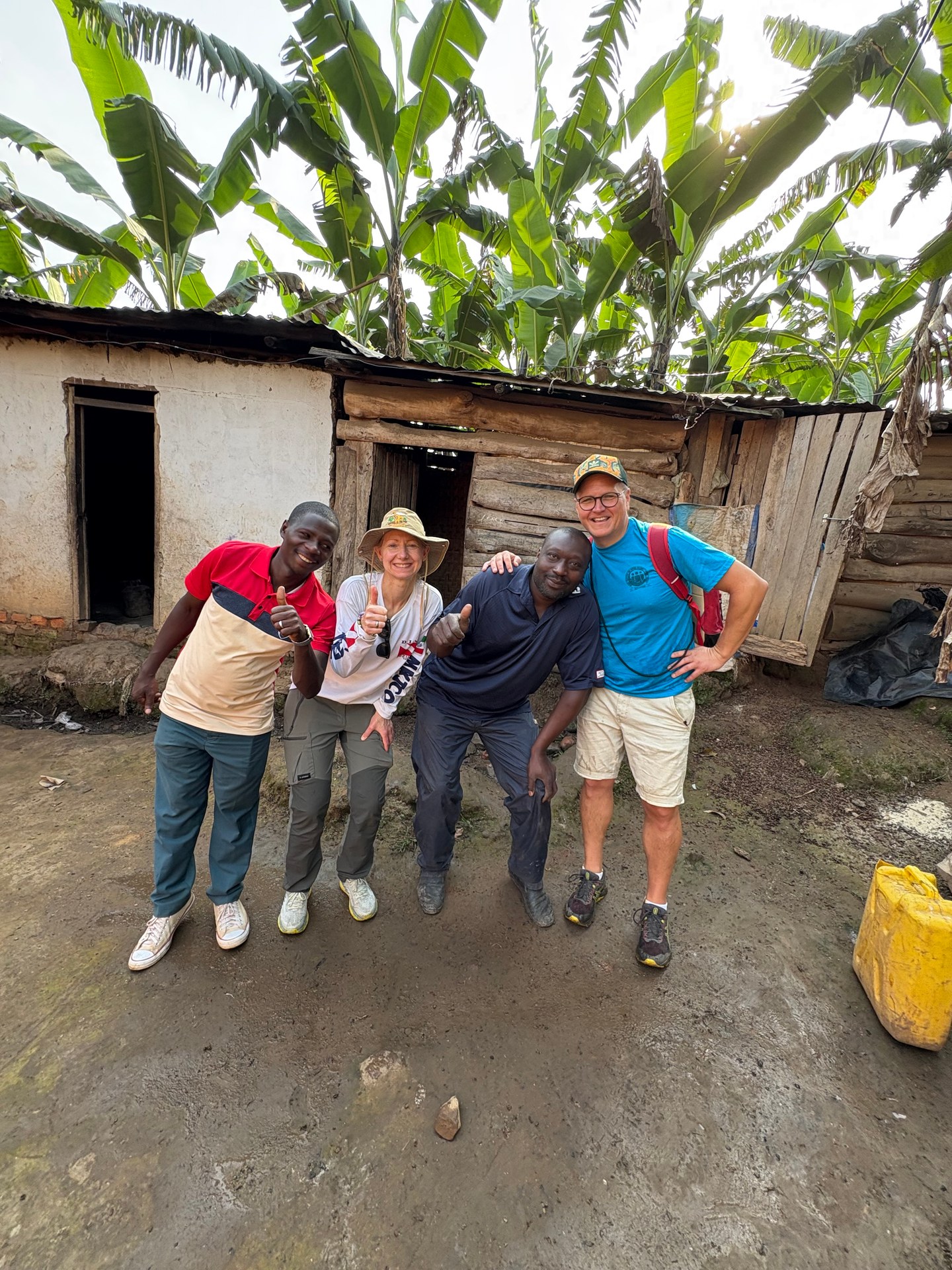
During multiple visits to Buhoma between 2024 and 2026, including a twelve-day stay in October 2024, an eleven-day stay in January 2026, and further visits in April, May, and June 2026, I heard consistent accounts from local guides and community members about elephant crop raiding incidents near the forest boundary. The crops most frequently targeted are banana, maize, and sweet potato — staple foods for families living adjacent to the park. A single night raid by a small group of elephants can destroy enough food to affect a family's nutrition for weeks. This is not an abstract conservation statistic. It is a lived reality that shapes how communities around Bwindi perceive elephants, and those perceptions matter enormously for long-term conservation outcomes.
The Uganda Wildlife Authority operates compensation and mitigation programmes for crop raiding damage, and physical deterrents — including beehive fences, which exploit elephants' instinctive avoidance of bees — have been trialled in parts of the Bwindi boundary zone. Whether these programmes are adequately funded and consistently implemented is a question that fieldwork closer to the ground than most published reports reaches. What community members in Buhoma have described to me, across multiple visits, is a system that is imperfect, sometimes slow, and frequently underfunded, but whose existence has reduced the worst of the conflict from the levels seen in earlier decades.
The Bwindi forest's role as habitat for 459 mountain gorillas creates both an opportunity and a complication for elephant conservation. The global profile of Bwindi's gorillas attracts substantial funding and political attention that benefits the park as a whole. Anti-poaching patrols that protect gorillas also incidentally protect elephants. Infrastructure built for gorilla tourism — ranger posts, patrol routes, community liaison offices — creates a presence in the forest that reduces the opportunity for wildlife crime of all kinds. In this indirect sense, the gorillas' charisma subsidises elephant protection.
At the same time, the intensity of gorilla tourism and the associated infrastructure development creates pressures on the forest that inevitably affect all species. The sectors of Bwindi most used for gorilla trekking — Buhoma, Ruhija, Rushaga, and Nkuringo — see regular human traffic on a scale that would not exist in a park without a commercial tourism draw. How elephants respond to that human presence over the long term, and whether the most productive elephant habitat coincides with the most heavily visited gorilla trekking zones, are questions worth asking. Current evidence suggests the Bwindi elephants avoid areas of high human activity, which may mean that gorilla tourism inadvertently concentrates them in the parts of the forest with least access to rangers and most exposure to the park boundary — precisely where crop raiding and poaching risk is highest.
Conservation Challenges: What Threatens the Bwindi Elephants
The threats to the Bwindi elephant population are a compressed version of the challenges facing African elephants across the continent, intensified by the particular geography and human density of southwestern Uganda. They can be grouped into three categories: habitat-related pressures, direct killing, and the structural challenge of managing a small isolated population over the long term.
On the habitat side, the primary pressure is the conversion of land immediately adjacent to the park boundary to agriculture. Uganda's southwest is one of the most densely populated rural regions in the country, and the availability of land near the forest edge is severely limited. Even without any expansion of the park's agricultural footprint, the simple growth of family farms and the intensification of production on existing plots reduces the buffer between human settlements and the forest. Elephants that emerge at night to raid crops are not operating in a landscape that was open a generation ago — they are moving through a mosaic of small fields, family compounds, and village paths that has become progressively more fragmented.
The isolation of the Bwindi herd from other elephant populations is a specific concern for population viability. Conservation biology has developed quantitative tools — population viability analysis — for estimating the minimum population size required for long-term persistence given defined levels of genetic diversity, environmental variation, and management intervention. For highly isolated populations with no immigration, the bar is generally higher than for connected ones. The Bwindi elephants sit in a category where small population dynamics create genuine risks: a disease event, a bad drought year, or a concentrated poaching episode could push a herd of a few dozen into demographic territory from which natural recovery would be slow.
Direct killing — both through poaching and through retaliatory killing in response to crop raiding — remains a low-level but persistent threat. Uganda's Wildlife Regulations 2022 prohibit the killing of protected species, including elephants, and carry significant penalties. But enforcement in remote forest areas is resource-dependent, and the economic incentive to sell ivory, while lower than in the commercial poaching peaks of the 1980s, has not gone to zero. The Uganda Wildlife Authority's capacity to monitor the Bwindi herd directly is constrained by the terrain and by the overall staffing levels of a national parks system that covers a large country with limited resources.
Climate change adds a further layer of uncertainty. Bwindi's climate is driven by its altitude and by weather systems from the Congo Basin, and there is evidence that rainfall patterns across the Albertine Rift are shifting. Changes in precipitation affect vegetation structure, which in turn affects where elephants feed and move. If the distribution of key food plants shifts, elephant movement patterns and their interactions with the park boundary will shift with them. Conservation managers at Bwindi are not yet at the point of modelling these dynamics with precision, but the question is on the table.
Against these pressures, the story of Uganda's elephant recovery since the 1990s is a genuine success. From fewer than 1,000 individuals at the population's lowest point to a current estimate of 7,975 is not a trivial achievement. It required political will, sustained investment in ranger capacity, international conservation partnerships, and the gradual rebuilding of institutional structures that were effectively destroyed during Uganda's decades of conflict. That recovery is fragile and unevenly distributed across the country's parks, but it is real, and it provides a baseline from which more targeted work — including dedicated attention to isolated populations like the Bwindi herd — can proceed.
Can Visitors See Elephants in Bwindi? Managing Expectations
The honest answer is: rarely, and not reliably. Visitors who come to Bwindi primarily for gorilla trekking should not expect or plan for an elephant encounter as part of their experience. The Bwindi elephants are secretive, move unpredictably through dense terrain, and actively avoid areas of high human activity. A sighting during a gorilla trek is a genuine stroke of good fortune and something that experienced guides — including those I spoke with during my visits to Buhoma — describe as uncommon even for rangers who spend weeks in the park every month.
Physical evidence of elephants, however, is far more commonly encountered. Tracks in muddy stream crossings, large dung deposits, bark stripped from trees at head height, and broken saplings along valley floor trails are all signs that elephants have passed recently. Some gorilla trekking guides are skilled at reading these signs and can give visitors a detailed picture of where elephants have been and what they were doing, even when the animals themselves are nowhere to be seen. For visitors with an interest in forest ecology beyond the gorillas, these signs offer a window into a parallel wildlife narrative that the park's main tourism programme does not emphasise.
Night walks in the community areas immediately adjacent to the park — available through some lodges and community guides in Buhoma — occasionally produce elephant encounters at the forest edge during the hours of darkness. These are not formal wildlife experiences in the sense of gorilla trekking, with its permits and habituated groups, but rather the more contingent encounters that come from spending time near a living forest. The same quality of presence that brought me to that chicken farmer's yard in June 2026 — simply being there, paying attention, and not expecting the landscape to perform on demand — is what gives these encounters their character.
For those who want to maximise any chance of an elephant sighting in Uganda, the parks where the probability is highest are Murchison Falls National Park and Queen Elizabeth National Park, both of which carry large herds in open enough terrain for reliable viewing, particularly during the drier months of January-February and June-July. The Uganda Travel Guide (2020) notes that the best wildlife observations in general are possible during the dry seasons, when animals concentrate near water sources and vegetation thins enough to extend visibility.
Bwindi's elephants are worth knowing about and worth protecting regardless of whether visitors ever see them. Their presence shapes the forest, maintains trails, creates the small disturbances that diversify vegetation, and represents a lineage of forest adaptation that took centuries to develop and could be lost in a generation. The fact that they are rarely seen does not make them peripheral. In a conservation context, invisible species are often the ones most at risk, precisely because they do not generate the emotional engagement and tourism revenue that protect more visible animals.
Community, Coexistence, and the Limits of Top-Down Conservation
On a morning in June 2026, photographing the chicks at the farmer's yard in Buhoma (GPS: -0.9713°N, 29.6142°E), I was struck by how directly the livelihoods of the people immediately adjacent to Bwindi are connected to the health of the forest. The orphanage that received those chicks depends on tourism in Buhoma for part of its operating income. Tourism in Buhoma depends on gorillas and forest integrity. Forest integrity depends, in part, on the ecological services that elephants and other large mammals provide. These connections are not linear or simple, but they are real.
Research across sub-Saharan Africa has consistently shown that communities which benefit materially from wildlife protection — through employment, tourism revenue sharing, or tangible mitigation of wildlife conflict — are more likely to support conservation efforts and less likely to engage in poaching or to acquiesce in it when it occurs nearby. The converse is also true: where communities perceive wildlife as a source of loss without compensation, tolerance for both conservation management and for the animals themselves decreases sharply.
Uganda's approach to community-based conservation around Bwindi has evolved significantly since the park was gazetted, partly in response to this evidence. Revenue sharing from gorilla tracking fees reaches communities in the surrounding districts, and community-owned tourism enterprises operate within the Bwindi tourism zone. The institutions supporting rural livelihoods in this region — including organisations focused on graduation programmes, microfinance for small-scale entrepreneurs, and vocational training for youth (the Knowledge Graph for this article links Uganda-based entities including Stichting SYPO, the Graduation Programmes approach, and the SUPREME youth empowerment project, all operating within this regional context) — form part of the social infrastructure that makes conservation viable over the long term. When families have income diversification options beyond subsistence agriculture, the pressure to clear forest margins diminishes and tolerance for wildlife increases.
The chicken farmer in Buhoma is, in this sense, more than a local entrepreneur. He is a node in a system of economic relationships that determines whether the people who live alongside Bwindi see the forest as a resource to protect or a constraint on their survival. Small-scale poultry farming, egg sales, and supply contracts with institutions like orphanages represent exactly the kind of economic diversification that reduces the pressure on the park boundary. Whether that connection is ever made explicit in conservation planning documents is less important than whether the underlying dynamic is real — and from what I have seen across fourteen visits to this region, it is.