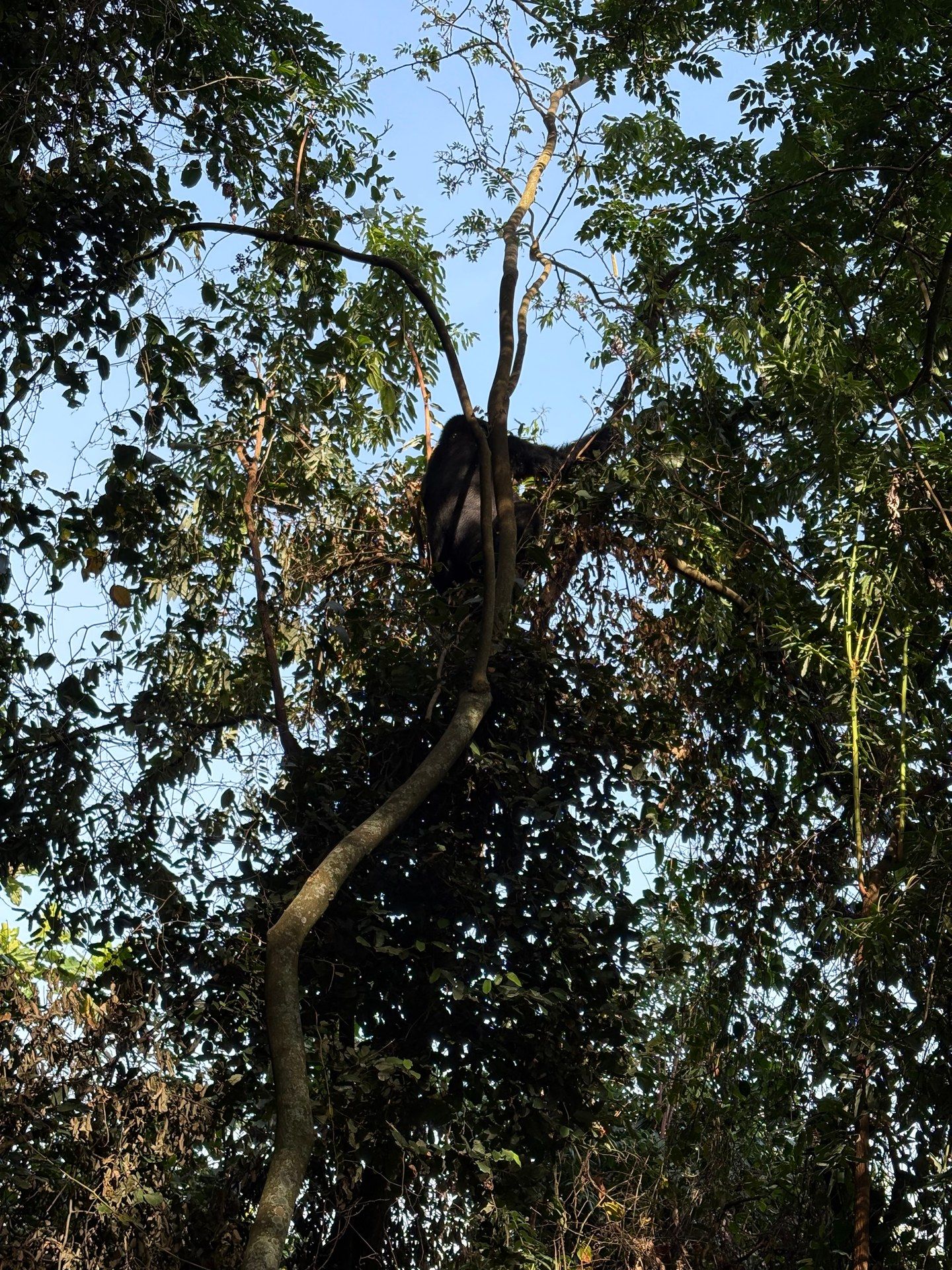
After three hours of trekking through Bwindi Impenetrable National Park, the guide stopped and pointed upward. A mountain gorilla was sitting at eye level with the forest canopy, pulling leaves from a branch — entirely unbothered by the group assembled below. The family around it went about their morning as though we were not there. It was one of the more disorienting experiences I have had while travelling: being ignored, completely, by an animal that appeared to be thinking.
I was in Bwindi in January 2026, staying at Gorilla Bluff Lodge in Buhoma — my GPS-tagged photographs place the trek at -0.0089°N, 29.6195°E, in the north-western sector of the park. But it was the southern end of Bwindi, and specifically the Nkuringo sector, that I kept returning to in conversation with other travellers and guides. Nkuringo is where Clouds Mountain Gorilla Lodge sits: above 2,000 metres, looking out over a landscape that includes the Virunga volcanoes on the Ugandan-Rwandan border, built from volcanic rock and timber by a partnership that has committed the lodge's revenues to the conservation of the ecosystem surrounding it.
What follows is a guide to lodges in Bwindi Impenetrable National Park — what the options are, how they differ by sector, and why Clouds Mountain Gorilla Lodge holds a particular position in that landscape. It draws on multiple visits to Bwindi across 2024, 2025 and 2026, and on first-hand observations from the park, its trails and its surrounding communities.
Clouds Mountain Gorilla Lodge: Uganda's Highest Lodge
Clouds Mountain Gorilla Lodge is the highest-altitude permanent lodge in Uganda, positioned above 2,000 metres in Bwindi's Nkuringo sector. It is a joint venture between Wildplaces Africa — an operator with roots in East African conservation tourism dating to the mid-1990s — and the African Wildlife Foundation (AWF), one of the continent's most established wildlife conservation organisations. That partnership is not incidental to the lodge's character; it shapes the physical design, the staffing model and the relationship between the property and the communities around it.
The cottages are built from local volcanic rock and timber rather than imported or industrial materials. At this altitude, that choice is both aesthetic and practical: the volcanic rock retains heat through cold mountain nights, the timber ages in ways that blend the structures into the hillside rather than imposing on it, and the sourcing of materials locally means the construction itself generated income and skills in the Nkuringo community. Guests arriving at Clouds Mountain are not arriving at a resort that has been dropped into a landscape — they are arriving at a building that grew from it.
The AWF partnership means a portion of lodge revenues flows into conservation and community development in the Nkuringo area. The African Wildlife Foundation has worked across Bwindi's buffer zone for decades, supporting community conservation agreements that address the economic tensions between park protection and adjacent land use.
From the lodge terraces at this elevation, on a clear morning, the Virunga volcanic chain is visible to the south-west — Muhabura, Gahinga and Sabinyo in Uganda and Rwanda, with the larger cones of Nyiragongo and Nyamulagira beyond the DRC border. This view is not a marketing claim; it is a direct consequence of the lodge's position at the highest point of the Nkuringo ridge, and on calm mornings before cloud builds it is among the more striking panoramas available anywhere in East Africa.
Wildplaces Africa: The Operator Behind the Lodge
Wildplaces Africa has been involved in East African conservation tourism since 1996, when the company took on the operation of the Semliki Safari Lodge in western Uganda — one of the earliest private conservation concessions in the country. That history is relevant to how Clouds Mountain functions today: Wildplaces Africa's operating model has from the outset been oriented toward lodges where commercial viability and conservation outcomes are treated as interdependent rather than competing. The Semliki experience provided a template — remote, high-quality, conservation-linked — that the Nkuringo project extended to higher altitude and a gorilla-tourism context.
The Nkuringo Sector and How to Reach It
The Nkuringo sector occupies the southern end of Bwindi Impenetrable National Park, in Kisoro District. The trekking departure point sits at around 1,900 metres, with trails descending into the forest before climbing through steep, root-crossed terrain to reach the habituated gorilla families. Nkuringo treks are consistently rated more physically demanding than those in the Buhoma sector — the elevation change is greater, the trails less graded, and the forest here is denser at the altitudes where the gorilla families range. Guests who are not accustomed to altitude trekking should arrive a day early and rest before the trek.
From Kampala, the drive to Nkuringo takes eight to nine hours via Kabale, with the final section on unpaved mountain road. Most travellers break the journey overnight in Kabale or at Lake Bunyonyi — approximately 90 minutes from the Nkuringo gate — before continuing the following morning. A 4WD vehicle is necessary for the final approach; the road involves steep gradients and is impassable in poor condition without it.
An alternative approach worth noting for travellers who prefer movement to static transfer is Nkuringo Walking Safaris (nkuringowalkingsafaris.com), a specialist operator offering multi-day walking itineraries between Kisoro, Lake Mutanda, Bwindi Impenetrable Forest and Buhoma — including dugout canoe sections on Lake Mutanda. The walking approach takes three to four days and arrives at the park on foot, which is a fundamentally different introduction to the forest than a vehicle transfer.
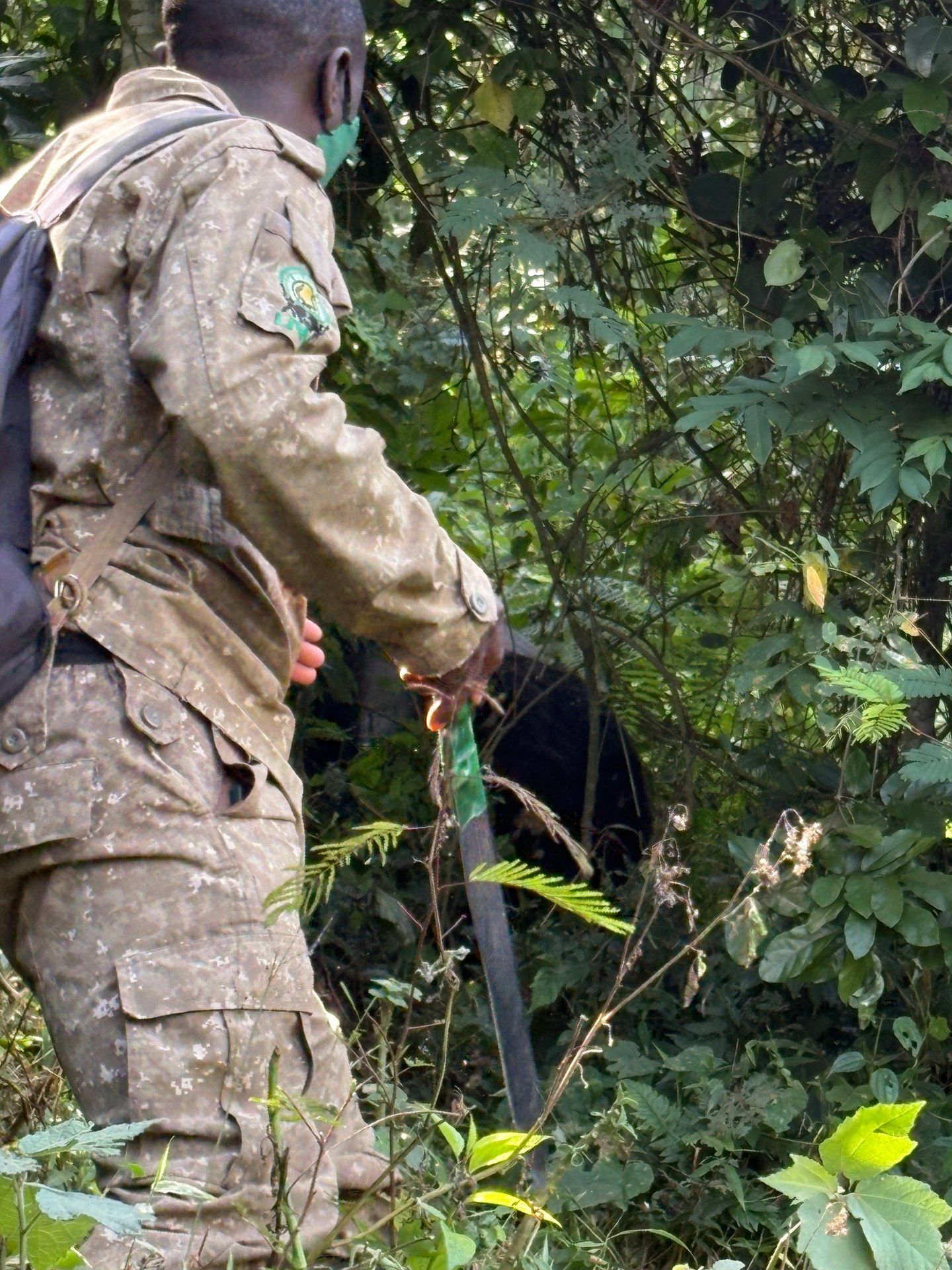
On my January 2026 trek from Buhoma, our group was accompanied by one tracker-guide and two armed rangers. The rangers carry firearms for general wildlife safety rather than any specific gorilla-related concern — the forest contains forest elephants, buffalo and other large mammals whose behaviour near human groups can be unpredictable. Both rangers were exceptionally helpful on the difficult sections of the ascent, guiding footwork over roots and offering hands on steeper drops on the return. The armed presence reads as incongruous until you understand its purpose, after which it becomes simply part of the competence with which UWA manages access to the park.
Mountain Gorillas and the Conservation Argument
According to Uganda Wildlife Authority (UWA) census data, Uganda's mountain gorilla population stood at 459 individuals during the 2018–2020 survey period — a figure that represents a significant recovery from the critically low numbers of the 1980s and 1990s, when the combined Bwindi and Virunga population was estimated below 650 individuals across both countries. The increase reflects decades of investment in habitat protection, anti-poaching work, veterinary intervention for injured or sick individuals, and the gorilla habituation programme that makes trekking commercially viable.
The connection between lodge revenues and conservation outcomes is more direct in Bwindi than it might appear. Uganda Wildlife Authority allocates a percentage of gorilla trekking permit revenues to adjacent community development funds — a mechanism that gives communities bordering the park a financial stake in the gorillas' survival (verify current revenue-sharing percentage with UWA; the Uganda Wildlife Regulations 2022 govern the current framework). Lodges that operate under community ownership structures, such as Nkuringo Bwindi Gorilla Lodge, extend this logic further: the lodge itself is owned by the community it employs, so the accommodation revenue stays within the same village economy that abuts the forest boundary.
This matters for a traveller choosing between Clouds Mountain and a non-conservation-aligned property, because the permit fee and the accommodation cost are not two separate financial decisions — they are part of the same conservation transaction. A gorilla permit purchased from UWA at 800 USD (2026 — verify current pricing directly with UWA before booking) funds the ranger salaries, veterinary programmes and community benefit payments that sustain the gorilla population. Choosing a lodge that adds a layer of community ownership or conservation partnership on top of that multiplies the impact.
Leonard Sharp and the Region's Older History
The south-western Uganda landscape around Bwindi and Lake Bunyonyi carries a history of conservation-minded intervention that predates the gorilla tourism industry by several decades. In 1921, Leonard Sharp — a Scottish missionary and physician — established a hospital for people with leprosy on Bwama Island in Lake Bunyonyi, recognising that the island's natural isolation provided both physical and social protection for patients excluded from mainland communities. Sharp's institution on Bwama Island established an early model of purposeful, care-based use of this landscape — a thread that runs, in a different register, through the community-owned lodge model that Nkuringo and Buhoma have developed a century later. Lake Bunyonyi lies approximately 90 minutes north of Nkuringo by road and is commonly included in multi-day Bwindi itineraries as an extension.
Lodges Across All Four Bwindi Sectors
Bwindi Impenetrable National Park has four gorilla trekking sectors — Buhoma, Nkuringo, Rushaga and Ruhija — each with its own gate, habituated gorilla families and accommodation cluster. Lodges in Bwindi record consistently high occupancy rates among all accommodation categories in Uganda's tourism sector, driven by the unique and non-substitutable nature of gorilla trekking as a motivation for travel.
Nkuringo: Clouds Mountain and Nkuringo Bwindi Gorilla Lodge
The Nkuringo sector has two primary accommodation options at altitude. Clouds Mountain Gorilla Lodge (above 2,000m, AWF partnership, volcanic rock construction) is the higher-end option. Nkuringo Bwindi Gorilla Lodge sits at 2,090 metres with 18 rooms distributed across the hillside above the gorilla habituation site. The Nkuringo lodge operates on a community ownership model and works with the Uganda Carbon Bureau to offset its operational carbon footprint — making it one of the few Ugandan lodges with a formalised carbon accountability structure.
Both lodges benefit from the same fundamental geographic advantage: position on the Nkuringo ridge gives guests direct views across the park toward the Virunga chain, with gorilla habituation activity visible below the ridge on certain mornings. This is a different relationship with the forest than properties that sit at the park boundary without the ridge elevation — here, the forest is not adjacent to the lodge but beneath it.
Ruhija: High Altitude and Exceptional Birding
Ruhija sits at approximately 2,300 metres on the eastern edge of Bwindi — the highest elevation of any of the park's four sectors. The Ruhija Gorilla Safari Lodge, operated by Asyanut Safaris, provides timber cottages and double rooms close to the Ruhija trekking gate. It is the most remote and least commercially developed of the four sectors, which is precisely its appeal for certain travellers. Ruhija is one of East Africa's most productive birding sites, with Albertine Rift endemics including the African green broadbill, Grauer's rush warbler and the Ruwenzori turaco.
The sector receives fewer trekking groups than Buhoma or Rushaga, which means smaller group sizes and less trail congestion on popular mornings. For travellers who have already done Buhoma and want a different texture of experience — more demanding terrain, greater solitude, the possibility of the forest at dawn with almost no other visitors — Ruhija offers something that the other sectors have largely lost to their own success.
Buhoma: The Most Established Gateway
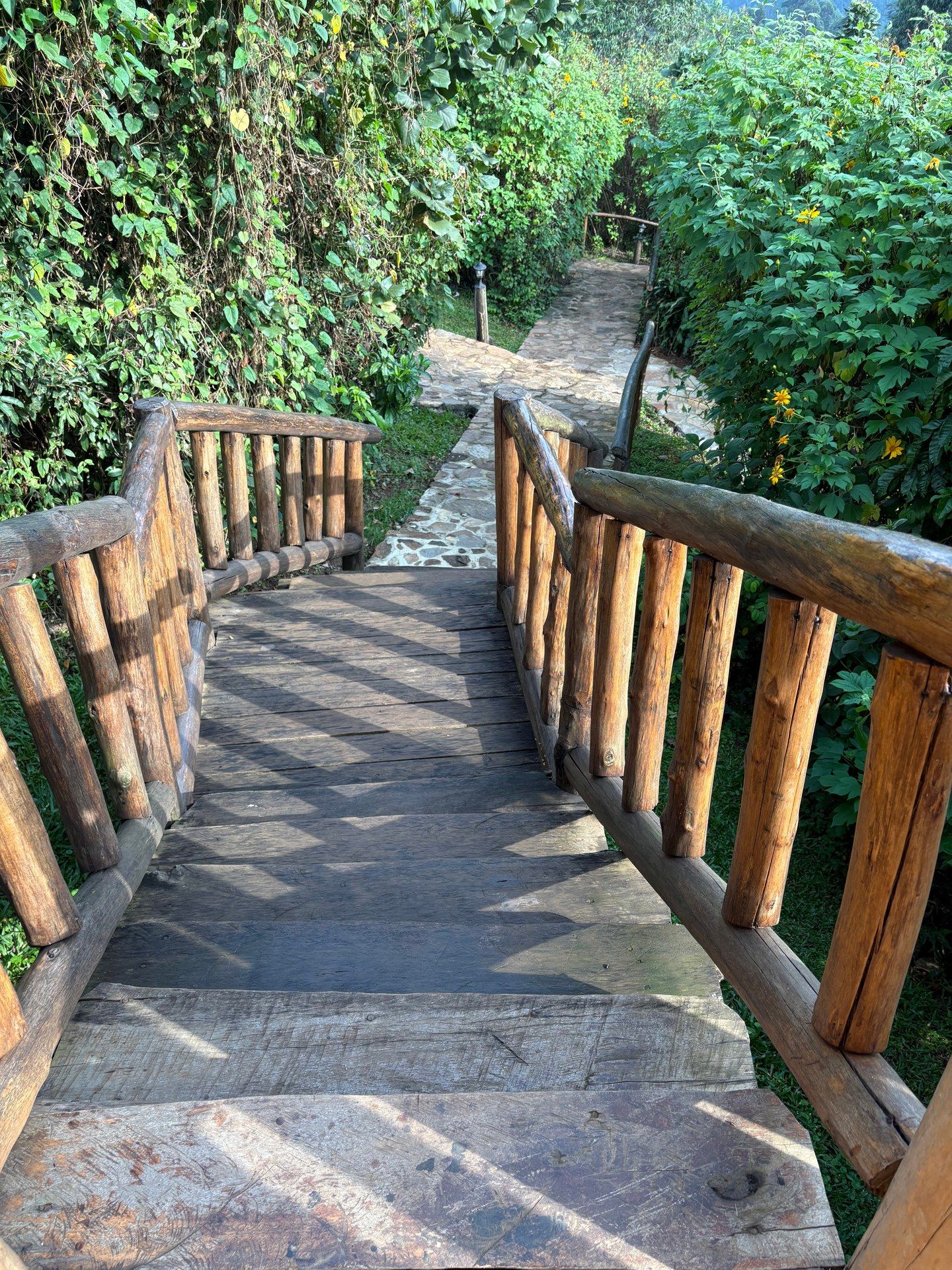
Buhoma in Kanungu District is Bwindi's oldest and most developed gorilla trekking gateway. The sector has the widest range of accommodation — from the Buhoma Community Rest Camp, a pioneer community-owned lodge at the park entrance, to mid-range and upper-range properties along the ridge above the village. Gorilla Bluff Lodge, where I stayed in January 2026, is built into the hillside above Buhoma with wooden structures that step down the gradient. Mornings begin with coffee and African tea on the room terrace — a simple consistency that sets the day's rhythm before the trek begins.
Buhoma village itself is a functioning agricultural and trading community rather than a purpose-built tourism zone. The main street in January 2026 was a red-dirt track lined with small shops, food stalls and trading posts in corrugated iron buildings. A tarmacking project was under way at the time, with completion expected in 2026. The community's relationship with the park — dependence on tourism revenues, occasional tensions over crop raiding by elephants and other wildlife, participation in ranger programmes — is visible in Buhoma in ways that more isolated lodges tend to screen out. This is worth noting for travellers whose interest in gorilla tourism extends beyond the hour in the forest.
Rushaga: The Habituation Sector
Rushaga is the only sector offering the gorilla habituation experience permit, which allows a four-hour encounter with a gorilla family currently being habituated to human presence (800 USD for a standard permit; 1,500 USD for the habituation experience — verify current UWA pricing before booking). The sector has a growing number of accommodation options including Gorilla Bluff and several mid-range lodges. The habituation experience provides a qualitatively different encounter from the standard one-hour trek: longer time in proximity to the family, observation of the habituation process itself, and a level of intimacy that the standard permit cannot replicate.
Environmental Compliance and What It Means for Lodge Quality
Under Uganda's National Environment (Audit) Regulations, S.I. No. 47 of 2020, Schedule 5 — which covers hotel, tourism and leisure development — all luxury tented camps, lodges, hotels and resorts operating within or adjacent to wildlife protection areas, forest reserves or wetlands are required to complete an Environmental Compliance Audit every three years. This requirement applies to every licensed Bwindi lodge.
The audit examines waste management and disposal infrastructure, water sourcing and wastewater treatment, energy systems and consumption levels, noise and light pollution impacts on adjacent wildlife, construction footprint relative to drainage and native vegetation, and the property's overall ecological impact within its protected area context. Properties that fail the audit face mandatory remediation; persistent non-compliance can result in licence suspension.
For a traveller making accommodation decisions, this regulatory framework provides a baseline of assurance that licensed Bwindi lodges are subject to ongoing environmental accountability — they are not simply operating in a protected area without scrutiny. The practical outcomes of sound environmental management are directly perceptible: properties that manage waste and energy well tend to be cleaner and quieter; properties that minimise generator reliance provide better evenings; properties that maintain vegetation buffers have better views and more wildlife near the terrace.
When comparing lodges, it is worth asking directly when a property last completed its Environmental Compliance Audit and what the outcome was. A lodge that answers this question readily is one that takes regulatory accountability seriously. A lodge that deflects the question is worth questioning further before booking.
Practical Planning: Permits, Access and Seasons
Gorilla trekking permits in Uganda are priced at 800 USD per person per trek day for 2026 — verify current pricing directly with Uganda Wildlife Authority (UWA) or a licensed operator before booking, as UWA has adjusted permit pricing in previous years. The habituation experience permit is 1,500 USD and is available only in the Rushaga sector. Permits for the dry-season peak months (June–September and December–February) sell out months in advance; for Clouds Mountain and Nkuringo specifically, the combination of limited accommodation and strong demand makes early booking essential.
A minimum of two nights is necessary for a meaningful experience at any Bwindi lodge — one night is essentially a transit. Three nights allows one trekking day, one recovery or activity day (nature walk, community visit, birding) and the gradual decompression that the forest environment rewards. At Clouds Mountain and Nkuringo, where the altitude and terrain are more demanding, three to four nights is a better target.
When I trekked in January 2026, the dry-season conditions provided clear mornings and firm trail surfaces — the first gorilla family we encountered was within an hour of the gate, and the encounter lasted the full permitted hour before the ranger signalled withdrawal. June visits have produced longer approaches in denser vegetation but equally close encounters. The variable is not season but which gorilla family is encountered; different families range to different altitudes and distances from the gate, and the tracker-guides adjust the route based on the family's overnight position.
For multi-sector itineraries — combining Buhoma with Nkuringo or Ruhija on a single trip — the inter-sector drives through Bwindi's buffer zone and the tea-farming country of Kanungu District are substantive experiences rather than simple transfers. The road between Buhoma and Ruhija climbs through smallholder farms and community forests with views back across the park boundary that are unavailable from inside the forest. Allow a full half-day for any inter-sector transfer rather than treating it as transit time. For travel agencies looking for well-regarded operators covering Uganda and Rwanda, Magic Safaris (magic-safaris.com) is a long-established provider with Belgian management and a strong track record on quality lodge itineraries across both countries.
Summary
Clouds Mountain Gorilla Lodge — the joint AWF and Wildplaces Africa project above 2,000 metres in the Nkuringo sector — represents the most altitude-specific and conservation-aligned accommodation option in Bwindi. Alongside it, Nkuringo Bwindi Gorilla Lodge at 2,090m offers community ownership and carbon accountability; Ruhija Gorilla Safari Lodge provides solitude and birding at 2,300m; Buhoma holds the widest range of options for first-time visitors. All licensed properties are required under S.I. No. 47 of 2020 to complete Environmental Compliance Audits every three years. Gorilla trekking permits cost 800 USD per person for 2026 (verify with UWA). Book permits and accommodation together, as early as possible, for dry-season travel.
Frequently Asked Questions
What makes Clouds Mountain Gorilla Lodge different from other Bwindi lodges?
+
Clouds Mountain Gorilla Lodge is Uganda's highest permanent lodge, above 2,000 metres in the Nkuringo sector. It is a joint project between Wildplaces Africa and the African Wildlife Foundation (AWF), built from local volcanic rock and timber. The AWF conservation partnership, the altitude, the Virunga panorama and the architectural integration with the landscape distinguish it from most other Bwindi properties.
How do I reach Clouds Mountain Gorilla Lodge from Kampala?
+
From Kampala, the drive to the Nkuringo sector of Bwindi takes approximately 8–9 hours via Kabale. Most guests break the journey overnight in Kabale or Lake Bunyonyi. A 4WD vehicle is advisable for the final unpaved section into Nkuringo. Nkuringo Walking Safaris also offers multi-day walking routes from Kisoro and Lake Mutanda as an alternative approach.
What are the main lodges in Bwindi across all four sectors?
+
Buhoma (north-west) has the widest range including Gorilla Bluff Lodge and Buhoma Community Rest Camp. Nkuringo (south) features Clouds Mountain Gorilla Lodge and Nkuringo Bwindi Gorilla Lodge at 2,090m. Rushaga (south-east) offers the gorilla habituation experience alongside several mid-range lodges. Ruhija (east, approx. 2,300m) has Ruhija Gorilla Safari Lodge, operated by Asyanut Safaris, and is the least visited sector.
What environmental requirements apply to Bwindi lodges?
+
Under Uganda's National Environment (Audit) Regulations, S.I. No. 47 of 2020, Schedule 5, all lodges and resorts within or adjacent to wildlife protection areas must undergo an Environmental Compliance Audit every three years. This audit covers waste, water, energy, noise, light pollution and the property's overall ecological footprint.
When is the best season to trek gorillas in the Nkuringo sector?
+
June to September and December to February offer the most reliable conditions for Nkuringo treks. Trails are firmer, mornings clearer, and the Virunga views from the ridge are at their best. January 2026 provided clear mornings and firm trail surfaces throughout. Nkuringo is more physically demanding than Buhoma, so dry-season footing is a practical advantage — not merely an aesthetic one.