Comparison Guide · All Sectors · Updated July 2026
Which Bwindi Lodge Should You Book for Gorilla Trekking? A Sector-by-Sector Comparison
By Mark Suer — January 2026 personal stay, Buhoma; June 2026 return visit · 7 GPS-verified on-location photographs
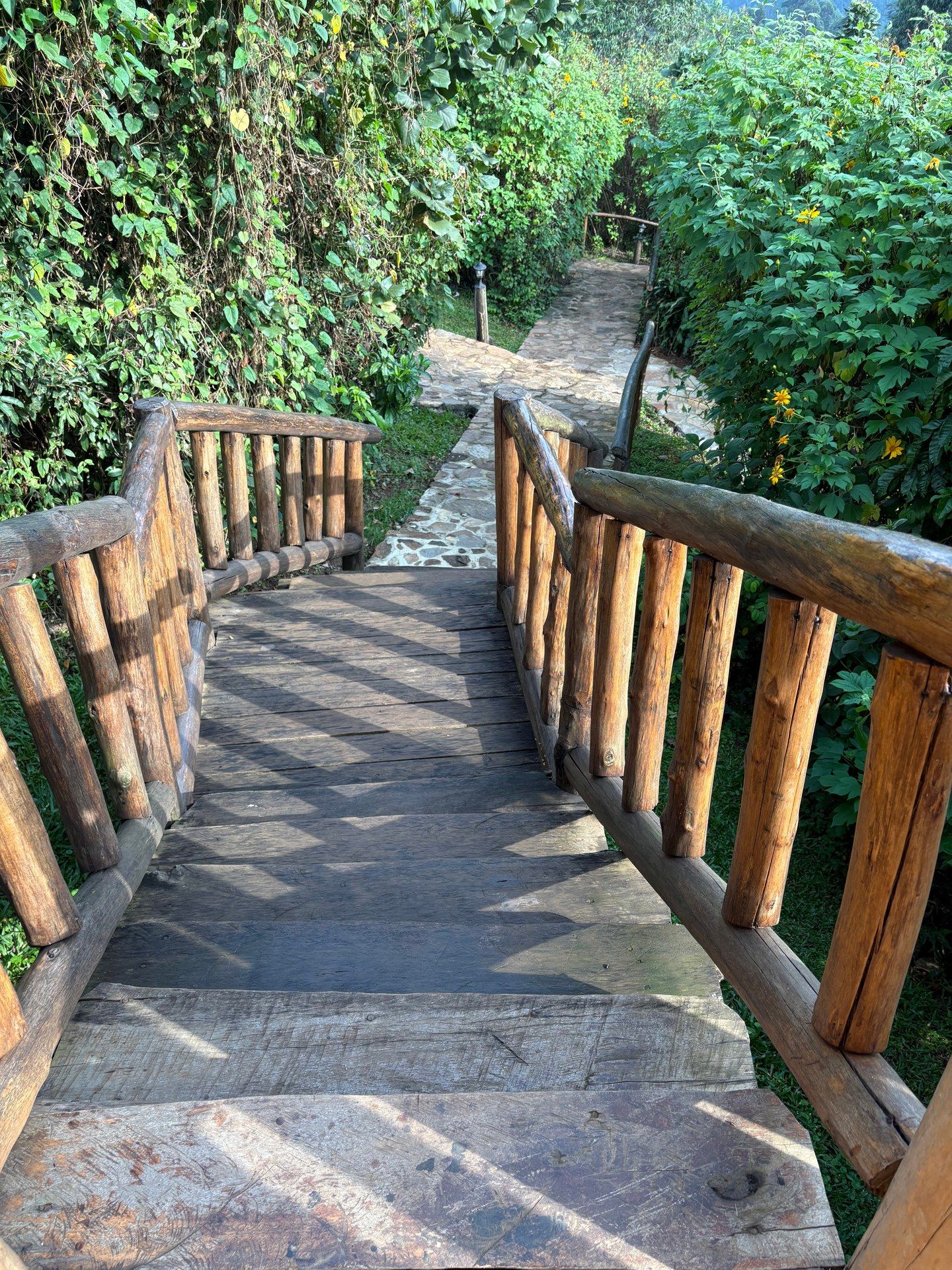
The stairs at Gorilla Bluff Lodge in Buhoma are the first thing that make it clear you are not in an ordinary hotel. They lead from the guest rooms up toward the main house — hewn from raw timber trunks, embedded into a slope that rises at something close to sixty degrees, flanked on both sides by forest vegetation that begins immediately where the construction ends. During our January 2026 stay, we climbed them at least four times a day. After a morning gorilla trek involving two or three hours of uphill walking through dense rainforest, those stairs were a genuine challenge. I mention this not as a complaint — the lodge is excellent — but because it encapsulates something that no comparison table can adequately represent: every lodge at Bwindi Impenetrable National Park is built into a mountainside, and the physical reality of the location is part of the experience whether you are staying at a budget guesthouse or a twelve-tent luxury camp.
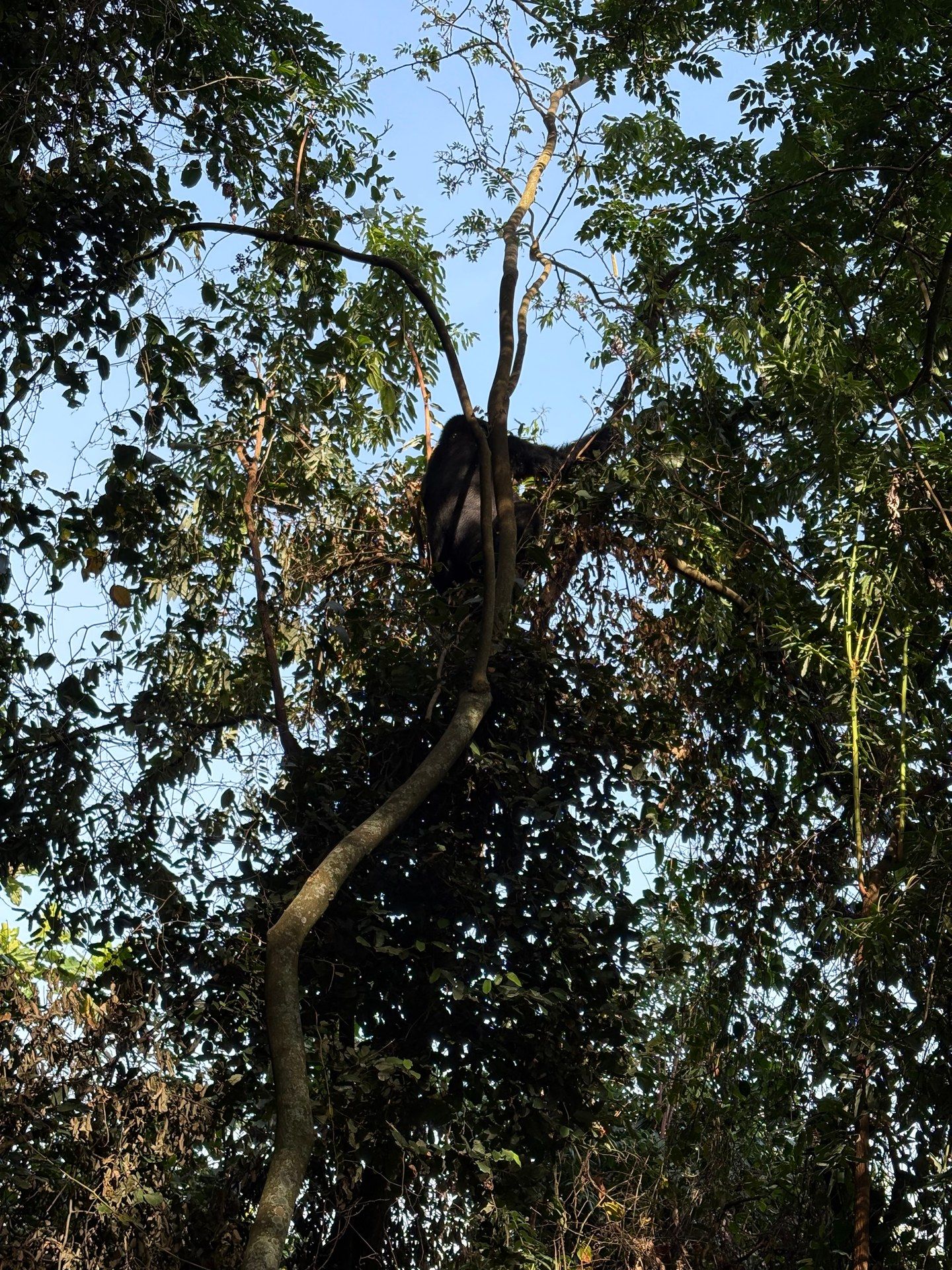
Choosing a lodge for gorilla trekking at Bwindi is not primarily a decision about amenities, dining, or pool access. It is a decision about which sector's gorilla families you will trek to, how far you will travel from your room to the briefing point on trek morning, and what the rest of the day — after the encounter — will look like. I have visited Bwindi on five separate occasions, including a four-day stay in January 2026 that included two gorilla treks in the Buhoma sector, and returned in June 2026 for a further encounter documented in the photograph above. This guide uses those visits, and the seven GPS-tagged photographs that are their evidence, to make the comparison concrete.
The Single Most Important Decision: Which Sector?
Every conversation about Bwindi lodge selection begins with the wrong question. Most travellers ask "which lodge has the best reviews?" when the question that actually determines their experience is "which sector am I trekking in?" This matters because permits are sector-specific — a Buhoma permit requires a Buhoma-based tracker, and a booking at a Rushaga lodge paired with a Buhoma permit means a two-hour vehicle transfer in each direction on trek morning. The lodge-and-permit combination must match.
The four sectors — Buhoma in the north, Ruhija in the northeast, Nkuringo in the southwest, and Rushaga in the south — each have a distinct character, a distinct lodge cluster, and a distinct gorilla family portfolio. Buhoma is the most established and has the widest range of accommodation. Rushaga has the most habituated gorilla families of any single sector, which means more permit availability. Nkuringo sits at the highest altitude with the most dramatic landscape. Ruhija is the birdwatching sector with the fewest accommodation options.
| Sector | Position | Gorilla families | Lodge range | Notable |
|---|---|---|---|---|
| Buhoma | North (1,450 m) | Several habituated | Budget to ultra-luxury | Oldest gate; only lodge inside park |
| Ruhija | Northeast (high altitude) | Multiple families | Limited options | Birdwatching capital; Albertine Rift endemics |
| Nkuringo | Southwest (2,000–2,090 m) | Including habituated study groups | Mid-range to luxury | Highest elevation; Congo views |
| Rushaga | South (near Rwanda border) | Largest number at any gate | Budget to mid-range | Rwanda gateway; Batwa community programmes |
The permit availability implication of the Rushaga sector is worth emphasising. Because Rushaga has more habituated gorilla families than any other single gate, it offers more permits per day — typically a larger number of eight-person trekking groups can depart simultaneously. This makes Rushaga the most reliable sector for late-booking travellers, for large groups, or for anyone visiting during peak season (June to August, December to February) when Buhoma permits sell out weeks in advance.
The Lodges: What Each One Actually Offers
The five lodges most closely associated with specific trekking gates are worth comparing in detail. These are not the only properties in the Bwindi area — a comprehensive directory of all accommodation options is available in our full lodge directory — but they are the ones that best illustrate the range of choices and the considerations that distinguish them.
Sanctuary Gorilla Forest Camp — Buhoma Sector
Sanctuary Gorilla Forest Camp holds a distinction shared by no other Bwindi property: it sits inside the park boundary. The camp's eight tented suites are embedded in the forest itself, which means guests fall asleep to the sounds of the forest at night, encounter birds and small mammals on the path between tent and dining area, and walk to the trekking briefing point without ever leaving the vegetation. The camp is operated by Sanctuary Retreats, and the full-board rate reflects both the positioning and the operational complexity of running any structure within a UNESCO World Heritage Site. It is the clear choice for guests for whom the immersive forest experience is the primary priority, and for whom proximity to the morning briefing matters above all other factors.
Rushaga Gorilla Camp — Rushaga Sector
At the opposite end of the price spectrum from Sanctuary Forest Camp, Rushaga Gorilla Camp provides basic but functional accommodation close to the Rushaga gate. The camp's primary advantage is permit availability: trekking from Rushaga means access to the largest number of habituated gorilla families at any single Bwindi gate, and same-week bookings are more frequently possible here than in Buhoma. The Rushaga sector also has a strong connection to the Bwindi Batwa Development Association, which runs community resource management programmes integrating the Batwa communities who have lived around the park's southern boundary for generations — a cultural context that some travellers find adds important depth to the visit. Accommodation at Rushaga Gorilla Camp is simple; the trekking experience itself is as compelling as at any other sector.
Clouds Mountain Gorilla Lodge — Nkuringo Sector
Clouds Mountain Gorilla Lodge is the highest lodge in Uganda, positioned at approximately 2,000 metres in the Nkuringo sector with clear-day views into the Democratic Republic of Congo. The lodge is a joint venture between Wildplaces Africa and the African Wildlife Foundation, which connects it to a broader conservation network in the Bwindi region. The altitude affects the experience in practical ways: temperatures at Nkuringo are significantly colder than at Buhoma, particularly at night, and the morning mist at this elevation is dense and persistent. The trek from the Nkuringo gate descends into the forest before rising again — a physical profile that differs from Buhoma's predominantly upward approach and that many guides consider more demanding. The lodge itself is architecturally the most dramatic of Bwindi's properties, with uninterrupted views that are simply not available at lower elevations.
Nkuringo Bwindi Gorilla Lodge — Nkuringo Sector
Nkuringo Bwindi Gorilla Lodge sits at 2,090 metres — eighteen rooms on a community-owned property that works with the Uganda Carbon Bureau on carbon offset initiatives. The community ownership model means that revenue from stays is channelled into local development programmes rather than leaving the region. The Nkuringo sector also hosts a demonstration plot for medicinal plants — a maintained record of the traditional botanical knowledge held by communities who have farmed alongside the forest boundary for generations. For travellers for whom sustainability and community benefit are explicit booking criteria, Nkuringo Bwindi Gorilla Lodge offers the most clearly documented evidence that the visit contributes to local livelihoods.
Ruhija Gorilla Safari Lodge — Ruhija Sector
The Ruhija Gorilla Safari Lodge provides rustic timber cottages near the Ruhija trekking starting point, operated by the Asyanut Safari company. Ruhija is the sector with the fewest accommodation options in Bwindi, and serious multi-day visitors — particularly those combining gorilla trekking with birdwatching, which is Ruhija's primary draw — should confirm availability in advance. Bwindi holds more than 350 of Uganda's 1,070-plus recorded bird species, and the Ruhija sector concentrates the park's Albertine Rift endemic species. A multi-day stay here, combining a gorilla trek with serious birdwatching, is a genuinely different programme from any other sector.
| Lodge | Sector | Tier | Distinctive feature | Best for |
|---|---|---|---|---|
| Sanctuary Gorilla Forest Camp | Buhoma | Ultra-luxury | Only lodge inside park | Maximum immersion |
| Gorilla Bluff Lodge | Buhoma | Mid-range | Short walk to park gate; personal author stay Jan 2026 | Value and proximity |
| Rushaga Gorilla Camp | Rushaga | Budget | Most gorilla families at gate; Rwanda gateway | Permit availability |
| Clouds Mountain Gorilla Lodge | Nkuringo | Ultra-luxury | Highest lodge in Uganda; Congo views | Dramatic landscape + trek |
| Nkuringo Bwindi Gorilla Lodge | Nkuringo | Mid-range | Community-owned; carbon offset programme | Sustainability priority |
The Gorilla Encounter: What the Lodge Comparison Cannot Tell You
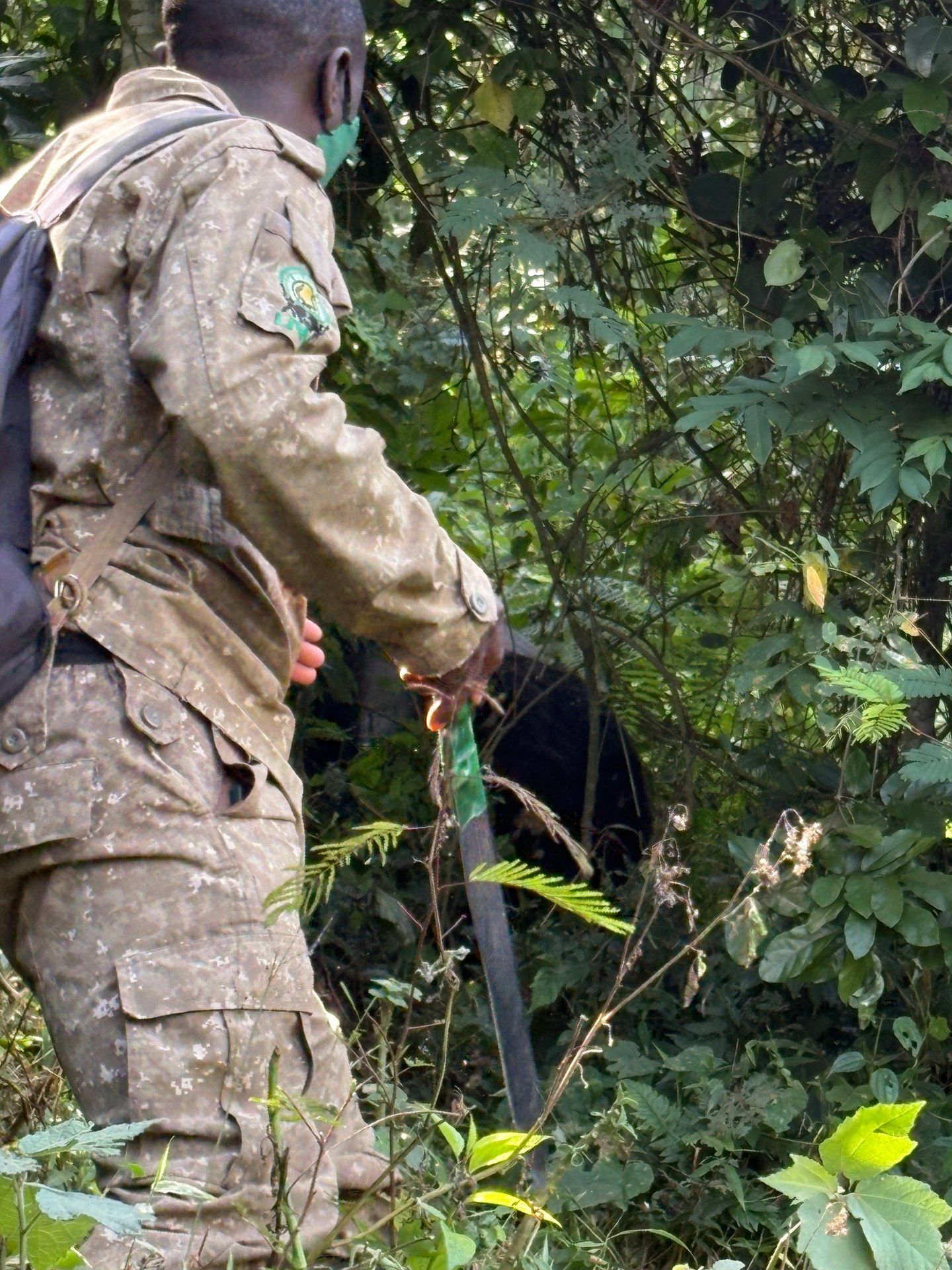
On our January 2026 trek in Buhoma sector, the group was led by a UWA guide and accompanied by two armed rangers. I had not expected the armed presence — this is a managed wildlife tourism programme in a functioning national park, not an expedition into uncharted wilderness — but the rangers made it unremarkable within minutes. They were attentive, good-humoured, and physically helpful on the steep ascents. At one point, where the trail had eroded into a wet clay face, both rangers positioned themselves as anchors for the group to hold as they climbed. The weapons were a practical reality of operating in a remote forest environment where other large animals, including forest elephants and buffalo, share the space with trekking groups. They were carried without drama.
After approximately one hour of walking, we reached the first gorilla family. One large adult had settled in a tree directly above the clearing we entered — sitting in the upper branches, eating leaves with methodical attention, entirely indifferent to the eight people watching from below. A second encounter in June 2026 required closer to three hours of walking and found the family in a more open area of forest, where several members were visible simultaneously. The variability is fundamental to the experience: no trek has a guaranteed duration or a guaranteed composition of the family encountered. What Uganda Wildlife Authority guarantees is the sixty-minute maximum with the family once found, and the minimum seven-metre distance regulation.
The seven-metre rule is a conservation measure informed by decades of disease transmission research. Mountain gorillas share approximately 98% of human DNA, which makes them unusually susceptible to human-borne pathogens. The 459 individuals counted in the UWA survey of 2018–2020 represent the majority of the world's total mountain gorilla population — the species exists in two populations, one in the Virunga Massif spanning Rwanda, Uganda, and the DRC, and one entirely within Bwindi. At a population this small, a respiratory disease outbreak transmitted from tourist contact could have population-level consequences. The sixty-minute encounter limit and the minimum distance regulation exist because of this, and they are enforced actively by the UWA guides who accompany every group.
The lodge's role in the encounter day begins the night before and continues through the afternoon after the trek. Every lodge in the Buhoma area prepares packed lunches for trek day — there are no cafés or food vendors at the park gate or on the trail. Most properties hold a pre-trek briefing for guests in the evening, covering what to wear (long sleeves, long trousers, waterproof layer, sturdy walking boots), what to carry (one litre of water minimum, camera, snacks), and what to expect of the physical terrain. This briefing quality varies considerably between properties and is worth asking about when booking. It is one area where mid-range lodges with experienced guide teams occasionally outperform luxury properties whose guest services are strong but whose specific gorilla trekking expertise is thinner.
Uganda vs Rwanda for Gorilla Trekking: An Honest Comparison
The comparison between Uganda and Rwanda for gorilla trekking is one of the most frequently asked questions in the category, and it deserves a direct answer rather than the diplomatic non-answer that most content in this space provides. Both countries offer genuine encounters with habituated mountain gorilla families. Both operate under the same UWA/RDB management framework of permits, guides, and UWA or RDB rangers. The differences are real and consequential.
| Factor | Uganda (Bwindi) | Rwanda (Volcanoes NP) |
|---|---|---|
| Permit price | USD 800 | USD 1,500 |
| Gorilla population (mountain) | 459 in Uganda (majority world total) | Virunga population shared with Uganda + DRC |
| Average trek duration | 1–4 hours (varies by family location) | Typically shorter (open terrain Virungas) |
| Forest type | Dense impenetrable rainforest | Montane forest and bamboo zones |
| Road to park | Partially unpaved; journey time from Kampala 8–10 hrs | Well-paved; ~2 hrs from Kigali |
| Combined itinerary options | Safari (Queen Elizabeth, Murchison Falls), Lake Bunyonyi, Kibale chimps | Shorter trip; Rwanda-only or Rwanda + Uganda |
| Recommendation | Better value; larger gorilla population; longer trip | Easier logistics; premium experience; higher cost |
The permit price difference — USD 800 versus USD 1,500 — is substantial and makes Uganda significantly more accessible for travellers who want to include the gorilla trek in a longer east Africa itinerary without the permit consuming the majority of the accommodation and transport budget. Rwanda's advantage is logistics: the drive from Kigali's international airport to the Volcanoes National Park gate is approximately two hours on good tarmac. The equivalent journey from Entebbe to any Bwindi sector gate is eight to ten hours, with the final section on unpaved road. This matters not as a mark against Uganda but as a practical calculation: a Rwanda gorilla trekking trip can be done in three days from any European hub; a Bwindi trip warrants at least five days, and ideally seven to ten if combined with other Uganda national parks.
The terrain difference is also meaningful. Bwindi's forest is genuinely impenetrable in character — the vegetation is dense, the light is low, and the trekking terrain involves steep gradients on paths that are sometimes barely visible. The Virunga Massif in Rwanda offers a more open landscape with larger clearings and more predictable underfoot conditions. Neither is superior; they are different experiences of proximity to the same animal. The word "impenetrable" in Bwindi's name is not marketing language — it is a direct description of the forest that makes the encounter feel, once achieved, genuinely hard-won.
Gorilla Trekking in the Rain: Season, Trail Conditions, and What Changes
Our January 2026 visits to Buhoma fell in one of Bwindi's dry periods — January and February typically see lower rainfall than the rest of the year, and the trails were firm and navigable. Our June 2026 return visit caught the edge of the longer dry season, which runs from June through August. The photographs taken on both visits show the forest in the lush, deeply green state that characterises a functioning tropical rainforest even in its dry seasons.
Bwindi has two main rainy seasons: a longer one from March through May, and a shorter one from September through November. Gorilla trekking operates year-round through both. The gorillas are genuinely indifferent to rain — they continue feeding, moving, and interacting with the same behaviours regardless of weather conditions. The photography changes: cloud cover and heavy rain reduce available light significantly, and the close-range shots that define the best gorilla encounter photographs require enough light to avoid motion blur. The trail conditions change: clay soils that are navigable in dry conditions become a different proposition in heavy rain, and the steep sections that require careful footing in any weather require more attention and more energy in wet conditions. Gaiters — waterproof coverings that seal the gap between boot and trouser — move from optional to strongly recommended in the wet season.
The forest itself is arguably more atmospheric in rain. When we spent time in the Bwindi forest in January 2026, the air was clear and the canopy visible. The photographs from that visit show strong light penetrating the mid-level branches. Guides who take groups through Bwindi in the rainy season describe a different quality — mist filling the lower levels of the forest, the sound of rain on the canopy creating a continuous background, the animals moving more slowly and spending more time in sheltered positions. For travellers willing to accept the physical demands of wet trails, the rainy season can produce the most visually memorable encounters.
The practical lodge consideration for wet-season trekking is whether the property provides equipment beyond the standard packed lunch. The best Bwindi lodges stock gaiters and walking poles available for hire at or near the gate, brief guests in advance on wet-weather packing, and have laundry facilities that can dry equipment overnight for multi-day stays. These details are worth confirming directly with the property rather than assuming them from general descriptions.
Lake Bunyonyi, Leonard Sharp, and the Conservation History Behind the Forest
Any visit to the southwestern Uganda region that includes Bwindi is likely to pass through, or at least within sight of, Lake Bunyonyi. The lake sits roughly fifty kilometres northeast of the Buhoma gate, and the road between them passes through high agricultural land that provides some of the most visually striking scenery in Uganda outside the national parks themselves. Lake Bunyonyi is a caldera lake at 1,962 metres, filled with islands and surrounded by terraced hillsides that descend sharply to the water. It functions as the natural rest stop for travellers approaching Bwindi from Kabale, and many multi-day Bwindi itineraries include a night on the lake — either at one of the islands or at a lakeside property on the main shore.
The lake's islands include Bwama Island, where in 1921 Leonard Sharp, a Scottish missionary and physician, established a hospital for leprosy patients. Sharp's hospital was one of the earliest structured healthcare interventions in southwestern Uganda and operated for decades as the primary medical facility for the surrounding region. The island and its buildings are still visible, though the hospital has long since ceased operation. Sharp represents a particular chapter in the history of Western engagement with this part of Africa — one in which the line between genuine humanitarian commitment and the complex power dynamics of colonial medical practice runs through the same individual. His name appears in the regional history of southwestern Uganda, and the Lake Bunyonyi visit is a natural opportunity to encounter that history directly.
The gorilla conservation history of Bwindi begins somewhat later. The park was gazetted in 1991, built on the earlier designation of a forest reserve, and received UNESCO World Heritage status in 1994. Gorilla trekking began commercially in 1993 with the first habituation of families in the Buhoma sector — a process that takes roughly two years of daily non-threatening human contact before a gorilla family becomes sufficiently comfortable with human presence to permit close observation. The population figure of 459 individuals in the 2018–2020 UWA survey represents genuine recovery from a nadir in the 1980s when mountain gorilla numbers in Uganda fell below 300. The current global mountain gorilla population — split between the Bwindi-only Bwindi population and the Virunga Massif population — is the only great ape subspecies whose numbers are increasing rather than declining.
The conservation revenue from gorilla trekking permits is a direct contributor to this recovery. Uganda Wildlife Authority directs a portion of permit income into community development programmes for villages around the park boundary — a mechanism designed to align the economic interests of local communities with the continued existence of the forest and its gorilla families. The logic is simple and well-documented: a community that earns income from a functioning gorilla population is less likely to encroach on the forest boundary than a community whose primary concern is agricultural land expansion. Whether this mechanism works consistently in practice, and whether it is capturing the right communities in sufficient amounts, is the subject of ongoing research and debate that any honest account of gorilla tourism must acknowledge.