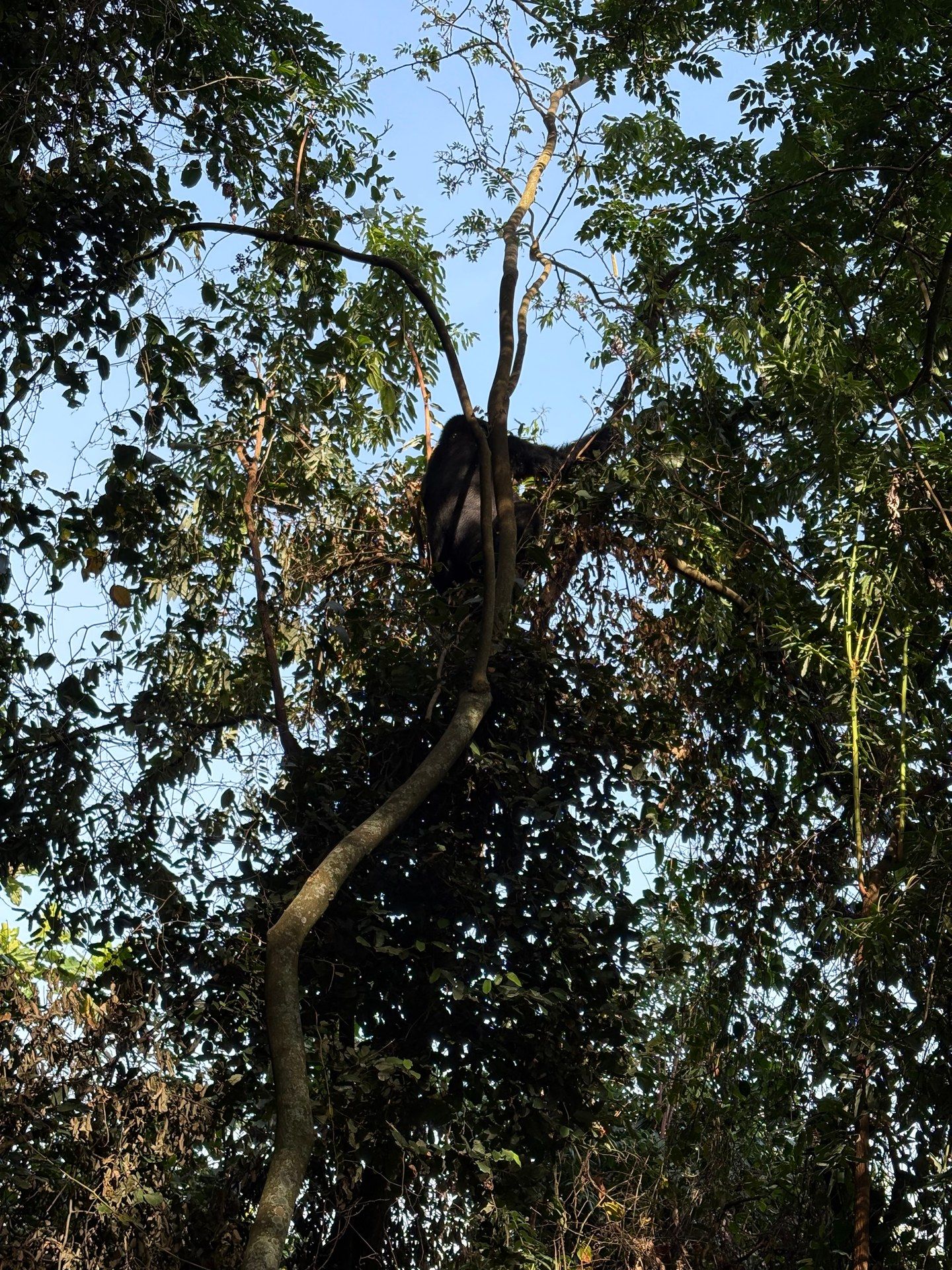
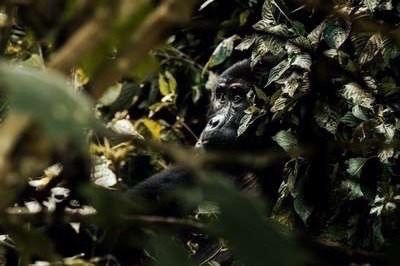
After three hours of walking through Bwindi Impenetrable National Park in January 2026, the tracker stopped, and the group stopped behind him. We were close — closer than the seven-metre guideline had implied would feel normal. The gorilla family was settled in a small clearing, several individuals moving through the vegetation at the group's margins with no more concern than a herd of cattle might show at the gate of a field. One adult held its position and looked directly at the group with an attention that was unhurried and apparently complete. The GPS coordinates of that encounter — approximately -0.9705°N, 29.6195°E, confirmed across seven GPS-tagged photographs taken across the same visit — place it inside the southern Buhoma trekking corridor. The whole experience, the walk and the hour with the family, was the reason the lodge booking had been made three months earlier.
That sequence — permit confirmed, lodge booked to match, physical proximity to the gate — is the fundamental logic of Bwindi accommodation. A guest who is staying in the right sector, close to the right gate, on the right permit date is in the best position the lodge market can offer. A guest in the wrong sector, or in generic accommodation far from the gate, is making a logistically harder version of the same trip for no gain. This guide explains how those decisions interlock: which sector, which lodge tier, which properties stand out, and when to book.
The information here is based on direct visits to Bwindi in January 2026 and October 2024, on documentation of the lodge market sourced from operator materials and Uganda Wildlife Authority data, and on personal observations from Buhoma, Gorilla Bluff Lodge and the Bwindi trekking trail. Where specific prices, room counts or operational details are unknown or unverified for 2026, this guide omits them rather than repeating figures from 2020 guidebooks that may no longer apply.
The Four Questions Every Bwindi Lodge Choice Rests On
1. Which sector is your permit for?
Bwindi Impenetrable National Park has four gorilla trekking sectors — Buhoma, Rushaga, Ruhija and Nkuringo — each with its own gate, its own pool of habituated gorilla families and its own cluster of accommodation. A permit for Buhoma cannot be used at the Rushaga gate, and vice versa. This means the first constraint on lodge choice is not budget or style: it is which sector your permit has been issued for. Everything else cascades from that fixed point.
If you are choosing your sector and you have flexibility, the differences are significant. Buhoma in Kanungu District is the most established sector with the most diverse accommodation inventory, the best community tourism infrastructure (the Buhoma Community Walk, Buhoma Community Rest Camp, and Ride 4 a Woman NGO are all based here) and the widest range of additional activities. Rushaga in Kisoro District is the only sector offering the Gorilla Habituation Experience — a 1,500 USD permit that allows four hours with a family currently undergoing habituation to human presence. Rushaga also has the most visible Batwa community engagement of the four sectors. Ruhija in the park's north-east is remote, at altitude, and the best sector for montane birding alongside the gorilla trek. Nkuringo in the south has the most physically demanding terrain of the four — the descent from the ridge to the park floor is steep in both directions — and is served by Clouds Mountain Gorilla Lodge, one of the highest-altitude permanent lodges in Uganda.
2. How close to the gate do you need to be?
Trekking begins at the sector gate at approximately 08:00 every morning. Being within walking distance of the gate — rather than requiring a 30-minute vehicle transfer — simplifies the morning significantly and allows an unhurried start. In Buhoma, Sanctuary Gorilla Forest Camp sits directly at the park boundary, making it the shortest walk to the briefing point. Gorilla Bluff Lodge, where we stayed in January 2026, is approximately 10–15 minutes from the gate on foot — close enough that the transfer is negligible. Budget lodges and community rest camps in Buhoma are also within a reasonable walking distance or a short boda-boda ride.
In Rushaga, Ruhija and Nkuringo, the lodge-to-gate distances are similarly small — the cluster of lodges in each sector has developed specifically around the gate, not at a distance from it. There is no sector where the recommended accommodation requires a long road transfer on the morning of the trek. The issue is not distance but the specific lodge's position relative to the briefing point, which is worth confirming at the time of booking.
3. What budget are you working with?
The Bwindi accommodation market spans a range of roughly 50 USD to 1,500 USD per room per night across budget rest camps, mid-range private lodges and luxury tented camps. The permit cost (800 USD per person, UWA 2026) is the dominant budget item for most visits. A traveller who has committed to the 800 USD permit is often in a position where the lodge cost represents a smaller proportion of the total than the permit itself, which shifts the value calculation: a premium lodge at 500–700 USD per night represents a 60% increment on the already-committed permit cost, not a new category of expenditure.
4. Do you want extra days and activities beyond the trek?
One night before and one after the trek is the minimum practical stay in any Bwindi sector. Two or three nights allows time for the community activities, forest walks and rest that make a gorilla trekking trip a complete experience rather than a logistics exercise. In Buhoma, the extra day might go to the Buhoma Community Walk, a guided forest walk inside the park, or a mountain bike tour with Ride 4 a Woman. In Rushaga, it might go to a Batwa cultural visit. In Nkuringo, the dramatic view from the lodge over the Virunga volcanoes is itself a reason to stay longer. Lodges that offer guided activities beyond the permit trek — and that have accumulated the local knowledge to make those activities genuinely substantive — are worth paying a premium for. The alternative is a trek-and-depart visit that uses the lodge only as a bed for two nights.
Sanctuary Gorilla Forest Camp — Buhoma's Boundary Lodge
Sanctuary Gorilla Forest Camp is the property in Buhoma that sits closest to the park boundary — its tented suites are positioned at the forest edge, meaning guests can hear the forest at night and step into the briefing area without needing a vehicle or a long walk. It is operated by Sanctuary Retreats, which is part of the Abercrombie & Kent Group, one of the larger luxury travel operators on the African continent. That ownership context matters for travellers booking through larger tour operators or travel agents: Sanctuary Gorilla Forest Camp will be the property that high-end international operators default to when building a Uganda itinerary for clients at the luxury end of the market.
The property's long operational presence in Buhoma is its most substantive asset beyond location. Sanctuary Gorilla Forest Camp has been running treks from the Buhoma gate since before many of its current competitor properties in the sector were built. That accumulated operational history means the camp's tracker teams and guides have a direct relationship with the Buhoma sector's gorilla families that is deeper than anything a newer property can replicate from fresh. The families the guides have watched grow — silverbacks they have known as adolescents, new infants they have tracked through the forest — give the experienced tracker-guide a narrative depth in the one-hour encounter that makes the experience richer for the guest.
The tented camp format — permanent structures with canvas walls rather than solid construction — is a specific design choice in this context. Canvas walls mean the sounds of the forest are present inside the tent at night: the calls of insects, the occasional distant movement of large animals, the rain on the roof when it comes. This is either exactly what a guest wants or a genuine sleep disruption, depending on the person. Travellers who need silence and total sensory separation from the outdoors to sleep well would be better served by a solid-construction lodge room like those at Gorilla Bluff Lodge. Travellers who want to feel the forest surrounding them throughout their stay will find the tented format the more authentic option.
For guests who are not travelling through an international operator with a pre-existing relationship with Sanctuary Retreats, the camp can be booked directly through its website or through a Ugandan licensed tour operator. Misty Gorilla Expeditions, the tour operator associated with bwindi-lodges.com, can arrange both the UWA permit and the Sanctuary Gorilla Forest Camp booking as part of a combined package — a practical choice for travellers who want the logistics handled in one place rather than coordinating separately with UWA, the lodge and an international agent.
All Four Sectors — Lodge Options and What Distinguishes Them
Buhoma — North-West, Established, Community-Rich
The Buhoma sector is Bwindi's gateway in the fullest sense — not just geographically but historically, as the first sector to be developed for gorilla tourism when permits were introduced in the early 1990s. Its lodge inventory reflects thirty-plus years of development: Sanctuary Gorilla Forest Camp at the luxury end, Gorilla Bluff Lodge and Buhoma Lodge as substantial mid-to-upper lodges built into the hillside, the community-run Buhoma Community Rest Camp at the accessible end, and Bwindi Backpackers Lodge and Amajambere Iwacu Community Camp for budget travellers. The sector also has the strongest extra-trek activity infrastructure of the four: the Buhoma Community Walk (guided through the village and adjacent farms), the forest ecosystem walks inside the park boundary, and Ride 4 a Woman's mountain bike programme all operate reliably from Buhoma.
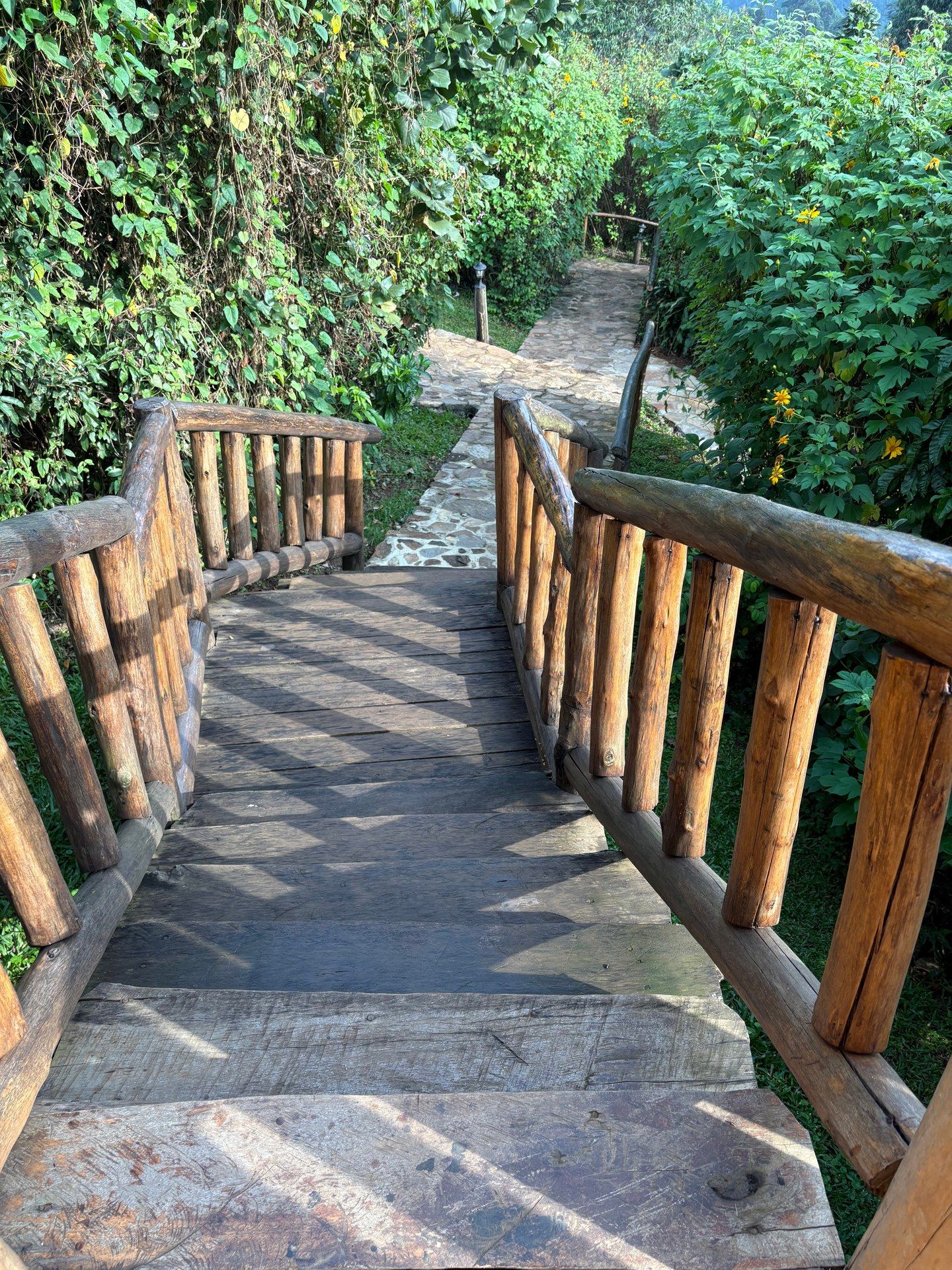
During our January 2026 stay at Gorilla Bluff Lodge, the mornings began with coffee and African tea on the private terrace of the room — a view across the forested valley below, GPS confirmed at -0.979°N, 29.617°E. Breakfast followed: fresh fruit (mango, banana, melon) before the walk to the gate. The lodge is built directly into the mountain; the stairs between rooms and the main lodge building are steep timber-and-earth constructions that establish the physical character of the place before the trek even begins. None of this is accidental — the lodges that have lasted in Buhoma are the ones that understood the terrain as an asset rather than a problem to be engineered away.
Rushaga — South, Batwa Communities, Habituation Experience
Rushaga is the sector for travellers who want the Gorilla Habituation Experience — the extended four-hour permit priced at 1,500 USD (UWA 2026; verify current pricing before booking) that allows a group to spend a morning with a family still in the habituation process. This is a categorically different experience from the standard one-hour permit encounter: less polished in terms of predictable viewing, but potentially more revealing about gorilla behaviour as the family interacts with its forest environment under less compressed conditions. Rushaga is also the sector with the strongest Batwa community presence and the most developed community revenue management (CRM) programmes in the Bwindi area. Lodges in Rushaga include Rushaga Gorilla Camp, Nkuringo Bwindi Gorilla Lodge (which is on the Rushaga/Nkuringo boundary, GPS and sector routing should be confirmed at booking) and several smaller properties.
Nkuringo — South, High Altitude, Clouds Mountain Gorilla Lodge
Nkuringo sits on a ridge above 2,000 metres with views, on clear days, across the Virunga volcanic chain to the south. The descent to the park floor and back is the steepest climb of the four sectors; Nkuringo treks are routinely described by experienced trackers as the most physically demanding in Bwindi. This is also the sector for Clouds Mountain Gorilla Lodge, operated by Wildplaces Africa in partnership with the African Wildlife Foundation — the highest-altitude permanent lodge in Uganda and one of the most architecturally distinctive properties on the Bwindi circuit. The AWF partnership gives the lodge a direct connection to the conservation science active in the area.
Nkuringo Walking Safaris operates multi-day guided walks from this area — connecting Bwindi to Kisoro, Lake Mutanda and the communities east of the park through canoe-and-walk itineraries that use the landscape between designated trekking points rather than simply the single-trek permit model. For travellers who want to spend several days in the Bwindi region moving through the forest terrain rather than returning to the same lodge each night, Nkuringo Walking Safaris offers the most developed multi-day option.
Ruhija — North-East, Remote, Exceptional Birding
Ruhija in the park's north-east is the least visited of the four sectors and sits at approximately 2,300 metres — higher than Buhoma, quieter in terms of visitor numbers, and with the montane forest character that produces the highest bird species diversity. The Ruhija sector's gorilla families are smaller in number but the trek groups are also smaller, which means a calmer, more personal encounter for the group that reaches the family. Ruhija Gorilla Safari Lodge is the main accommodation at this sector — a rustic property with double rooms and timber cottages operated by Asyanut Safaris. Ruhija Community Rest Camp offers a more basic option at lower cost. The drive from Kabale to Ruhija via the park's north side is scenic but requires a 4WD vehicle and patience with the road surface after rain.
Price Tiers at Bwindi — From Community Rest Camps to Luxury Tented Camps
The Bwindi accommodation market has three broadly distinguishable tiers, though the boundaries between them shift with exchange rates and annual pricing reviews. All figures below are approximate and must be verified directly with the property before booking — the 2020 Reiseführer prices that appear in many online guides are not reliable for 2026.
| Tier | Price Range | Example Properties | Best For |
|---|---|---|---|
| Budget | On request | Buhoma Community Rest Camp, Bwindi Backpackers Lodge, Ruhija Community Rest Camp | Independent travellers; community tourism priority |
| Mid-range | On request | Gorilla Bluff Lodge, Rushaga Gorilla Camp, Ruhija Gorilla Safari Lodge, Nkuringo Bwindi Gorilla Lodge | Most travellers; good value against permit cost |
| Premium | On request | Sanctuary Gorilla Forest Camp, Clouds Mountain Gorilla Lodge, Volcanoes Bwindi Lodge, Buhoma Lodge | Full-service itineraries; full-board inclusions; guided activities beyond the trek |
All Bwindi lodge prices must be verified directly with properties. The permit (800 USD, UWA 2026) is separate from and additional to lodge accommodation costs.
The community-run options — Buhoma Community Rest Camp being the most visible — deserve specific mention beyond their budget positioning. These properties return accommodation revenue directly to the village community rather than to an external lodge operator. For a traveller who wants their spending to flow as directly as possible to the people who live adjacent to the park, the community lodge is the principled choice even if the facilities are simpler than a private lodge would offer. Buhoma Community Rest Camp is one of the longest-operating community-owned accommodation properties in Uganda; its founding followed the creation of community revenue sharing programmes that channel a percentage of gorilla permit fees back to the communities around the park boundary.
The full-board or all-inclusive pricing models at the premium lodges typically include meals, park fees for non-gorilla activities, and guiding. When comparing a premium lodge at, for example, 600 USD per room per night full-board against a mid-range lodge at 200 USD per night room-only, the real comparison requires adding the cost of all meals, guiding and other activities to the mid-range figure before concluding that the price gap is threefold. In practice, the gap narrows significantly once all cost components are accounted for, which is why the premium lodges at Bwindi compete effectively despite their headline rates.
Booking Strategy — Permits First, Lodge Second
The most common booking error at Bwindi is attempting to run the process in reverse — choosing a preferred lodge based on its website photography or reviews, and then trying to obtain a gorilla trekking permit that matches. The problem is that permit availability is determined by a combination of the gorilla families' current habituation status, the sector allocation for the requested date, and the number of permits already sold for that family on that day (maximum eight). A sought-after permit date in Buhoma's peak season can be fully sold out while permit availability at Ruhija or Rushaga for the same week remains open. Committing to a Buhoma lodge before confirming a Buhoma permit is committing to the wrong location.
The correct sequence is: (1) decide your travel window; (2) contact Uganda Wildlife Authority (UWA) directly or through a licensed operator to check permit availability for the window; (3) book the permit once availability is confirmed; (4) book the lodge in the same sector as the confirmed permit. If you are travelling in the June–September or December–February high season, steps 1 and 2 should happen at least four to six months before your intended travel date. Lodge availability generally outlasts permit availability — it is the permit that will force you to move faster, not the accommodation booking.
For travellers who want to avoid managing the permit and lodge booking separately, a Ugandan licensed tour operator can handle both simultaneously. Misty Gorilla Expeditions, the operator associated with bwindi-lodges.com, specialises in exactly this combination — permit procurement, sector-matched lodge booking, transfer logistics and activity coordination across the Bwindi sectors. The practical advantage is a single point of contact who knows both the current permit availability and the current lodge situation, rather than the traveller managing two separate booking threads that need to synchronise.
For travellers arriving from Kampala by road — the standard approach at eight to nine hours by vehicle — the logistics of a multi-sector Bwindi visit require advance planning on transfer timing. The road from Kampala to Buhoma runs through Masaka, Mbarara and Kabale before descending on an unpaved final section to the lodge cluster; Buhoma is not an airport-to-lodge same-day transfer in any comfortable sense. Building in one night in Kabale (Uganda's highest town, approximately 1,890 metres, two hours from Buhoma) turns the Kampala–Bwindi leg into two manageable days rather than one exhausting one and positions guests to arrive rested for the morning trek.
The season question — when to go — is independent of which lodge you choose, because gorilla trekking operates year-round regardless of weather. The drier seasons (June to September, December to February) offer firmer trails and clearer mornings; the wetter seasons (March to May, October to November) bring heavier trail conditions but also lower permit competition and a forest that is at its most visually lush. Both of our Bwindi visits — January 2026 and October 2024 — took place outside the peak high season and encountered no difficulty with permit availability or lodge space, though booking was still done two to three months in advance.
Frequently Asked Questions
Which is the closest lodge to the Buhoma gorilla trekking gate?
+
Sanctuary Gorilla Forest Camp is the lodge closest to the Buhoma trekking gate — its tented suites sit at the park boundary. Gorilla Bluff Lodge is approximately 10–15 minutes on foot uphill from the gate; Buhoma Community Rest Camp is also within walking distance. For any lodge in Buhoma, transfers to the gate on trek morning can be arranged through the lodge itself. Confirm the exact distance and transfer arrangement at booking, not on the morning of the trek.
What is Sanctuary Gorilla Forest Camp like?
+
Sanctuary Gorilla Forest Camp is a luxury tented camp at the boundary of Bwindi Impenetrable National Park in Buhoma, operated by Sanctuary Retreats (Abercrombie & Kent group). Its tents sit at the forest edge. Its long operational history in Buhoma gives it a depth of familiarity with the sector's gorilla families and terrain that newer properties cannot match. The tented format means forest sounds are present inside — a feature for guests who want full immersion, a potential sleep disruption for those who need silence.
Do I need to book my Bwindi lodge before or after my gorilla permit?
+
Book your gorilla permit first. Permits are the binding constraint — issued for specific families in specific sectors on specific dates, with a maximum of eight visitors per family per day. Commit to the permit; then book the lodge in the same sector. Booking a lodge first and hoping for a matching permit is the wrong sequence and regularly leads to mismatched accommodation-and-sector situations.
What is the difference between Buhoma and Rushaga lodges?
+
Buhoma is the most established sector with the widest accommodation range, the best community tourism infrastructure (Buhoma Community Walk, Ride 4 a Woman, Buhoma Community Rest Camp) and the most developed extra-trek activity programme. Rushaga is the only sector where the four-hour Gorilla Habituation Experience permit (1,500 USD) is available and has the most visible Batwa community engagement. Rushaga lodges are generally newer and fewer in number than Buhoma's. Both offer standard one-hour permits at 800 USD.
How far in advance should I book a Bwindi lodge?
+
In peak season (June–September, December–February), three to six months in advance for both the permit and the lodge. In the shoulder and low seasons, six to eight weeks may be sufficient, but premium lodges such as Sanctuary Gorilla Forest Camp can fill year-round. Our January 2026 Buhoma visit was booked approximately two to three months in advance without difficulty — but January sits at the edge of the dry season and outside the absolute peak months.